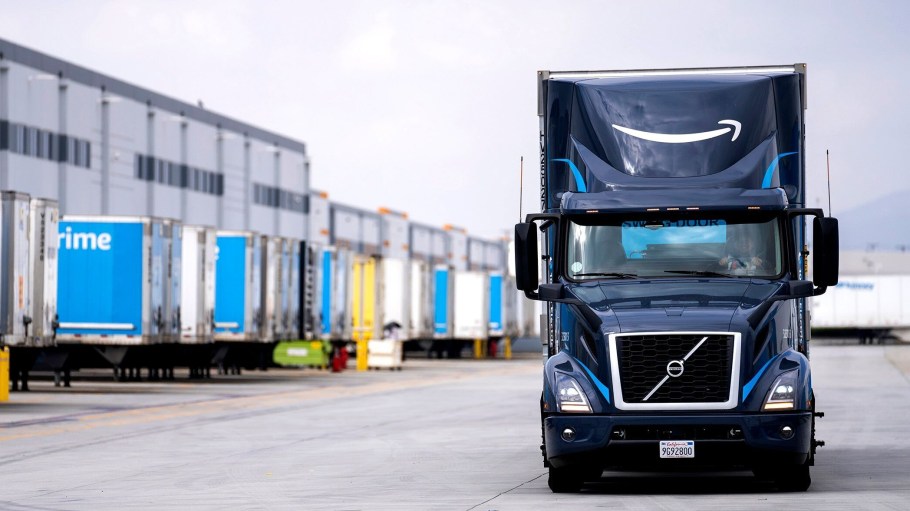
Since Yellow filed for bankruptcy and ceased operations in summer 2023, trucking companies have scampered to fill the void left in the less-than-truckload (LTL) sector. But this industry, like many others before it, may be in for some disruption if Amazon decides to make a concerted push into the space—as one investment bank suggests.
A Friday research note from J.P. Morgan warned LTL players that Amazon could take away market share in the sector if it decided to enter the field as a “for-hire” competitor.
Related Stories
“The most obvious risk for LTL stocks is if this service launches for external users at some point in 2026 as it is pretty much impossible to put that disruptive idea back in the box,” J.P. Morgan’s Brian Ossenbeck said in his note.
In the wake of the note’s release, Old Dominion (9 percent), Saia (9 percent), XPO (5.5 percent), ArcBest (5 percent), TFI International (7 percent) and Knight-Swift (3 percent) all saw stock prices fall substantially late last week.
Ossenbeck’s note followed up the posting of several jobs for positions within the e-commerce giant’s full truckload freight division, Amazon Freight. One position, posted Feb. 17, is for a sales operations manager at Amazon Freight’s go-to-market team. That team supports the sales team by introducing new products and modes—with the post highlighting LTL as one such new offering.
On Thursday, Amazon posted an opening for a supply chain manager at the Amazon Freight LTL dispatch and disruptions team based out of Tempe, Ariz. This role is tasked with hiring and developing a team responsible for executing and improving inbound freight performance and mitigating disruptions within the LTL network.
The next day, the tech titan put up a post for a supply chain manager at the Amazon Freight LTL team in Bellevue, Wash. This position appears to be focused on establishing the pilot services, scaling the LTL network and identifying opportunities for performance improvements and cost saving.
Sourcing Journal reached out to Amazon.
Scooter Sayers, founder and CEO of LTL-specific logistics consultancy Sayers Logistics, said it was “very possible” for Amazon Freight to make the move to LTL shipping.
“Amazon has the cross-dock network, the line haul network, the systems and the people in place to start up a sizable LTL operation,” said Sayers in a post on LinkedIn. “Heck, they already run an LTL operation, they just don’t make it available to the outside. The only thing Amazon appears to be missing is the local pickup/delivery network needed across the U.S. to move pallets rather than parcels. Maybe they can outsource that like line haul, maybe borrowing the playbook on the parcel front.”
Amazon’s entrance would come as the LTL industry is still encountering serious speed bumps as weak demand and margin pressures remain in play. TFI International CEO Alain Bedard called the fourth quarter a “disaster” quarter with expectations for a “difficult 2025.” That firm saw LTL revenue decline 13 percent in the quarter to $737.3 million, with subsidiary TForce Freight seeing volumes decline.
The current revenue and income leader in LTL, FedEx Freight, is being prepped to be spun off by parent FedEx, and saw revenue declines of 11 percent in the quarter to $2.2 billion. And chief competitor Old Dominion saw LTL revenues drop 7.4 percent to $1.4 billion, with daily tonnage plummeting 8.2 percent.
These carriers have also been buoyed by Yellow’s absence due to the capacity that exited the market, thus keeping freight rates steady despite the lower demand. However, even that appears to be slipping, according to a recent index report from TD Cowen and third-party logistics provider (3PL) AFS Logistics. In the fourth quarter, LTL costs per shipment dropped 1.3 percent sequentially from the prior period. This significantly outpaces the 0.3 percent decline in weight per shipment over the same period.
“Overall, we will remain watchful for Amazon Freight building up its internal LTL capacity before potentially entering the market as a for-hire carrier…to which the impact on sentiment would be negative and outsized even if [Amazon] might not easily scale up to be a credible risk to other carriers,” Ossenbeck said.
Sayers was more optimistic on the incumbents as they still endure the freight downturn, saying that even with Amazon’s possible entry into the category that LTL carriers shouldn’t be nervous.
“Most agree that the LTL industry is capacity-constrained, with just 1/2 of the former YRC terminals back online,” Sayers said. “One small shift in LTL demand can change the dynamic quickly. Amazon Freight could make a splash, and take on market share, but these are savvy and salty LTL carriers who have mastered the art of profit share over tonnage share.”
Another investment bank indicated that the incumbent trucking companies are still in the driver’s seat, upgrading Old Dominion, Saia and XPO to a “buy” rating on Monday.
“We do not see Amazon as a meaningful competitor to legacy LTL providers, as a bona fide offering would require billions in investment and years to stand up, in our view, even on top of Amazon’s existing fulfillment and cross-dock footprint,” said Stifel global logistics analyst Bruce Chan in a research note.