Air cargo demand showed signs of a slowdown trajectory in September, says a top airline trade association.
Total cargo tonne-kilometers (CTKs) grew 2.9 percent year over year in September, marking the seventh consecutive month of overall growth, according to the International Air Transportation Association (IATA). But the month’s growth decelerated 1.1 percentage points from August numbers, and contracted 0.6 percent on a seasonally adjusted, month-over-month basis.
“Buried in that growth is a significant alteration of trade patterns as U.S. tariff policies, including the ending of de minimis exemptions, kick in,” said Willie Walsh, IATA’s director general, in a statement. “On one side of the equation, a decline in North America-Asia demand has set in over the last five months.”
Related Stories
The Asia-to-North America trade lane, which has been impacted most heavily by the shifts in trade policy, saw a 3.5 percent contraction in demand in September. The suspension of de minimis shipments from all countries played a role in widening the annual declines, with demand on the route having dipped 1 percent in July and 2.2 percent in August.
UPS recently illustrated a magnified example of this, noting that its China-to-U.S. trade lane saw average daily volumes decrease 27 percent in the July-through-September quarter.
Asia-to-North America flights saw the second-largest demand decline among the major trade routes examined by IATA, with Middle East-to-Europe flights enduring a 4.6 percent drop in CTKs. But the Asia-to-North America trade lane continued to be the biggest anchor weighing down overall air cargo demand, with a global market share of 24.4 percent of CTKs
According to data from air cargo market data firm WorldACD, more recent flights out of China and Hong Kong to the U.S. indicate tonnages remain below last year’s levels as of the week of Oct. 13 to 19. Conversely, China/Hong Kong-to-Europe tonnages are above year-ago totals, mainly reflecting the diversion of e-commerce volumes away from the U.S. market.
IATA’s Walsh said the slowed China-to-U.S. demand “has been more than compensated for with strong growth within Asia and on routes linking Asia to Europe, Africa and the Middle East.”
The association’s data for the prior month showed that the biggest strength has been on the Asia-to-Europe trade lane, with 12.4 percent demand growth over the year prior. The route has seen 31 consecutive months of growth.
Air cargo demand within Asia had the second-strongest growth rate at 10 percent, with growth increasing for 23 straight months.
“While many had feared an unwinding of global trade, we are instead seeing air cargo adapting successfully to serve shifting market demands,” Walsh said.
Flight revocations, cargo restrictions escalate U.S.-Mexico aviation dispute
The landscape of North American air cargo could be shifting due to escalating tensions between the U.S. and Mexico.
On Tuesday, Transportation Secretary Sean Duffy revoked approval for 13 flight routes operated by Mexican airlines between the two countries for violating their bilateral aviation agreement signed in 2015.
The Trump administration claims Mexico has not complied with the agreement since 2022, when it abruptly rescinded some U.S. passenger carriers’ slots at Benito Juarez International Airport (MEX) and then required U.S. cargo-only carriers to relocate operations to newly opened Felipe Angeles International Airport (NLU).
At the time, Mexico said its actions were temporary to allow for construction to alleviate congestion at MEX. But Duffy says that has yet to materialize three years later.
During the stretch, Mexican air carriers have added new routes and services between MEX and the U.S., leading Duffy to allege that Mexico is engaging in anti-competitive behavior.
Secretary Duffy is also proposing a ban of Mexican passenger airlines from transporting belly cargo between MEX and the U.S. This action would take effect 108 business days after it is finalized.
Mexican President Claudia Sheinbaum said Wednesday she disagreed with the U.S. decision to revoke the flights.
“From our perspective, these actions, which are being taken unilaterally, have no basis,” said Sheinbaum during her daily press conference.
Sheinbaum said she has instructed Foreign Affairs Minister Juan Ramon de la Fuente to request an urgent meeting with Secretary of State Marco Rubio and U.S. Department of Transportation officials to review the grounds for the decision.
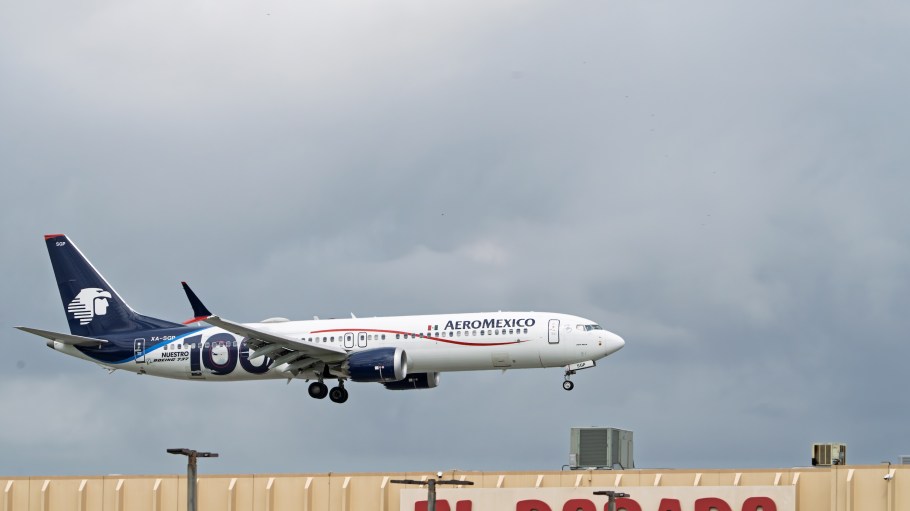
The accusations from the U.S. have already had one major consequence. In September, the Trump administration ordered Delta Airlines and Aeromexico, who have a joint venture that allows them to coordinate schedules and pricing for flights between the U.S. and Mexico, to terminate the partnership by Jan. 1.
Both airlines sued the U.S. government earlier this month to challenge the order, asking an appeals court to halt the directive.