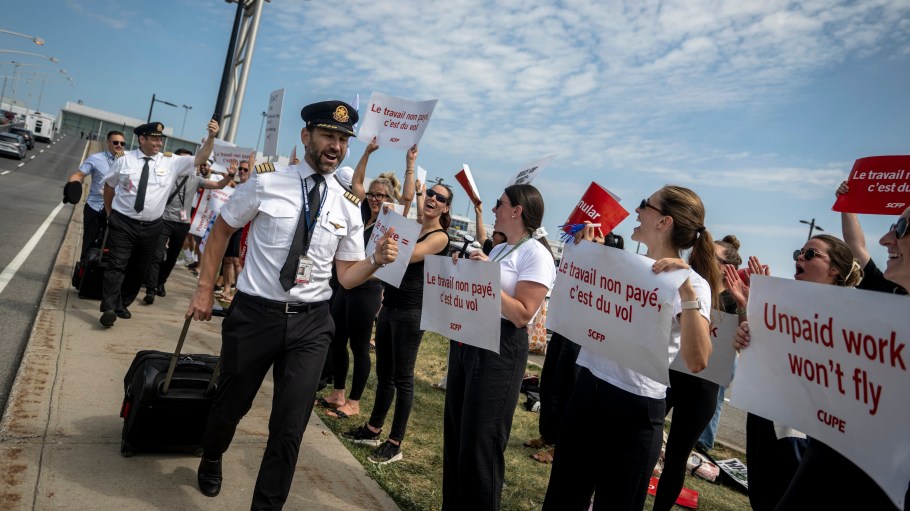
A strike among 10,000 flight attendants at Air Canada endured for a third day on Monday, with the employees defying two back-to-work orders from the federal government and keeping much of the airline’s cargo operations on ice.
The airline has suspended all passenger operations of Air Canada and Air Canada Rouge due to the work stoppage, conducted by 10,500 flight attendants represented by the Canadian Union of Public Employees (CUPE).
In the meantime, Air Canada Cargo is operating a temporary freighter schedule to mitigate the disruption, which includes capacity to Atlanta and Miami in the U.S., alongside several airports across Mexico, South America and Europe.
Related Stories
“This will protect approximately 20 to 25 percent of usual volumes, but not to all geographies usually served by Air Canada’s passenger network,” an Air Canada spokesperson confirmed to Sourcing Journal.
Nearly 75 percent to 80 percent of typical volumes are at risk for delays.
Four of the flights operate seven days a week, with two of them flying between Toronto and Frankfurt and the other two transiting between Toronto and Liege, Belgium. The remaining flights operate either once or twice per week.
As of June 30, Air Canada had six Boeing 767 freighters in its operating fleet, two of which are parked for maintenance. The freighters are designed to allow the airline to provide consistent capacity for shippers on key trade lanes versus passenger aircraft, which also carry freight but are subject to schedule and route changes based on travel demand.
The airline says it has also added a comprehensive trucking network between freighter destinations and its key hubs.
Last week, the company already had implemented a phased winddown of most of its cargo operations. The cargo division stopped taking bookings to transport specialty cargo products like e-commerce goods and pharmaceuticals, unless they were specifically booked on a freighter flight.
Any existing bookings are subject to delay or cancellation, Air Canada said.
Cargo remains a minuscule portion of business for Air Canada, which generated $5.6 billion in total operating revenue in the second quarter. But despite making up just $253 million of that total, the cargo division is a heavy growth driver for the airline, with revenues increasing 10 percent.
Ahead of the strike, the company didn’t anticipate reaching that growth in the third or fourth quarters.
“I think you’ll see a bit of normalization in Q3 and Q4,” said Mark Galardo, chief commercial officer and president of cargo at Air Canada, during a July 29 earnings call. “And a lot of that was driven by the strength, in particular, in Asia…I don’t think we’ll see the same relative strength into Q3 and Q4, but overall, the cargo revenue picture stays relatively stable.”
The extension of a strike to a third day forced Air Canada to suspend its third quarter and full-year guidance.
The strike officially began before 1 a.m. Easter Time Saturday, with the airline locking out the flight attendance a half hour later. This led to the grounding of hundreds of flights, impacting as many as 500,000 customers.
Less than 12 hours after the work stoppage took effect, federal Jobs Minister Patty Hajdu asked the Canada Industrial Relations Board (CIRB) to bring the two parties to binding arbitration. The CIRB further ordered that the term of the previous 10-year collective agreement between Air Canada and CUPE that expired on March 31, be extended to the day the new agreement between the parties comes into effect.
This move legally ended the strike, with Air Canada announcing early Sunday in response that it would resume flights. However, later that day, the union indicated that it was defying the order.
The CIRB declared the strike activity “unlawful,” and ordered union leadership to direct members to return to work.
“This is not over,” warned CUPE national president Mark Hancock on Saturday ahead of the back-to-work order. “We will continue to fight on the picket lines, on the streets, at the bargaining table, in the courts, and in Parliament, until the injustice of unpaid work is done for good. Workers will win—despite the best effort of the Liberal government and their corporate friends.”
Monday morning, the board issued a second return-to-work deadline of noon Eastern Time, with the union again ignoring the mandate.
Air Canada has offered a 17.2 percent wage increase over four years, which the union said would make flight attendant earnings less than that of current competitors in Canada. Beyond wages, the workers had issue with ground pay, which encompasses the tasks that flight attendants do before a flight takes off and after deplaning. CUPE alleges that the required safety checks and passenger assistance goes unpaid under the current pay structure.