Air Canada has reached a tentative contract agreement with more than 10,000 flight attendants, ending a strike that had forced the cancellation of hundreds of flights and grounded as much as 80 percent of cargo flown by the airline.
The two sides struck a deal shortly before 4:30 a.m. Eastern Time on Tuesday.
The airline said it would gradually restart operations Tuesday, with president and CEO Michael Rousseau saying full-service restoration will take “a week or more.” Air Canada Cargo’s passenger network operations, which usually host been 75 percent and 80 percent, had been at risk for delays for the duration of the nearly four-day strike.
Related Stories
“Cargo operations will slowly return to normal as passenger flights return,” an Air Canada spokesperson told Sourcing Journal. “During the disruption, Air Canada Cargo operated a freighter relief schedule, and this will slowly be transitioned back to the regular freighter schedule as the passenger schedule ramps back up.”
The temporary freighter schedule enabled Air Canada to move the remaining 20 percent to 25 percent of total volumes via its four Boeing 767 freighters currently in service.
The first regular flights are scheduled for Tuesday evening, but customers are advised that the airline’s return to full, regular service may require 7-10 days since both aircraft and crew are out of position. During this period, some flights will be cancelled until the schedule is stabilized.
“The suspension of our service is extremely difficult for our customers. We deeply regret and apologize for the impact on them of this labor disruption,” said Rousseau in a statement. “Our priority now is to get them moving as quickly as possible. Restarting a major carrier like Air Canada is a complex undertaking…we ask for our customers’ patience and understanding over the coming days.”
Terms of the new contract have not been disclosed by Air Canada or the Canadian Union of Public Employees (CUPE), which represents the flight attendants.
Air Canada will not comment on the agreement until the ratification process is complete.
During any ratification or under the binding arbitration process, a strike or lockout is not possible, “meaning customers can plan, book and travel with Air Canada with certainty,” the company said.
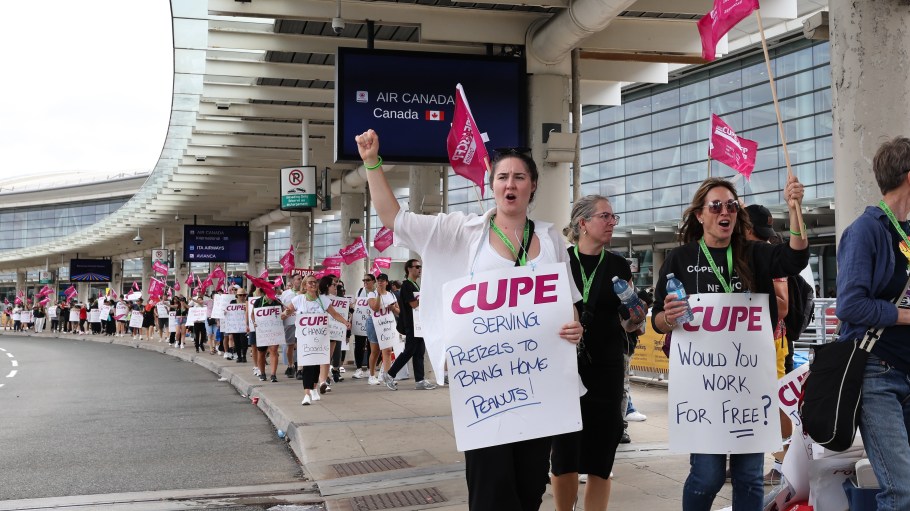
Flight attendants walked off the job after eight months of contract negotiations due to disputes on wages and scheduling, as well as claims of unpaid labor. The union alleged that workers are not paid for duties performed before takeoff.
The airline’s last offer included a 38 percent increase in total compensation, including benefits and pensions, over four years, with a 17.2 percent wage bump over that time. But the union said Air Canada flight attendants were earning less than their counterparts at other airlines.
“Unpaid work is over. We have reclaimed our voice and our power,” CUPE said in a statement Tuesday morning. “When our rights were taken away, we stood strong, we fought back—and we secured a tentative agreement that our members can vote on.”
The demands to reform unpaid work follow recent wins by flight attendants in the U.S. at American Airlines and Alaska Airlines, which now must pay cabin crew when passengers are boarding, not when the flight starts moving down the runway.
Wesley Lesosky, a flight attendant and president of the CUPE air division, said during a news conference last May that flight attendants do 35 hours of unpaid work monthly on average.
The federal government initially intervened in the strike on Saturday, forcing the union into binding arbitration, prompting the Canada Industrial Relations Board (CIRB) to order the union back to work.
However, the CUPE-represented employees defied the order in what the CIRB called “unlawful” activity. The CIRB issued a second return-to-work order on Monday, which the union again ignored.
Jobs Minister Patty Hajdu urged both the union and Air Canada to consider government mediation before launching a probe Monday into CUPE’s claims of unpaid work across the airline sector.
The parties agreed to use a mediator, which led to the tentative deal.
This labor dispute comes as the country’s postal workers remain at odds with Canada Post over wages and weekend work staffing. Unlike Air Canada, the Canadian Union of Postal Workers (CUPW) has remained on the job after their contract expiration in May. Instead, the labor group has instituted a national overtime ban, where employees don’t work beyond their typical schedule.
The next talks between the national courier and the union will take place Wednesday.