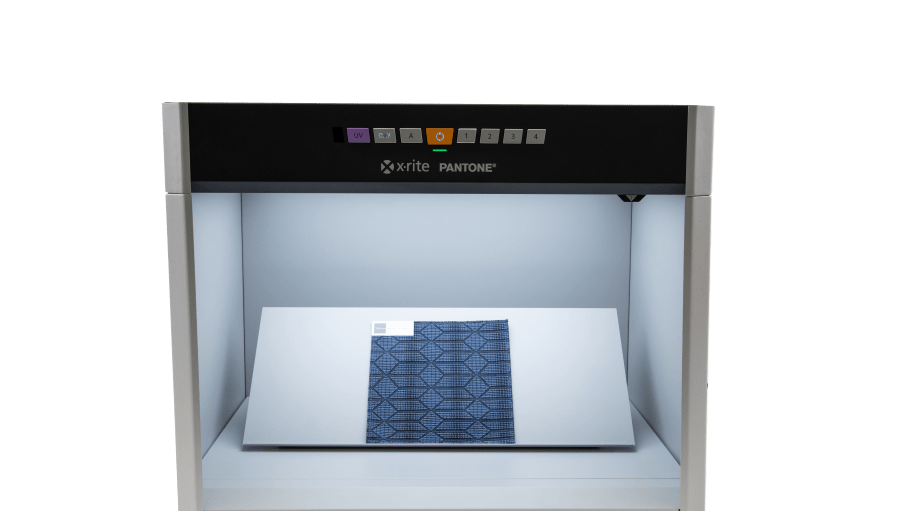
Fluorescent lighting is on the decline amid expanding legislation banning or phasing out the sale of these bulbs due to their mercury content. One alternative taking their place are energy efficient LEDs, which have recently seen market growth. Per data from the U.S. Department of Energy, installations of LED lighting approximately doubled from 2016 to 2018, and LEDs are expected to make up the majority of lighting installations in the U.S. by 2035.
For color management professionals, including those in the fashion industry, this shift is ushering in the need to incorporate LED-based quality checks. Reacting to the LED “turning point,” color technology and science firm X-Rite has debuted the Judge LED light booth.
Related Stories
“LED lighting today is more than just energy savings,” said Jeff McKee, president of X-Rite, during a webinar launch event for the device. “It’s about innovation. With LED technology, businesses gain more control, more consistency and the ability to meet regulatory requirements without compromising performance.”
Moving from legacy fluorescent-based booths to LEDs presented some difficulties. “LED lighting introduces similar challenges to the ones that were already existing, such as variability in color temperature and spectral power distribution, which can cause inconsistencies in color appearance compared to fluorescent lighting,” Albert S. Laforet, director of strategic projects at X-Rite, told Sourcing Journal. “These challenges make it difficult for color teams to achieve accurate and repeatable results across different lighting conditions.” Helping to overcome these issues, X-Rite’s machine is equipped with LEDs that mimic the characteristics of fluorescent lighting, but with enhanced stability.
For the Judge LED, users can choose seven light sources from a selection of different temperatures that fit industry standards, including a directional daylight output with the standard illuminant D65. This helps teams view the surface of objects, including texture like a dimpled “orange peel” look and checking for defects. There is also an ultraviolet light that can show fluorescent materials, as well as temperatures akin to retail and home lighting. The device meets visual assessment requirements for ISO, ASTM, AATCC, and BSI standards. An optional built-in monitor enables color teams to compare digital and physical samples under the same light.

During the webinar, Judge LED user Carmen Keim, colorist and digital pioneer at performance textile manufacturer Sympatex, spoke about the machine’s instantaneous warm up time and rapid switching between light settings, both of which have boosted efficiency over fluorescent light solutions. She added, “We hope the benefits of the X-Rite LED booth will inspire our suppliers and customers to adopt it as well. While we continue to use the previous technology when necessary, we believe it is important to explore and support innovative tools to drive more sustainability in color management across the textile industry.”
Adoption will not happen all at once. Fashion brands are typically working with multiple suppliers spread across the globe, who may not all be using LED at the beginning. “Early adopters of LED will see improved consistency and efficiency in their color evaluation processes, but they may face challenges if their suppliers continue using older technologies,” Laforet told Sourcing Journal. “To ensure compatibility during the transition, early adopters can specify and provide guidelines for lighting conditions that suppliers must replicate, either through calibrated LED systems or fluorescent equivalents. Tools like the Judge LED, which mimic legacy lighting conditions while providing the benefits of LED technology, can serve as a bridge, enabling brands and suppliers to evaluate colors accurately until full alignment is achieved.”
Although digital tools like X-Rite’s suite of hardware and software can measure the accuracy of a color match and provide data on colors, light booths offer a means for more subjective assessments. Laforet explained that human eyes are needed to evaluate aspects of color like texture, gloss and metamerism—or the phenomenon where color appears different when seen under a different type of lighting.
“Typically, our customers use spectrophotometers for initial color analysis and specification, followed by visual inspections in the Judge LED booth to ensure real-world appearance matches their expectations,” Laforet told Sourcing Journal. “This hybrid approach combines the strengths of digital tools with the irreplaceable nuance of human judgment, resulting in more reliable and comprehensive color management processes.”