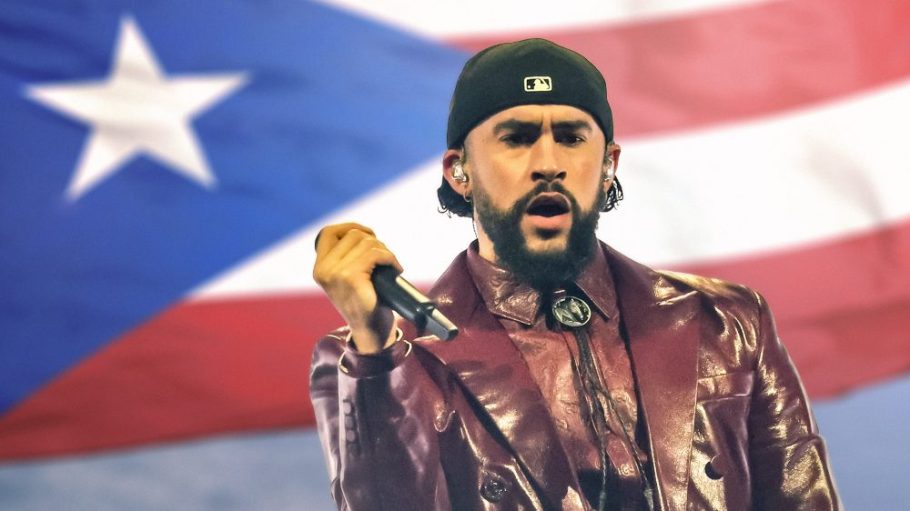
As the political climate in Puerto Rico intensifies, Bad Bunny has emerged as the island’s unofficial (yet undeniably influential) hero, and his latest album and initiatives are a clear reflection of that.
On Jan. 5, the Latin superstar released his sixth solo studio album (seventh overall) titled “DeBÍ TiRAR MáS FOToS,” which translates to “I should have taken more photos.”
While the 17-track album has already broken records—like debuting at No. 1 on Billboard’s Top Streaming Albums chart with the largest streaming week for a Latin artist in over a year—the Grammy-award winning artist had a bigger picture in mind when releasing it: Making a political statement and standing in solidarity with Puerto Rico.
Related Stories
“I am Puerto Rican, I am Caribbean, and my music, my culture, my country’s history run through my veins, from plena to reggaetón,” Bad Bunny said in a press release. “At the peak of my career and popularity, I want to show the world who I am, who BENITO ANTONIO [the singer’s real name] is and who PUERTO RICO is.”

While each song has an overarching message about where the artist is in his personal life, the album’s broader narrative delves into Puerto Rico’s political struggles and the disillusionment of a generation that continues to fight for its voice and its future amidst gentrification and economic struggles.
For example, in his song “LO QUE LE PASÓ A HAWAI‘I” (which translates to “What Happened to Hawaii”), Bad Bunny delivers a powerful message urging everyone to prevent what happened to Hawaii—i.e., colonization and the destruction of its culture—from happening to Puerto Rico.
“No one here wanted to leave, and those who left dream of coming back. If one day it’s my turn, it’s gonna hurt so much,” Bad Bunny croons in his heartfelt song, adding “They want to take my river and my beach, too. They want my neighborhood and your kids to leave. No, don’t let go of the flag…’cause I don’t want them to do to you what they did to Hawaii.”
Puerto Rico residency
After the release of his album—which saw all 17 tracks chart on the Billboard Hot 100 despite its mid-week debut—the 30-year-old artist announced his first concert residency, taking place in none other than Puerto Rico. The 21-show run, titled “No Me Quiero Ir De Aquí” (I Don’t Want to Leave Here), is set to kick off on July 11 at the Coliseo de Puerto Rico in San Juan.
As a gesture of love to the Puerto Rican people, the first nine shows will be exclusive to Puerto Rican citizens. To ensure that only Puerto Ricans attended the first shows, all tickets had to be purchased in-person at select locations across the island, preventing scalpers or non-residents from buying them.
The remaining 12 shows will be open to the rest of the world, which, unlike wealthy millionaires like Logan Paul who have moved to Puerto Rico and disrupted the island’s balance, will have a more positive impact on the Puerto Rican economy.
“Bad Bunny’s residency has shown the tourist potential of the Puerto Rican creative industries and may transform other artistic presentations toward the future,” said José Caraballo-Cueto, assistant professor and researcher at the University of Puerto Rico. “[While] the long-term effects of his residency are difficult to forecast right now, it might be the case that some potential incoming wealthy foreigners rethink before gentrifying or that it shifts the ongoing debate on the potential benefits of this type of immigrants.”
As Caraballo-Cueto noted, the exact numbers are a little difficult to predict right now, however, economists and travel advisors are already expecting “big things” for Puerto Rico’s economy.
“The economic and tourist impact of a Bad Bunny residency at the Choliseo is enormous: thousands of visitors, full hotels and a multimillion-dollar boost for the local economy,” Wilson Santiago, founder and CEO of Mochileando LLC (one of the largest travel platforms in Puerto Rico) said in an X post. “Without a doubt, one of the best pieces of news for tourism in Puerto Rico this 2025.”
Trump tariffs
Bad Bunny has long been known for his unapologetically bold stance on social and political issues, and “DeBÍ TiRAR MáS FOToS” is no exception, especially when it comes to Puerto Rico’s political and cultural landscape.
For example, in October, President-elect Trump hosted a rally at Madison Square Garden where comedian Tony Hinchcliffe called Puerto Rico a “floating island of garbage.” Shortly after the comment went viral, Bad Bunny posted an eight minute long video to his 46 million followers that showcased the beauty and power of the island and its people. A powerful message closed out the video, stating “We have been fighting since day one of our existence, we are the definition of heart and resistance. Here we go, here we are, and for those who forget who we are, don’t worry, we proudly remind you.”
Bad Bunny then went on to publicly endorse Kamala Harris, reposting a video of the presidential candidate talking about her plan to improve economic opportunities for Puerto Rico and criticizing President-elect Donald Trump for withholding hurricane relief to the island.
His opposition to the Trump administration takes on added significance, particularly as discussions surrounding Puerto Rico’s future have recently resurfaced. The territory, which became a U.S. possession in 1898 following the Spanish-American War, has seen renewed debate about whether it should become the 51st state or, alternatively, seek full independence.
The idea of Puerto Rico becoming a U.S. state is not new. In fact, the island has long had a strong political movement advocating for statehood, seeking full legal and political integration as the 51st state. This push gained significant traction in 2012, when a majority of voters in the territory favored statehood, according to PR51st, an organization advocating for Puerto Rico’s statehood. The call for statehood was reaffirmed in subsequent votes in 2017, 2020 and most recently this past election cycle.
“The U.S. citizens of Puerto Rico have made it loud and clear that they want full democracy, federal voting rights and full equality through statehood for their future. But for the island’s undemocratic and unequal territory status to end, Congress must now legislate,” said George Laws Garcia, executive director of the Puerto Rico Statehood Council. “Puerto Rican voters have spoken in a free, fair and secure election with great turnout. This is a clear mandate for Congress to pass legislation to offer voters on the island a definitive and binding choice to resolve the scourge of territorial colonialism in Puerto Rico.”
Garcia added that a statehood would help “turbocharge Puerto Rico’s economy” and “finally provide federal representation” for the more than 3 million U.S. citizens living on the island in the form of two senators.
“Financially, Puerto Ricans would receive equal federal benefits in Medicare, Medicaid, food assistance and other vital federal programs and a torrent of private sector investment onto the island in critical sectors, including pharmaceutical and technology,” Garcia said. “This would help balance Puerto Rico’s budget, remove austerity measures from the financial oversight and management board and position the island to be a hub of commerce between the U.S. mainland, the Caribbean, Latin America, Europe and Africa.”
Despite the ongoing support for statehood, the likelihood of Puerto Rico achieving full state status remains highly uncertain. The biggest obstacles to attaining statehood have been congressional inaction due to the “political polarization that has been facing America,” Garcia noted.
“We urge Congress to listen to the mandate of Puerto Rico’s voters and take action on legislation to grant Puerto Ricans a legally binding vote among the non-territorial options,” he added. “Congress must now do its part to empower the…U.S. citizens of Puerto Rico and live up to America’s founding values of government by consent of the governed.”
Currently, the most direct path for Puerto Rico to become a state is for the Puerto Rico Status Act—pending in both the House and the Senate—to pass. However, this bill calls for one more vote, this time a binding, federally sponsored one, followed by action on the part of Congress to implement the new status, PR51st noted.
As the debate over Puerto Rico’s future continues, a recent survey by market research firm YouGov highlights public opinion on the island’s potential independence. Among the 7,200 American adults surveyed, who were not born/raised on the island, a slim majority—52 percent—indicated they would support Puerto Rico becoming its own country if its residents voted for independence. In contrast, 13 percent opposed the idea, while 36 percent were unsure.
From an economic standpoint, shipments from the U.S. to Puerto Rico are not classified as exports since it is a U.S. territory. However, there are both state and county sales taxes, according to the International Trade Administration’s Office of Textiles and Apparel (OTEXA).
Should Puerto Rico achieve independence, however, it could face significant economic challenges.
Throughout his campaign, Trump touted a universal baseline tariff scheme that would center on taxing foreign imports from countries across the world at a rate of 10 to 20 percent. Should Puerto Rico choose to leave the U.S., it too could be subject to these duty rates, which would place a significant strain on the island’s economy and its international trade relationships.
Currently, the U.S. is Puerto Rico’s largest export partner, accounting for roughly 70 percent of its total exports, according to Trading Economics. The island’s primary exports are pharmaceuticals, which make up over 50 percent of exports, followed by apparel, another key sector of Puerto Rico’s economy that is poised for growth. In fact, Puerto Rico’s apparel market is projected to generate $3.1 billion in revenue in 2025 alone, with an expected annual growth rate of 2.78 percent from 2025 to 2029, according to Statista.
As a U.S. territory, Puerto Rico is also party to critical Western Hemisphere trade agreements like the U.S.-Mexico-Canada Agreement (USMCA), negotiated during Trump’s first term, as well as the Dominican Republic-Central America Free Trade Agreement (CAFTA-DR). With interest in nearshoring and the development of a robust regional co-production chain for textiles and apparel on the rise, access to such multilateral U.S.-led trade programs is central to Puerto Rico’s apparel sector’s growth.
Despite the potential risks, some still believe independence would be better for Puerto Rico and its economy.
“The Puerto Rico Independence Party believes in full independence from the United States to form a new completely separate country with full sovereignty,” John A. Regis Jr., a member of Puerto Rico’s Independence Party, said in a statement. “This proposed Puerto Rican country would base its economy in tourism, manufacturing, agriculture, service industries and a new foreign trade without all the trade and tariff restrictions [like Trump’s plan to hit Canadian and Mexican imports with new duties of up to 25 percent] imposed by the U.S. Government.”