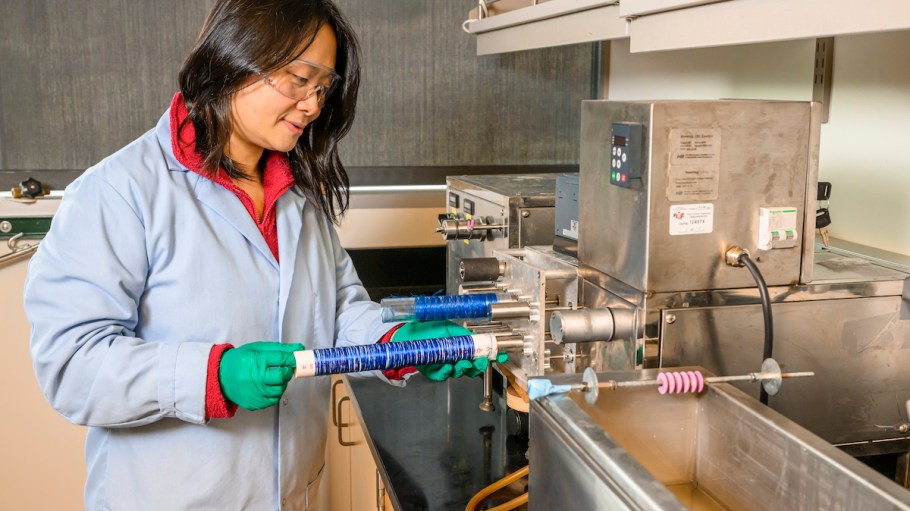
Conductive clothing made from e-textiles got a bump with the recent development of a cotton cellulose fiber that blends with synthetic polymers shown to have conductive properties.
In a study done by Washington State University, the new textile fiber exhibited conductive properties of the kind commonly applied in the manufacture of printed circuit boards and which can power an LED light, for example, but which also has the capability to detect hazardous materials or toxic gases like ammonia.
Related Stories
It was created by developing a single strand of fiber that combines the conventional cotton cellulose with polyaniline, also known as PANI, but making them from two different solutions. The two solutions, cellulose and conductive, are merged together but don’t mix, and the resulting conductive material is extruded to make one fiber.
The fibers are essentially two-sided but have excellent interfacial bonding qualities that allow the different materials to stay together through stretching and bending. Polyaniline, which is brittle, has to be reduced to liquid form in order to be made into fiber for textiles.
“We have one fiber in two sections: one section is the conventional cotton, flexible and strong enough for everyday use, and the other side is the conductive material,” said Hang Liu, WSU textile researcher. “The cotton can support the conductive material which can provide the needed function.”
Applications for the textile that can detect hazardous materials include health monitoring functions. The fibers can also be made into sensor patches with flexible circuits that are integrated into uniforms for firefighters, military personnel or people who work with hazardous chemicals.
The challenge of the study was to mix the conductive polymer with the cotton cellulose and it was a delicate balance, according to Liu.
“We wanted these two solutions to work so that when the cotton and the conductive polymer contact each other, they mix to a certain degree to kind of glue together, but we didn’t want them to mix too much otherwise the conductivity would be reduced,” she said.
The study was financed by the National Science Foundation and the Walmart Foundation Project and was published in the journal Carbohydrate Polymers.
“We have some smart wearables, like smart watches, that can track your movement and human vital signs, but we hope that in the future your everyday clothing can do these functions as well,” said Liu. “Fashion is not just color and style, as a lot of people think about it: fashion is science.”