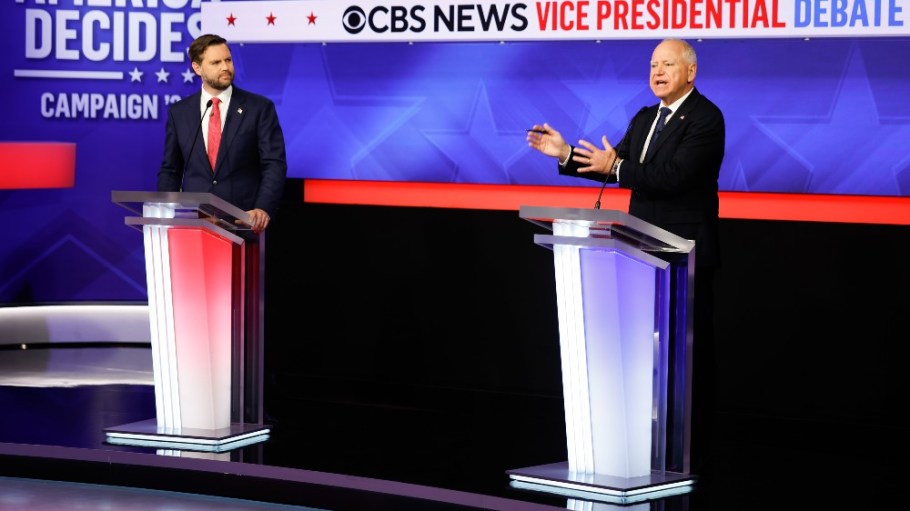
From the jump, Tuesday night’s vice presidential debate struck a more civil chord than the face-off between the Democratic and Republican nominees for president that took place last month.
Ohio Senator J.D. Vance, the running mate to former President Donald Trump, took the stage opposite Vice President Kamala Harris‘ surrogate and Minnesota Governor Tim Walz for a lively but mostly restrained discussion that touched on foreign and domestic policy, trade and tariffs.
The midwestern lawmakers leaned on the relatability of their middle-class roots, blunting the barbs they’ve been lobbing at each other from the campaign trail during the CBS News-hosted event. Instead, Vance and Walz each took on the records of the opposing party’s nominee, both of whom have had a hand in crafting the policies of the past eight years.
Related Stories
Between heated discussions about geopolitical conflicts and reproductive rights, the vice presidential nominees spoke about the future of American industry.
“What we’ve seen out of…the Biden Harris administration is, we’ve seen this investment, we’ve seen massive investments, the biggest in global history that we’ve seen in the Inflation Reduction Act, has created jobs all across the country,” Walz said, asserting that the current administration has created 250,000 more manufacturing jobs through such policies.
Walz’ attacks on Trump’s record centered on the high unemployment rate at the end of his presidency, his tax cuts for the wealthy, and the trade war with China, which he said has imperiled U.S. jobs.
It was “Donald Trump’s failure on Covid that led to the collapse of our economy,” he asserted. “We were already, before Covid, in a manufacturing recession. But 10 million people out of work, largest percentage since the Great Depression, 9 million jobs closed.”
The Minnesota governor said Trump’s protectionist trade policies aren’t helping domestic industry.
“Look, I’m a union guy on this. I’m not a guy who wanted to ship things overseas, but I understand that…we produce soybeans and corn. We need to have fair trading partners. That’s something that we believe in,” he added. “I think the thing that most concerns me on this is, is Donald Trump was the guy who created the largest trade deficit in American history with China.”
What’s more, Trump has proposed a universal baseline tariff on goods from all over the world, not just China.
“Now he’s proposing a 20-percent consumption or sales tax on everything we bring in. Everyone agrees, including businesses, it would be destabilizing. It would increase inflation and potentially lead to a recession,” Walz said.
The Democratic vice presidential nominee also took a swipe at Trump’s record on unions. During his presidency, “We had people undercutting the right to collectively bargain. We had right to work states made it more difficult. We had companies that were willing to ship it over[seas], and we saw people profit,” Walz said. “Folks that, folks that are venture capital, in some cases, putting money into companies that were overseas, we’re in agreement that we bring those home.”
In an exchange about climate change, Vance appeared to argue a different side of the issue of reshoring.
“This idea that carbon emissions drives all the climate change. Well, let’s just say that’s true, just for the sake of argument, so we’re not arguing about weird science…Well, if you believe that, what would you want to do? The answer is that you’d want to reshore as much American manufacturing as possible and you’d want to produce as much energy as possible in the United States of America because we’re the cleanest economy in the entire world.”
The Ohio Senator accused the Biden-Harris administration of environmentally-focused energy policies that have forced American companies to source power from elsewhere—a move that he believes has emboldened non-market economies.
“What have Kamala Harris’s policies actually led to? More energy production in China, more manufacturing overseas, more doing business in some of the dirtiest parts of the entire world,” he said. “I mean the amount of carbon emissions they’re doing per unit of economic output…So if we actually care about getting cleaner air and cleaner water, the best thing to do is to double down and invest in American workers and the American people.”
Vance has made onshoring a central talking point in his stump speeches of late, homing in on the flight of industry to Asia in recent decades.
“Governor, you say trust the experts, but those same experts for 40 years said that if we shipped our manufacturing base off to China, we’d get cheaper goods. They lied about that. They said if we shipped our industrial base off to other countries, to Mexico and elsewhere, it would make the middle class stronger. They were wrong about that,” he said, directing his comments to Walz.
“They were wrong about the idea that if we made America less self-reliant, less productive in our own nation, that it would somehow make us better off…And for the first time in a generation, Donald Trump had the wisdom and the courage to say to that bipartisan consensus, we’re not doing it anymore. We’re bringing American manufacturing back.”
But Walz said Trump’s policies didn’t create a favorable environment for the growth of U.S. business, and that the former president’s tax cuts benefited large corporations and executives over workers and the middle class.
“Now, this is a philosophical difference between us: Donald Trump made a promise, and I’ll give you this—he kept it. He took folks to Mar-a-Lago and he said, ‘You’re rich as hell. I’m going to give you a tax cut.’ He gave the tax cuts that predominantly went to the top caste. What happened there was an $8 trillion increase in the national debt, the largest ever.”
Harris, by contrast, has repeatedly invoked plans to extend and expand the Covid-era child tax credit and benefits to small businesses that could save them up to $50,000.
If Trump were to extend and expand the Tax Cuts and Jobs Act of 2017 (TCJA), as he has said he would do if reelected, Wharton School economists have predicted that it would increase the nation’s deficit by $5.8 trillion. Asked about this, Vance defended his running mate’s record.
“Tim admirably admits that they want to undo the Trump tax cuts. But if you look at what was so different about Donald Trump’s tax cuts, even from previous Republican tax cut plans, is that a lot of those resources went to giving more take home pay to middle class and working class Americans,” Vance said.
He also notably praised President Biden for maintaining Trump-era tariffs on China-made products, and attempted to draw a distinction between the current president and Harris when it comes to China trade policy.
“Look, the one thing, and you’re probably surprised to hear me praising Joe Biden, but the one thing that Joe Biden did is he continued some of the Trump tariffs that protected American manufacturing jobs. And it’s the one issue, the most pro-worker part of the Biden administration,” he said. “If you’re trying to employ slave laborers in China at $3 a day, you’re going to do that and undercut the wages of American workers unless our country stands up for itself and says you’re not accessing our markets unless you’re paying middle class Americans a fair wage.”
Vance said the country would be “taking in a lot of money by penalizing companies for shipping jobs overseas” with a new, tariff-centered international trade plan.
Walz concluded the discussion on the economy—the issue that has proven most salient with voters—by returning to the vice president’s plan to allow the TCJA to expire and up taxes for high earners.
“Kamala Harris has said to do the things she wants to do. We’ll just ask the wealthiest to pay their fair share,” he said. “When you do that, our system works best. More people are participating in it, and folks have the things that they need.”