As garment workers in Bangladesh, Cambodia, Lesotho and Vietnam brace themselves for some of the most expansive of President Donald Trump’s so-called “reciprocal” tariffs, currently on hold, their counterparts in the United States are feeling the pressure from the stiff levies that are already in place, including an extra 145 percent—perhaps 245 percent?—punitive tax on Chinese goods.
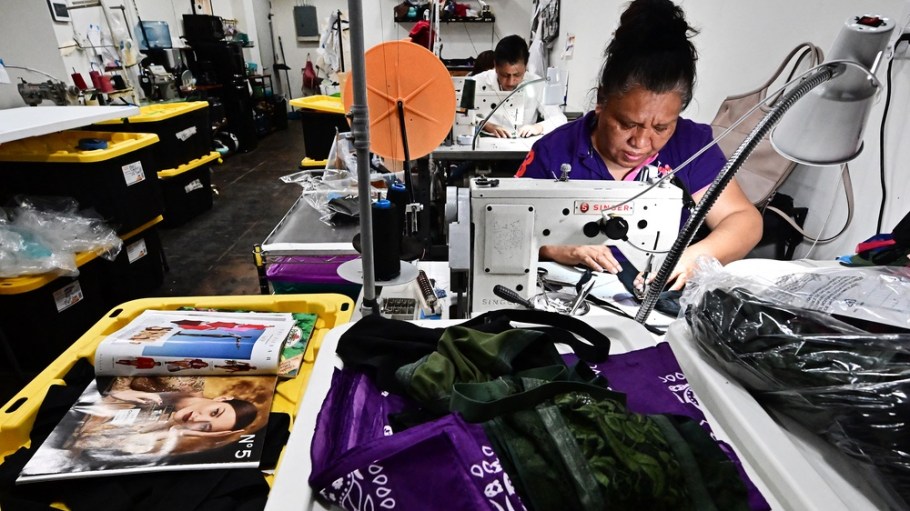
They include women like Maria, a Los Angeleno who asked that only her first name be used because of potential retaliation. If the trade war drags on—or worse, escalates—the American businesses and workers that the president claims to want to put “first” will be hit hard as the rising cost of necessary imports such as fabric, buttons, zippers, threads and machinery wipe out any advantage that increased orders from companies looking to avoid hefty tariff payments may afford. Already, the 10 percent “universal” tariff that will serve as a baseline while the 90-day pause is still in effect is beginning to add up.
Related Stories
“Many people may not know this, but garment workers typically have to bring their own tools to work, and most of these tools are made in other countries, so this will take more money out of garment workers’ pockets because our tools—trimmers, feet, sewing tweezers, bobbins—will become more expensive,” she said. “Tools like sewing feet get worn down quickly and we have to replace them often. It’s going to be hard to afford to replace them if they become much more expensive.”
As is the case elsewhere in the world, it’s the worker at the supply chain’s lowest rung that ends up bearing the brunt. Maria expects her already meager paycheck to shrink further still. Despite a 2021 law requiring Californian factories to pay the people who stitch their clothes the minimum wage, violations are still widespread.
She pointed out that while factories may gain more work, they may also lack the wherewithal to take it on. “Basically, all the textiles we use to make clothes will also become more expensive,” she said, adding that the additional costs will end up hurting everyone, whether employer or employee. They could even lead to layoffs, which would have the opposite effect of what Trump said he wants.
It isn’t for nothing, either, that former L.A. County district attorney George Gascón once dubbed Los Angeles the wage theft capital of America. A 2022 Department of Labor survey of 50 randomly chosen garment manufacturers in the Southern California area, for instance, found that half of them were illegally paying their workers off the books, including through the outlawed piece-rate system. In what investigators called a “particularly egregious” case, one garment contractor paid its workers as little as $1.58 per hour. Garment workers elsewhere in the country have even fewer protections, though it hasn’t been for a lack of trying.
All of which is to say that cutting into already razor-thin manufacturing margins could make unscrupulous employers behave even worse.
“While tariffs are often framed as a way to protect American jobs, they can actually backfire when it comes to apparel by increasing jobs for brands without addressing the root causes of why domestic apparel manufacturing has declined,” said Katrina Caspelich, executive director of Remake, a fashion advocacy group that has been lobbying for federal legislation in the form of the Fashioning Accountability and Building Real Institutional Change—or FABRIC—Act.
Like its California predecessor, the FABRIC Act wants to end piece-rate payments, albeit at a national level. But it also proposes giving domestic manufacturers a leg up through a $50 million-a-year support program, administered by the Department of Labor, that would dole out grants and technical aid to help manufacturers with facilities and equipment upgrades, workforce development and safety training and improvements.
Caspelich said that fashion made in the United States can be part of a thriving future, but only if it’s people-first. If the Trump administration wants to bolster local production—and in a way that’s ethical and sustainable—it needs to pour in real investment, including expanding workforce development programs, bolstering labor protections, enforcing existing laws against wage theft and unsafe workplace conditions and offering tax incentives and grants to businesses that commit to fair labor practices at home.
“If we truly value ‘made in America,’ we have to value the people who make it possible,” she added. “Instead of blanket tariffs, we need policies that directly invest in rebuilding the infrastructure for responsible domestic manufacturing.”
An ‘absolutely terrifying’ time
The fact of the matter is that the strength of domestic apparel manufacturing isn’t what it used to be. After the advent of free trade and China’s entry into the World Trade Organization sent production fleeing to cheaper climes overseas, only 2 to 3 percent of clothing sold in the United States is also cut and sewn in the United States.
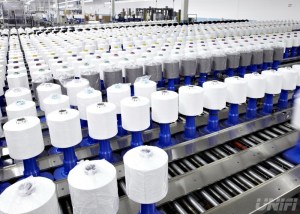
The sprawling ecosystem of cotton ginners, yarn spinners, textile mills and dyeing and finishing houses that once underpinned any semblance of self-sufficiency has mostly been broken up and sold for parts. And the rest have been struggling to hang on, with more than a dozen textile plants permanently shuttering in 2024, according to the National Council of Textile Organizations, a lobbying group.
But Marissa Nuncio, director of the Garment Worker Center in Los Angeles, still can’t help but feel a twinge of indignation whenever she reads takes that dismiss the existence of an American labor force. Roughly 100,000 garment workers still toil in the United States, most of them concentrated in downtown Los Angeles and New York City’s Garment District.
“It’s really important that the impact on workers doesn’t get lost,” she said. “It’s also really important that there is a growing ecosystem of sustainable, ethical, high-road fashion businesses that are trying to change the industry from within, and they’re directly impacted by this. Without attention to what it takes to support and bolster and build up domestic industry, we’re going to see the negative impacts of these tariffs.”
Leaner paychecks aren’t the only concern for garment workers. As the prices of groceries spiral upward, adding to the higher-than-average cost of living in cities like Los Angeles and New York, the squeeze is going to come from both sides, creating more financial duress. Garment workers also tend to be of immigrant extraction, with many of them undocumented women from Latin America and Asia. The White House’s aggressive push to apprehend and deport as many people as it can has created a climate of fear and uncertainty over potential sweeps of their factory floors by Immigration and Customs Enforcement.
“It’s an absolutely terrifying time,” said Nuncio, whose organization has held at least half a dozen “know your rights” workshops in the various regions in L.A. County since November, complete with free consultations with immigration lawyers.
“We speak to our members; they have a lot of questions: what does this particular news or this executive order mean?” she said. “We’ve heard from multiple members who said we had a real increase in ICE activity in the south L.A. region, where a lot of our members are, where our factories are. And we’ve heard from members who said, ‘I didn’t go to work today. I’m scared to go out.’ That’s a real direct impact. Folks need to be able to live their lives.”
Thousands of miles west in Brooklyn, where Roopa Pemmaraju, founder of Refugee Atelier, helps equip refugees and asylum seekers with the tailoring skills that will allow them to seek fair-paying jobs, the mood is one of resigned acceptance. These are people, she said, her voice barely rising above the factory floor din, who are used to being taken advantage of because of their desperation for a better life.
“They just say that if they have to get picked out, that’s the reality and nobody can change that,” Pemmaraju said. “But meanwhile, I’ll continue to help them fill out their paperwork and get the right wages, connect them with affordable housing. That’s what I’m focusing on now.”
Garment workers frequently skew older, too, with many already on the verge of aging out of the business, said Jennifer Guarino, president and CEO of the Industrial Sewing and Innovation Center, or ISAIC, in Detroit, which trains young people in the fundamentals of advanced and automated apparel production at its “factory classroom.”
Especially with technology in play, the problem isn’t so much the labor force, she said, but whether there is a long-term commitment to sustain it. Consider, for instance, the rise and then collapse of the domestic personal protective equipment sector during the Covid-19 pandemic. As soon as China resumed exports of masks and gowns, the American businesses that rallied on a shoestring were abandoned en masse. The same fear infuses the industry today. What if American suppliers threw everything they had at expanding their capacity, only to see tariffs dissipate and orders dwindle once more?
“I think businesses have to get beyond this reactionary hair-on-fire response to tariffs and say, ‘Oh, you know what? If it’s not this, it’s going to be another,’” Guarino said. “What we really need to do is commit to a transformative supply chain that will be good no matter what happens with tariffs. And that it’ll be better for us in the long term, for our business and the environment.”
ISAIC is an example of how garment jobs, with the proper investment that Caspelich was talking about, can be transformed for the better. It sees its trainees as more than just future bodies on a production floor. It’s not just training sewing operators, she said, but “flexible product fabricators” that, yes, can sew, but they can also run digital cutting machines or interface with digital embroidery and printing. Making jobs higher-skilled and higher-wage will make it more appealing to the next generation, but it also requires reassessing talent development.
“When I hear manufacturers say, ‘We can’t find enough sewers,’ well, it’s just not the right answer. It’s just doing it the old-fashioned way,” she said. “So, at least from our perspective, the talent will be there, but you have to present a different career value proposition. You need the dedicated commitment that the jobs will be there.”
Taking the high road
There are a few certainties in the domestic garment production sphere. American military uniforms have to be made in the United States by law. And since 2012, Team U.S.A.’s opening and closing Olympic ceremony uniforms have been manufactured by Ralph Lauren’s stateside contractors.
But the fact that the online shopfront for the L.A. Olympics in 2028 has, to date, no products that are made locally is a sign that larger impediments are involved, said Daniel Cardozo, CEO of Ethix Merch, a responsibly sourced swag merchant that founded the Alliance for Responsible Apparel Manufacturing & Purchasing—ARAMP, for short—with the Garment Worker Center, the Sweat-Free Purchasing Consortium and others to provide a vetted marketplace of high-road L.A. manufacturers that “take care of their workers the right way.”
“I can’t tell you how many labor unions there are that we talk to—that we lose business to—because they go and they buy imports for their rallies, events and giveaways without any kind of labor regulations behind them, because it’s written into the DNA of the economy at this point that you just get the best deal, and you don’t have to do the work to identify the impact that your purchases have,” he said. “And now there’s no system in place for the L.A. Olympics to support its own garment industry whatsoever.”
Cardozo thinks that the tariffs, done properly, could bring some clothing manufacturing back to the United States. The problem is that he has little faith that this is the case. He wouldn’t be surprised, in fact, if most of the new work ends up going to sweatshops.
“There’s no prep work being done to invest in the industry on the front end so that we can have the capacity to take advantage of these opportunities,” he said. “There’s no guarantee that these tariffs are going to last. The administration has been extremely capricious about it. They’re coming, they’re being lowered, they’re being raised, they may be paused, etc. It doesn’t give the industry the opportunity to invest because you don’t know what’s coming down the road.”
Then there’s the fundamental flaw that Christian Birky, founder of Because Capital, a firm that focuses on reducing overproduction in fashion, and co-founder of ISAIC, sees as that reason many garment workers, including those in the United States, have to grapple with near-, if not below-poverty wages. For reshoring to take, he said, brands will have to recognize that the current tack of massive overproduction, followed by selling off the surplus at deep discounts, is not a viable financial strategy.
“The capital that we need to invest in better wages and to treat people fairly in this industry is tied up in huge amounts of clothing being produced that we don’t need,” he said. “That’s the reality of it. And until we address that, we’re going to be playing in the margins. We make too many garments for the number of garments that we sell.”
Nuncio agreed. The notion that tariffs are going to rebuild American apparel manufacturing is an incomplete analysis, especially from a worker organizing standpoint. And ARAMP, she said, is getting close to being able to run a pilot to see what “forward-looking” partnerships and solutions might look like. Otherwise, fashion production will continue to be a race to the bottom, whether in the United States or overseas.
“Workers are the backbone of the industry,” she said. “They’re the ones who can articulate what are the needs of the industry. And for us that that needs to be a focus in this conversation: What’s needed to keep good, dignified jobs present and growing for them?”
New York and California are among the states suing the Trump administration for “illegally imposing” tariffs through the International Emergency Economic Powers Act, which imbues the president with extraordinary economic powers during a national emergency. But the cities where garment workers are concentrated, like Los Angeles, could do more to help garment workers, too, Maria said.
“The city would have the power to price things at the necessary level for the workers to make what they should be making,” she said. “The city could make the choice to invest taxpayer dollars in good-paying jobs. In the end though, it’s not just our tools and materials that will increase in cost, but likely everything in our lives will go up: cost of food, everything. And this will cause more financial stress in our lives.”