With second-quarter earnings in the rearview, American brands and retailers have now had a moment to take stock of the impact of ever-shifting tariff policies on their balance sheets and bottom lines. While the impacts are manifold (and widespread), U.S. companies managed through the first half of 2025 with varying degrees of success—and an array of mitigation tactics.
Walmart
“With regards to our U.S. pricing decisions, given tariff-related cost pressures, we’re doing what we said we would do. We’re keeping our prices as low as we can for as long as we can,” said the big box retailer’s president, CEO and director C. Douglas McMillon during an earnings call last month. “Our merchants have been creative and acted with urgency to avoid what would have been additional pressure for our customers and members.”
Related Stories
Walmart posted adjusted earnings per share of $0.68—below the $0.74 per share expected by analysts—but revenue for Q2 surpassed the $176.16 billion projection, reaching $177.4 billion.
According to the executive, the impact of tariffs has been “gradual enough that any behavioral adjustments by the customer have been somewhat muted.” However, as the retailer replenishes inventory at new, post-tariff prices, it’s seeing its costs increase weekly—a trend he expects to see continue into the third and fourth quarters.
Executive vice president and chief financial officer John David Rainey chimed in, saying that as Walmart embarks on Q3, the firm’s “momentum has persisted and our inventory is at a healthy level,” up about 4 percent year over year. That’s primarily attributable to the heightened cost of imported products and the timing of receipts, he said.
“In this tariff-impacted period, we’re closely monitoring customer demand and managing quantity decisions as we measure the price elasticity of impacted items,” he added.
Target
Target’s troubles aren’t constrained to a CEO shakeup driven by dampened consumer demand and boycotts.
In an August earnings call, outgoing CEO Brian Cornell said that as one of the nation’s biggest importers, Target was “facing some major financial and operational hurdles as we entered the year.” Existing hardships were compounded by the subsequent (and frequent) changes to tariff and trade policy announced by the Trump administration as the year has gone on, he added.
According to executive vice president and chief financial officer James Lee, the company’s Q2 gross margin rate fell 1 basis point from the same period last year. That change was mostly the result of “about 210 basis points of pressure within merchandising,” or inventory adjustment costs prompted by the slowdown in Q1 sales as well as tariff pressures (including the cost of cancelling purchase orders).
Additionally, Lee said Target’s inventory costs more than it did a year ago due to tariffs, among other circumstances. “As such, our Q2 ending inventory units saw a low single-digit decline versus last year,” he said. The national retailer’s adjusted earnings per share rang in at $2.05 in the second quarter, compared to $2.57 one year ago. “It’s notable that the vast majority of this decline was driven by the combined impact of inventory adjustment costs and tariff-related costs,” he added.
Tapestry
Joanne Crevoiserat, CEO and director of the Coach and Kate Spade parent, said the firm is looking ahead to 2026 and expects “continued growth” after a Q2 that saw remarkably stronger-than-expected revenue of $1.72 billion, outpacing its $1.67 billion estimate—an 8.3 percent year-over-year increase.
“Our guidance calls for mid-single-digit top-line growth and mid-to-high single-digit earnings growth, inclusive of tariffs. And we’re clear eyed about the environment. We’re incorporating the latest news on tariffs, both in how it could pressure consumers as well as the impact on our business,” she said. Despite the tariffs, Crevoiserat said the firm is continuing to expand its operating margin in 2025, and is positioned to “fully offset” the duty impacts in time.
Getting into the nuts and bolts, Scott Roe, Tapestry’s chief financial officer and chief operating officer, said he expects inventory levels to come down modestly in 2026. The CFO said the company is “facing greater than previously expected profit headwinds from tariffs and duties with the earlier than expected ending of de minimis exemptions being a meaningful factor.”
“In aggregate, the total expected impact on profitability this year from tariffs is $160 million, representing approximately two thirty basis points of margin headwind,” he added. The company is mitigating the impacts by “leveraging our agile supply chain to optimize our global manufacturing footprint, minimizing our tariff exposure where possible,” and working with longstanding service providers to drive efficiencies where possible.
Under Armour
The Baltimore-based athleticwear brand delivered a disappointing Q1 earnings report in early August, having missed forecasts for both earnings per share and revenue. The company posted EPS of $0.02—short of the $0.03 that was projected—amounting to a 33.3 percent miss. Revenue also fell short of forecasts, ringing in at $1.1 billion compared to the anticipated $1.13 billion. It anticipates revenue decline to continue into 2026, to the tune of 6 percent to 7 percent.
According to CEO Kevin Plank, Under Armour expects to see fiscal challenges linger next year in the North American market due to higher costs from tariffs and softer demand from consumers. “Yet we see this as an inflection point, not a ceiling. Despite the environment, we’re executing a phase plan to rebuild brand loyalty, improve revenue quality and lay the groundwork for sustainable growth,” he said. Much of the brand’s future strategy revolves around premium brand positioning and trying to sell more products at full price.
Plank addressed the Trump administration’s tariff announcements in late July, which brought “increased pressures” to an already challenging landscape. “Following those updates, we estimate approximately $100 million in additional tariff-related costs along with softer than expected demand in fiscal 2026,” he said. Combined even with mitigation efforts and “disciplined” selling, general and administrative (SG&A) management, “our profitability is projected to be about half of what it was last year,” he explained. “None of this is ideal. We don’t like this.”
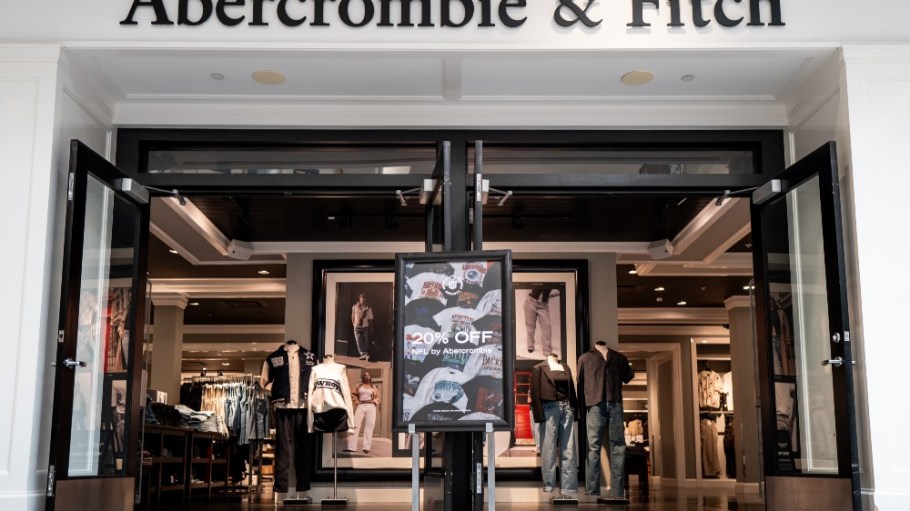
Abercrombie & Fitch Co.
The specialty retailer’s chief financial officer, Robert Ball, said Abercrombie has seen about $5 million in adverse impact from tariffs during the second quarter, chiefly manifested in the cost of sales, and expects $90 million net impact from tariffs for the year.
Lower gross margin was “partially offset” by about 60 basis points of operating expense leverage, he said. “We ended the second quarter with inventory in a clean current position with inventory at cost up 10 percent and units up 7 percent,” he added.
Speaking to the logistics strategy that the company is leveraging to remediate tariff impacts, Ball said, “In anticipation of tariffs, we did selectively clear third quarter receipts early within our bonded warehouses driving around one point of the cost increase. As we alluded to last quarter, we saw a normalization of freight costs and unit mix that drove sequential improvement in year-over-year inventory comparisons.”
The company expects that China sourcing will remain in the low single digits for the year, and it has little exposure to the de minimis exemption that’s been terminated, “so it’s not a factor.”
“Globally, we remain nicely diversified across 16 countries and the team is continuing to evaluate supply chain footprint changes, vendor negotiations and operating expense efficiencies that will largely take shape in fiscal 2026,” he said. Abercrombie doesn’t expect broad price increases in 2025.
With tariff rates evolving constantly and trade agreements continuing to be negotiated, the company is avoiding “making any sort of knee jerk reactions,” Ball said. “What we are doing is we’re staying on offense. We’ve got great teams. We’ve got proven playbooks to address disruptions like this, just like we have in the past. But changes particularly in this space are complicated.”
PVH Corp.
The Tommy Hilfiger and Calvin Klein parent company saw a 4 percent increase in revenue on a reported basis, and a 1 percent increase on a constant currency basis, outperforming its guidance for Q2. Between the two brands, Calvin Klein saw a 5 percent revenue increase (and a 3 percent increase in constant currency), while Tommy Hilfiger saw a 4 percent increase in revenue, remaining flat in constant currency.
Chief financial officer Zac Coughlin said the firm is expecting Q3 gross margin to decline approximately 175 basis points from the year-ago period. “The impact of tariffs will be felt much more heavily in the fourth quarter given when new rates take effect in the timing of sell through,” he said. The company expects SG&A as a percentage of revenue to grow by about 75 basis points compared to fiscal 2024.
How is the company planning to keep shoppers engaged? “We are investing more into marketing in the third quarter to capitalize on key consumer moments, and to support our brand building cut through campaigns amplified by mega talent,” he said.
Gap Inc.
Gap Inc. saw better-than-expected results during the second quarter, driven in large part by its namesake brand.
The firm saw an overall 1 percent increase in comparable sales for Q2 (driven by positive comps for Gap, Old Navy and Banana Republic), and earnings per share hit $0.57, a 6 percent jump from the previous year. It closed the quarter with robust cash balances of around $2.4 billion, showing solid financial standing and a capacity for future investments. The Gap brand itself saw its seventh consecutive quarter of positive comps, leading to a 4 percent increase.
Katrina O’Connell, executive vice president and chief financial officer, said the company is remaining mindful as trade policy evolves of its financial outlook for the remainder of 2025. “It was exciting to see continued strength at Old Navy and Gap with emerging growth at Banana Republic, all of which helped us navigate the quarter despite choppiness at Athleta where we welcome new leadership,” she said.
Operating margin fell 10 basis points from the year-ago period to 7.8 percent, while earnings per share for the quarter were $0.57—an increase of 6 percent versus last year’s earnings per share of $0.54. End of quarter inventory levels were up 9 percent year over year, “primarily as a result of accelerated receipts and higher cost due to tariffs,” O’Connell said. “We remain committed to our disciplined inventory management principles, and we believe we ended the quarter with the right inventory composition.”
During Q1, Gap Inc. previewed an estimated net tariff impact for 2025 amounting to about $100 million to $150 million, based on the Trump administration’s stated April tariff rates. “I am proud that the teams have since mitigated the majority of that impact,” O’Connell said. Based on new tariff rates announced in late July, Gap Inc. still expects net sales to grow between 1 percent and 2 percent year-over-year in 2025.
Urban Outfitters
Urban Outfitters delivered strong performance across all its brands in Q2, with shining stars being Nuuly and Anthropologie.
During its earnings call, the company reported an 11 percent increase in total sales and a 22 percent bump in net income, setting new records for the second quarter. Nuuly, the company’s rental service, saw impressive revenue growth of 53 percent and a 48 percent increase in average active subscribers, while the company’s wholesale segment saw revenue grow by 18 percent, leading to a 15 percent increase in gross profits, reaching $566 million.
Notably, though, SG&A expenses escalated 13 percent, but Urban was also able to obtain a 20 percent increase in operating income, reaching $174 million. Anthropologie saw retail segment comps increase 6 percent, while Free People saw a 14 percent increase in total revenue. Full-year gross margin is projected to increase by about 100 basis points for fiscal 2026.
Co-president and chief operating officer Frank Conforti said that despite an “exceptional quarter,” the trade environment has, and will, present challenges.
The landscape continues to change as tariff rates have increased for many countries,” he said. “As of today and based on new assumptions, we believe the impact for the second half of the year could be approximately 75 basis points to gross margins.” Urban’s teams are continuing to put together strategies to mitigate impact, “including negotiating better terms with our vendors, diversifying our countries of origin, changing our mode of transportation from air to ocean, and strategically adjusting pricing to minimize the impact on our customers.”
Nonetheless, Conforti said tariffs represent a “temporary challenge” to the business, and he noted that he’s confident in the company’s ability to manage through the maelstrom “and still achieve approximately 100 basis points of gross margin improvement for the full fiscal year 2026.”