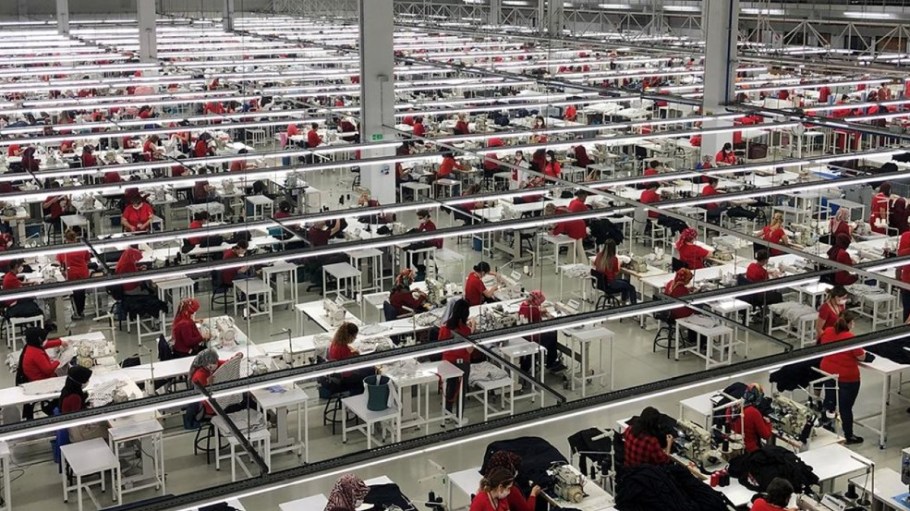
Searching for economic options, apparel manufacturers in Turkey—who have been moving out of Istanbul in the last few years, cutting costs and finding ways to scale up—are scrambling for solutions in 2025.
More than economic models, it’s about survival plans, according to industry analysts. That’s especially true since the 30-percent minimum wage increase that went into effect Jan. 1.
Turkey’s minimum wage is now 22,104 Turkish lira, or about $621.22 per month. The 2024 minimum wage was 17,002 Turkish liras (around $477.83), already putting Turkey at the higher end of wages compared with other sourcing countries. Cambodia, Vietnam, India, Bangladesh and Sri Lanka typically pay workers $200 or less per month.
Related Stories
“It is becoming more difficult for us to cover our costs. The statutory minimum wage now amounts to 26,005.50 Turkish liras ($730.31) gross, translating to 22,104.67 Turkish liras net, with the cost to the employer being 30,621.48 Turkish liras ($860.48),” a manufacturer told Sourcing Journal.
As Turkish manufacturers have long pointed out, their focus has become more specialized; they’re focused less on volume and more on specialty orders. More than 60 percent of their output is targeted at the EU market, with nearshoring representing a critical factor for European buyers. Proximity put Turkey in good stead with these firms during the pandemic, and while orders in many countries declined dramatically, Turkey showed growth.
The new wage touches the lives of approximately 9 million workers, and an approximate 1.5 million of them work in the apparel and textile industry. It’s still an uneasy truce on the wage, with the Confederation of Turkish Trade Unions, better known as Türk-İş, saying it doesn’t cover the living expenses due to heightened inflation.
It is a balancing act, several economists told Sourcing Journal. While the minimum wage increase is needed to support labor, the increase could also have the knock-on effect of fueling inflation. The number crunching explains the difficulties on the ground; inflation rose from 64.77 percent in December 2023 to 75.45 percent in May 2024, finally dropping to 44.38 percent in December 2024. Forecasts for the end of 2025 expect it to drop lower, with the Central bank projecting inflation to drop to 21 percent by December.
The Turkish lira has also been dropping steeply, hovering at an approximate 35 against the U.S. dollar this week. By comparison, it was 1.1 against the U.S dollar in 2008 and 13.09 against the dollar in January 2022.
Several associations in the textile and apparel sector have called for government support in the face of increasing costs. Ramazan Kaya, president of TGSD, the Turkish Clothing Manufacturers’ Association, noted that the burden arising from labor costs—especially in labor-intensive sectors—should be shared. He also said that additional taxes and reference prices applied to raw material imports should be reviewed. He called for insurance premium reductions and suggested that the provision could be shared as well.
“We can say that costs have increased by 100 percent,” said another representative of TGSD. “It is difficult to compete with rival countries, and we are experiencing a minimum wage period where both employers and employees will not be happy. Our exports will enter a contraction period in 2025. Our costs have increased a lot. The minimum wage in rival countries is around $200 to $300, and we are approaching $1,000. We are having difficulty keeping up with the price. The European market is shrinking.”
While many manufacturers were thinking about moving operations to Egypt, some aren’t finding it to be an attractive option. “Egypt is not an easy choice. Unprofitability is a big problem,” a manufacturer said. The undertones of discussions among manufacturers center around the level of expertise of the country’s workers, along with working style challenges.
Meanwhile, the focus on sustainability and innovation is growing, and manufacturers said that brands are not increasing prices.
Aysegul Kaya, innovation and sustainability manager at TYH Tekstil, observed, “Since we did not see a change in the exchange rate at a similar rate, I can roughly say that our costs increased by at least 30 percent, but we could not reflect this cost increase on our orders or customers. While our customers and brands prefer to buy cheaper prices, the increase in our costs does not allow this.”
Turkey’s apparel sector has set an export target of $19 billion for 2025.
In 2023, Turkey ranked No. 6 in global apparel production, with 3.5 percent of market share worth $20.3 billion. It was the third largest exporter in the EU, with a share of 12.6 percent.
Manufacturers are calling for foreign exchange input costs to move in parallel for recovery, and for additional taxes to be reviewed. The losses in the sector are being negatively reflected in employment, they said. The contraction in exports is causing production losses for many companies, and investments in the sector have largely been shelved for this reason.
In 2024, Turkey’s apparel industry was worth approximately $18 billion.
According to industry analysts, the apparel sector’s export share dropped by 6.9 percent in 2024, accounting for approximately 7.9 percent of the country’s overall exports. The textile sector has decreased by 0.6 percent, and accounts for 4.2 percent of the country’s exports.
As factories have been closing down, manufacturers said that there has been a “serious employment loss in the textile sector and apparel sector in the last two years”; during that time, 62,637 workers left the apparel sector, while 85,745 people exited the textiles segment.
According to October 2024 data, 10,257 workers left the apparel industry year over year, leaving 580,624 workers. Meanwhile, 10,244 people left the textile trade, leaving 966,045 workers still employed last fall.
While some investments have come in—the International Finance Corporation (IFC) in December invested $50 million in Turkish textile manufacturer Küçükçalık Tekstil, for example—they don’t adequately reflect of the needs of the industry, manufacturers said.
IFC said the move would help the company improve sustainability practices, up production capacity and create 700 new jobs. The company’s director for Turkey and Central Asia, Wiebke Schloemer, said the cash infusion will also help competitiveness in the synthetic fabrics sector.
Another impact to the sector has been reflected in the prices of raw material. As the Turkish lira has dropped, so have profit margins. The appeal of nearshoring, wherein delivery to Europe within three to four days was a real advantage, has been tempered by costs.
“We cannot utilize our supply advantage due to being expensive,” a manufacturer told Sourcing Journal. “If our sector can receive the support it expects in 2025, we can remain at the same level as 2024 and end the shrinkage process. Otherwise, we may shrink by 5 percent in 2025 compared to [2024].”
“The current picture shows that 2025 will also be an extremely difficult year,” he said.