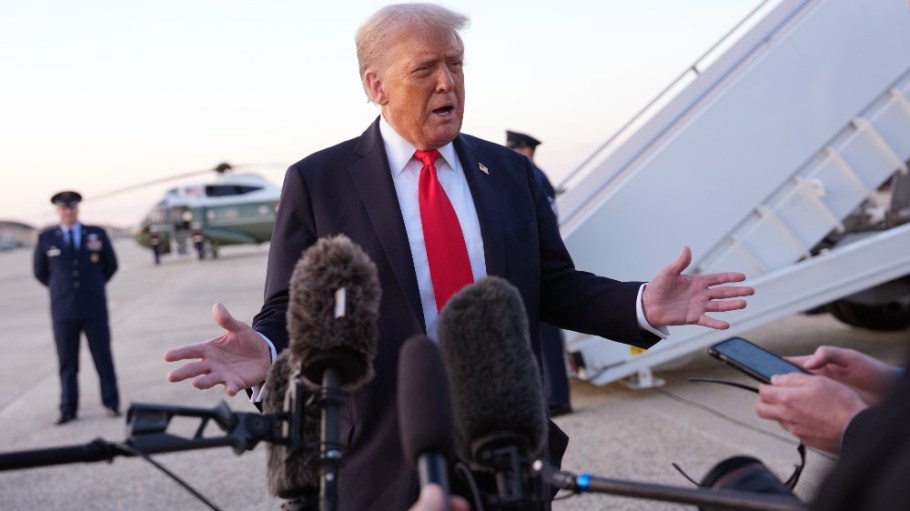
Restoring relationships with Southeast Asia was high on President Trump’s agenda as he arrived in Kuala Lumpur on Sunday for the opening of the 47th ASEAN Summit—a meeting where trade issues, tariffs, and new agreements dominated discussions.
Received at the airport by Malaysian Prime Minister Anwar Ibrahim with ceremonial fanfare, Trump paused to move in rhythm with dancers lined up on the tarmac before praising regional leaders in his address at the Kuala Lumpur Convention Center.
Related Stories
“Everything you touch turns to gold,” he told them, commending ASEAN nations for “transforming Southeast Asia into a global center of growth and stability.”
Discussions on trade tariffs were high on the bloc’s agenda.
The 10-member grouping—Cambodia, Indonesia, Laos, Malaysia, Myanmar, the Philippines, Singapore, Thailand, and Vietnam—includes several of the world’s leading sourcing hubs for apparel and manufacturing. Overall, ASEAN exports touched $2.05 trillion in 2024, and the region has a combined population of 650 million people.
Many had been reeling from the shock of high U.S. tariffs introduced earlier in Trump’s term, which initially ranged between 40 and 50 percent across much of the region.
While some were later moderated—Vietnam to 20 percent, and Thailand, Malaysia, and Cambodia to 19 percent, with Singapore at 10 percent—Laos and Myanmar continue to face 40 percent duties.
That disparity has caused months of tension and recalibration, strengthening the region’s economic ties with China, which many see as a more predictable trade partner, while the unpredictable and fast changing U.S tariffs have been causing confusion.
But on Sunday, Trump struck a different tone—one of friendship and renewed cooperation.
“My message to the nations of Southeast Asia is that the U.S. is with you 100 percent,” he said. “We intend to be a strong partner and friend for many generations to come. Together, we’ll create incredible prosperity on both sides of the Pacific and seize new opportunities for all our people.”
The outreach was underlined by Trump’s co-signing of a peace agreement between Thailand and Cambodia on the sidelines of the summit, one that he had emphasized was essential in July when hostilities broke out in border areas. He used the threat of increased tariffs to help broker peace. The agreement was signed by Thai prime minister Anutin Charnvirakul and Cambodian prime minister Hun Manet. The agreement commits both nations to withdraw heavy weapons from border areas, clear unexploded ordinance, manage overlapping territorial zones, among other commitments to peaceful co-existence.
Importantly, separate reciprocal tariff agreements with Malaysia and Cambodia were signed; finalized frameworks were also drawn up for Thailand and Vietnam.
Although the existing tariff levels—19 percent for Malaysia, Cambodia, and Thailand, and 20 percent for Vietnam—remain unchanged, the reciprocal agreements detail new provisions, including zero tariffs for select goods, and stricter environmental and labor compliance terms.
According to the joint statement released Sunday, the U.S.–Malaysia reciprocal trade agreement aims to “strengthen our bilateral economic relationship, providing exporters from both countries unprecedented access to each other’s markets.”
Malaysia also secured exemptions on key exports, including palm oil and rubber—commodities that make up about 12 percent of its total exports, valued at $5.2 billion—while offering preferential access for U.S. industrial goods and committing to higher standards in environment, labor, intellectual property, and security cooperation.
Among the other commitments in the agreement, Malaysia has pledged to adopt and maintain high levels of environmental protection, effectively enforce its environmental laws, and take concrete measures against illegal logging, harmful fisheries subsidies, unregulated fishing, and wildlife trafficking. It will also increase enforcement against markets known for counterfeiting and piracy.
To protect internationally recognized labor rights, Malaysia has committed to preventing forced labor and to strengthening the identification and resolution of labor law violations in high-risk sectors, including those involving child labor. Kuala Lumpur has also agreed to uphold and effectively enforce its labor laws, establish proper institutions to protect worker rights, and apply legal sanctions for violations. The government has pledged not to weaken or reduce protections to encourage trade or investment and to rectify any previous dilution of those standards.
In the agreement frameworks—Thailand has agreed to cut tariffs on nearly all imports; and Vietnam has aimed at expanding market access for U.S. exporters.
Analysts noted, however, that there may not quite be cause for celebration. “The exchange made by the region is to pay 19 percent tariff, in exchange for zero percent. It is not a favorable balance for the region.” However, others said they would wait and watch after more details are available, including the important issue of transhipments—which target the movement of goods from China—given that manufacturers noted that many of their exports include Chinese materials.
As ASEAN navigates a delicate balance between the competing interests of major powers, the bloc continues to push for multilateral trade frameworks and deeper partnerships with new economic allies. The summit also formally welcomed East Timor as ASEAN’s 11th member—a historic step for the young nation. Meanwhile, the political and humanitarian crisis in Myanmar, with elections scheduled for December, remained a central topic alongside broader regional stability concerns.
Yet, despite the fresh agreements and optimistic rhetoric, talk of tariffs is far from over.
On the sidelines, Trump met Brazilian President Luiz Inácio Lula da Silva to discuss the 50 percent tariffs imposed on Brazilian products, signaling possible adjustments ahead. “I told him it was extremely important to take into account Brazil’s experience as the largest country in South America, the most economically significant, and with almost all of South America as a neighbor,” the Brazilian president told reporters afterward, underlining his expectation of a shift.
As Trump departed Kuala Lumpur for Tokyo on Monday—the next stop on his six-day Asia tour—anticipation has been building for his meeting with Chinese President Xi Jinping Oct. 30.
The two leaders are scheduled to meet Thursday in Gyeongju, South Korea, on the sidelines of the Asia-Pacific Economic Cooperation forum. It will mark their first face-to-face since the start of the trade war earlier in Trump’s term.
Both sides have hinted at progress, with officials saying a “framework” for settlement is already in place. Whether this week’s series of agreements across Asia marks the start of a broader reset—or a temporary thaw in a turbulent trade landscape—will depend on how these commitments unfold in the months ahead. For now, the region appears cautiously hopeful that the tone has changed, and that Washington’s promises of partnership will be matched by consistency in policy.