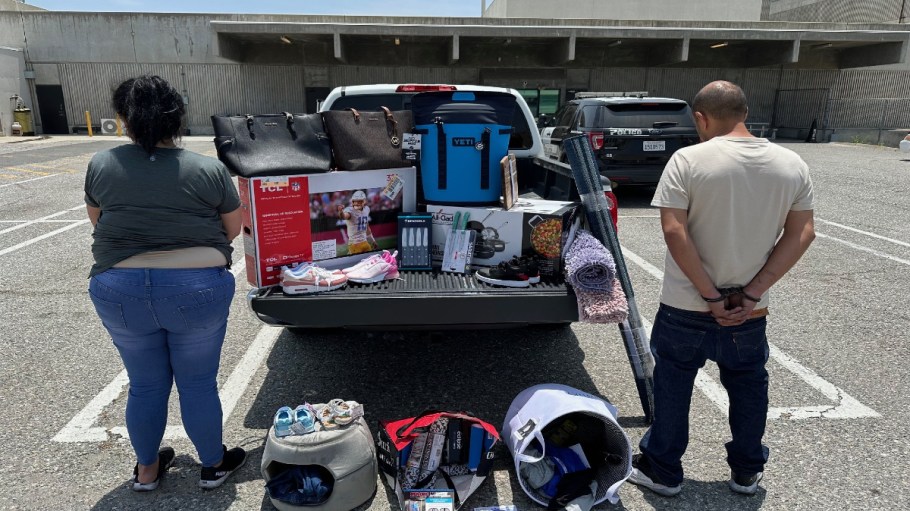
Retailers and police organizations have turned to atypical measures for fighting crime in retail stores.
The San Bernardino County Sheriff’s Department arrested two suspects for alleged conspiracy to commit commercial burglary on Monday after multiple incidents in TJX stores, starting in September 2023.
Police said they found $2,000 of stolen merchandise in the possession of Miguel Rosales, 40, of Azusa, Calif., and Iveth Carrion, 39, of Whittier, Calif., on the day of their arrest. However, the department alleged, the total amount of stolen goods the two are responsible comes in above $5,300.
Related Stories
The San Bernardino Sheriff’s Department said in a statement that it had worked with TJX retail crime investigators to catch the suspects. The county joins a number of other regions nationwide that have brought about task forces and law enforcement initiatives for retail crime.
In November 2023, the department said it became particularly concerned with the way retail crimes altered residents’ quality of life, noting in a release that, “These violent criminals terrorize the citizens of San Bernardino County by utilizing intimidation tactics and a mob mentality that creates an unsafe and uncomfortable shopping environment for our residents.”
Since then, it has facilitated Operation Smash & Grab, which works to “disrupt and dismantle…retail store theft crews” using “conventional and non-conventional investigative methods.”
TJX has also resorted to non-conventional methods in its stores, where some employees have begun wearing body cameras in what John Klinger, the company’s chief financial officer, has declared an effort to decrease shoplifting and retail crime.
“It’s almost like a de-escalation where people are less likely to do something when they’re being videotaped,” he said, referring to the body camera play on the company’s earnings call last month.
A TJX spokesperson told said the company has, over the past year, started using body cameras in certain stores across the U.S., but did not specify which regions it has targeted or which of its brands has the highest usage rate. That person also noted that employees who are expected to wear body cameras receive training from the company in order to “use the cameras effectively in their roles.”
The spokesperson said TJX only divulges the footage recorded on the body cameras to law enforcement when requested or if the company receives a subpoena for the footage.
The company hopes that the addition of body cameras to its arsenal of safety tools will help re-assure its employees and consumers.
“Body cameras are just one of the many ways that we work to support a safe store environment,” the spokesperson said. We hope that these body cameras will help us de-escalate incidents, deter crime and demonstrate to our associates and customers that we take safety in our stores seriously.”
That kind of commitment could be boon for retention in TJX stores, if employees believe it to be true. Data from Lotis Blue Consulting showed that, in 2023, frontline retail employees were 68 percent more likely to stay in their current role if they felt their employer had strong health and safety considerations in place. That figure increased by 10 percentage points between 2022 and 2023.
In the apparel and luxury sectors, health and safety has an even stronger impact on employee retention. In 2023, employees were 76 percent more likely to stay with an employer if they thought the company valued their health and safety, up from 58 percent in 2022.
TJX, which owns Marshall’s, TJ Maxx and HomeGoods, is not alone in its video-centric fight against retail crimesters—and the battleground has become international. Sourcing Journal reported earlier this year that British chains Tesco and Woolworths have both rolled out associate-worn body cameras in stores; Tesco did so last fall, and Woolworths did so in April.
And the National Retail Federation’s 2023 Retail Security Survey showed that 35 percent of organizations have started researching body cameras for their store employees or loss prevention teams. However, just one in ten retail organizations reported that they had started testing in-store body cameras.