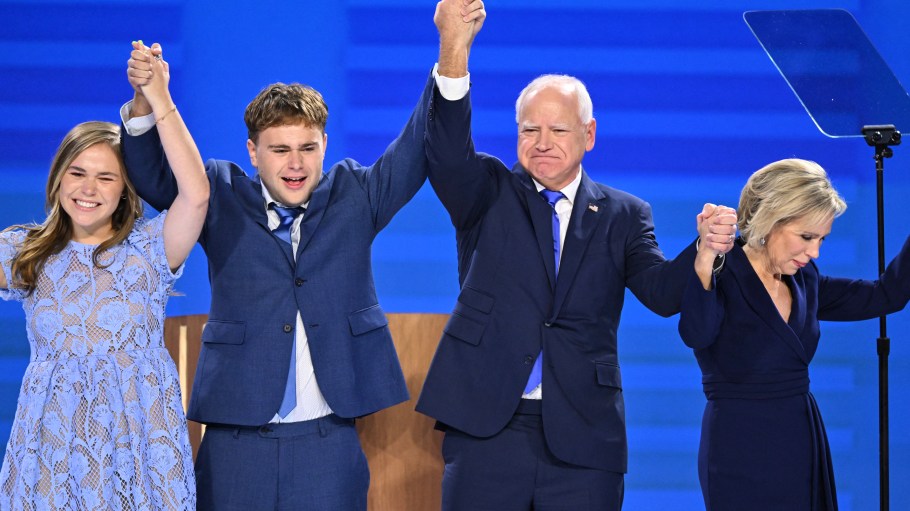
Joy to the world—or at least to the Democratic National Convention.
Throughout day three of the convention, taking place in Chicago this week, a slew of public figures—from Bill Clinton, to Pete Buttigieg, to Oprah Winfrey—brought their remarks back around to a sense of joy and hope.
Once Minnesota Governor Tim Walz took the stage, closing out the night and accepting the Democrats’ nomination for the vice presidency—which he called “the honor of [his] life”—the ebullient rhetoric around the election only continued.
Related Stories
Walz, in a succinct, 15-minute pep talk and ode to the Democrats’ presidential nominee, Kamala Harris, headed up his formal introduction to America with a wave of thank yous, culminating in one to those watching, whether from Chicago or their living rooms.
“Thank you for your passion. Thank you for your determination. And most of all, thank you for bringing the joy to this fight,” he said.
The native Nebraskan’s wife, Gwen Walz, introduced her husband in a short video spotlighting his small-town roots, his commitment to industry and his progressive gubernatorial policy record.
“He’s as at home on a farm, a fishing boat, a football field or a factory floor as he is on the floor of Congress,” she said as images and videos of the governor showed him in each of those places, clad in plaid, camouflage, the bright red akin to Mankato West High School football uniforms and more.
Gwen Walz said her husband’s down-to-earth affect and insistence on championing the working class has brought him to this point, and noted that, in his time as a politician, he has been laser focused on a new way forward for middle-class Americans.
“Whether it was in Congress or as governor, his focus has always been helping working people, like those he grew up with. That’s why he fought for the largest tax cut in Minnesota state history,” she said. “With Tim as governor, Minnesota is one of the best places to raise a family and one of the best states for business.”
Tim Walz, coined “America’s dad” by hordes of social media users, had yet more to say about his beliefs and record in his own speech, which also proved a reflection on what it means to be a neighbor and a part of a community in America.
He spoke about or alluded to a variety of topics: the economy, reproductive freedoms, education, crime and housing.
He highlighted some of his achievements as Minnesota’s governor, including tax cuts for the middle class, the passage of paid family and medical leave for workers throughout the state, the reduction in cost for prescription drugs and free meal programs for students in schools across the state.
“While other states were banning books from their schools, we were banishing hunger from ours,” he quipped, a slight slash at red states like Texas, Florida and Missouri.
“When Republicans use the word freedom, they mean that the government should be free to invade your doctor’s office; corporations, free to pollute your air and water and banks free to take advantage of customers,” he said. “But when we Democrats talk about freedom, we mean the freedom to make a better life for yourself and the people that you love.”
While he took aim at the Republican party as a whole, Walz also took his speech as a chance to contrast his and Harris’ platform with that of their opponents, Donald Trump and J.D. Vance. Walz, in plain speech, slammed the two Republicans, saying they “just don’t understand what it takes to be a good neighbor” and lack the responsibility to foster better futures for Americans.
He went on to say that Project 2025, a right-wing policy agenda in some ways linked to Trump and Vance, would “make things much, much harder for people who are just trying to live their lives.”
Though the Trump campaign has started to distance itself from Project 2025, Walz said Republicans will likely deploy many of the strategies laid out in the plan, which he called “an agenda nobody asked for.”
“[Trump and Vance] spend a lot of time pretending they know nothing about [Project 2025]. But look, I coached high school football long enough to know—and trust me on this—when somebody takes the time to draw up a playbook, they’re going to use it,” he said. “If these guys get back in the White House, they’ll start jacking up the costs on the middle class.”
And for Walz, the only way out of that was through his running mate, the nation’s current vice president.
Walz lauded Harris, giving a verbal highlight reel of her tenure in government and politics leading up to the current election cycle.
“We’ve got something better to offer the American people. It starts with our candidate, Kamala Harris. From her first day—as a prosecutor, as a district attorney, as an attorney general, as a United States senator and then our vice president—she’s fought on the side of the American people,” he said. “She’s taken on the predators and fraudsters. She’s taken down the transnational gangs. And she’s stood up to powerful corporate interests. She has never hesitated to reach across that aisle if it meant improving your lives, and she’s always done it with energy, passion and joy.”
Walz also spoke about Harris’ plans for the economy, which the candidate unfurled late last week. He said Harris would slash taxes for middle-class families, and for those “trying to get into the middle class.” He promised Harris would make purchasing a home more affordable and that she would “take on Big Pharma.”
To round out his speech, Walz used football metaphors—a nod to his time as “Coach Walz”—to hype up the crowd, encouraging them to mobilize behind him and Harris.
“You might not know it, but I haven’t given a lot of big speeches like this. But I have given a lot of pep talks,” he said. “So let me finish with this, team. It’s the fourth quarter. We’re down a field goal. But we’re on offense and we’ve got the ball. We’re driving down the field. And boy, do we have the right team. Kamala Harris is tough. Kamala Harris is experienced. And Kamala Harris is ready.”
In a final call to action, he encouraged voters to make phone calls, knock on doors and donate to the campaign, stating that kind of movement would be the way to ensure “no community is left behind.”
“Look, we’ve got 76 days. That’s nothing. There’ll be time to sleep when you’re dead. We’re going to leave it on the field; that’s how we’ll keep moving forward,” he said.