As President Donald Trump’s “reciprocal” tariff scheme roared to life this week, the fallout is already becoming apparent.
Among the most swiftly and acutely impacted targets of tariff terror is India, which, in addition to being hit with 25-percent duties on Thursday, will face an additional tariff burden of 25 percent beginning Aug. 28.
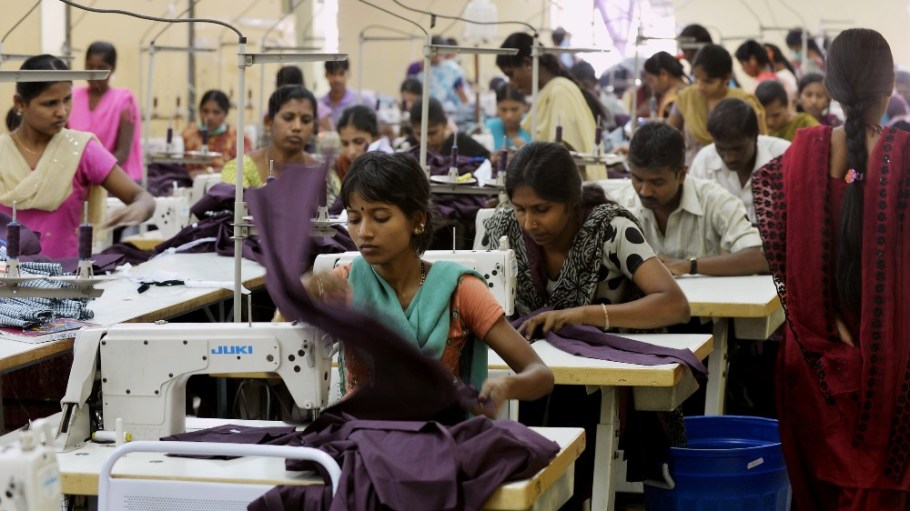
While all United States trading partners now face double-digit duties, even the hardest hit apparel sourcing destinations pale in comparison to India’s hefty 50-percent duty rate. Nearby neighbors like Pakistan (19 percent) and Bangladesh (20 percent) will also face hardships, along with Asian sourcing locales like Laos and Myanmar (40 percent), Vietnam (20 percent) and Cambodia and Indonesia (19 percent), but the adverse effects of Trump’s new duties to India’s burgeoning apparel and textile industry could prove devastating.
Related Stories
Ratings agency Moody’s said as much on Friday, commenting that the duties could stymie the growth of the country’s manufacturing sector.
Moody’s predicted that should the weight of the full, 50-percent duties be thrust upon the country’s producers, India’s gross domestic product (GDP) growth could slow, contracting by 0.3 percent from its 6.3-percent forecast for fiscal 2025-2026.
“Beyond 2025, the much wider tariff gap compared with other Asia-Pacific countries would severely curtail India’s ambitions to develop its manufacturing sector…and may even reverse some of the gains made in recent years in attracting related investments,” Moody’s said Friday.
Clothing Manufacturers Association of India (CMAI) president Santosh Katariya was more to the point, saying the imposition of the additional 25-percent tariffs “will deliver a crippling blow to the Indian apparel industry.”
A 50-percent duty increase will up the cost of India-made apparel by 30 to 35 percent compared with analogous goods from countries like Vietnam and Bangladesh, “making Indian exports uncompetitive in the global market,” Katariya said.
“Buyers are unlikely to bear such a substantial pricing gap, which could lead to a sharp decline in export orders,” he added, with multiple outlets reporting that he denounced the tariffs as “unjustified, unfair, and arbitrary.”
According to the U.S. Fashion Industry’s 2025 benchmarking study released in July, which relied on input from 25 leading U.S. apparel executives at the nation’s largest brands and retailers, India earned a four-out-of-five score in terms of price competitiveness as a sourcing destination—a distinction that stands to be threatened massively should this reality take hold.
The CMAI’s sense of alarm is far from premature, according to recent reports.
Indian publication NDTV Profit wrote Friday that the biggest American apparel purchasers, from Walmart and Target to Amazon and Gap, have pulled back on orders from India-based suppliers. Sources told the news outlet that exporters have received notice from U.S. brands and retailers demanding a pause on shipments.
NDTV, which spoke to some of India’s most prominent exporters, reported that the heightened duties could drive down U.S. orders by 40 to 50 percent—a loss of $4 billion to $5 billion.
This comes just as India was gaining on apparel production stalwarts in the region. Total apparel exports grew 11.3 percent year-over-year in May, and industry insiders had been targeting double-digit growth again this year. In fiscal year 2025, India’s textile and apparel exports rose by 6.3 percent to reach $36.6 billion. Apparel exports alone saw a 10-percent increase, while textile exports grew by 3.61 percent.
USFIA’s study said “it has become more common for respondents this year to allocate more than 10 percent of their apparel sourcing orders to India, Cambodia, and Indonesia, signaling improved production capacity and a larger role for these countries as apparel suppliers for U.S. fashion companies”—while orders from China have, on the whole, decreased.
Indonesia, India and Cambodia were the three most popular emerging sourcing destinations, the data showed, with more than 60 percent of executives saying they plan to increase sourcing from these countries over the next two years.
But that progress could be thwarted by tariffs, with global investment bank UBS estimating that $8 billion worth of exports—clothing and textiles among them—are now at risk.
The tariff ramp-up has prompted hand-wringing and contingency planning, with Indian Prime Minister Narendra Modi seeking an audience with Chinese President Xi Jinping later this month. The country is also deepening its ties with the United Kingdom, having announced a landmark trade deal earlier this year.
But Trump appears undeterred by the shifting of allegiances and deepening of trade ties beyond U.S. borders. The president took to Truth Social on Friday to tout the “huge positive impact” tariffs have had on the American stock market and the hundreds of billions of dollars in revenue that are “pouring into our Country’s coffers.”
Still, the president’s tariff agenda continues to face legal challenges, with a Court of Appeals for the Federal Circuit in Washington expected to deliver a ruling on whether Trump overstepped his authority as Commander in Chief by imposing sweeping duties without the approval of Congress. The panel of 11 judges largely expressed skepticism about the president’s leveraging of the International Emergency Economic Powers Act (IEEPA) for such a purpose.
“If a Radical Left Court ruled against us at this late date, in an attempt to bring down or disturb the largest amount of money, wealth creation and influence the U.S.A. has ever seen, it would be impossible to ever recover, or pay back, these massive sums of money and honor,” Trump wrote Friday, clearly mulling the forthcoming decision.
“There is no way America could recover from such a judicial tragedy, but I know our Court System better than anyone, there is no one in history that has gone through the trials, tribulations and uncertainties such as I, and absolutely terrible, but also amazingly beautiful, things can happen,” he added.