Despite the buzz surrounding robotics, the growth of mobile robots globally may be stunted compared with previous expectations.
Ash Sharma, Interact Analysis’ chief commercial officer and vice president of research for robotics and automation, said in a recent report that the company had backed down from its initial projections for mobile robotics growth this year. The firm has reduced its 2025 market outlook by $800 million, stating that all geographies globally are likely to see slower-than-anticipated growth for the remainder of the year.
Related Stories
According to Sharma, the cause is simple: tariffs and economic uncertainties, many of which have been brought about by U.S. President Donald Trump’s erratic tariff strategy, are causing some companies to back down from capital-intense investments.
“At the heart of the forecast revision lies the damaging global tariffs, instigated by the new US administration under President Trump. These tariffs are reshaping global supply chains and injecting a high degree of uncertainty into capital investment decisions, causing delays,” Sharma wrote. “Companies are holding back on large-scale automation investments, wary of shifting trade policies and uncertainty over both their own costs and the fiscal health of customers and vendors.”
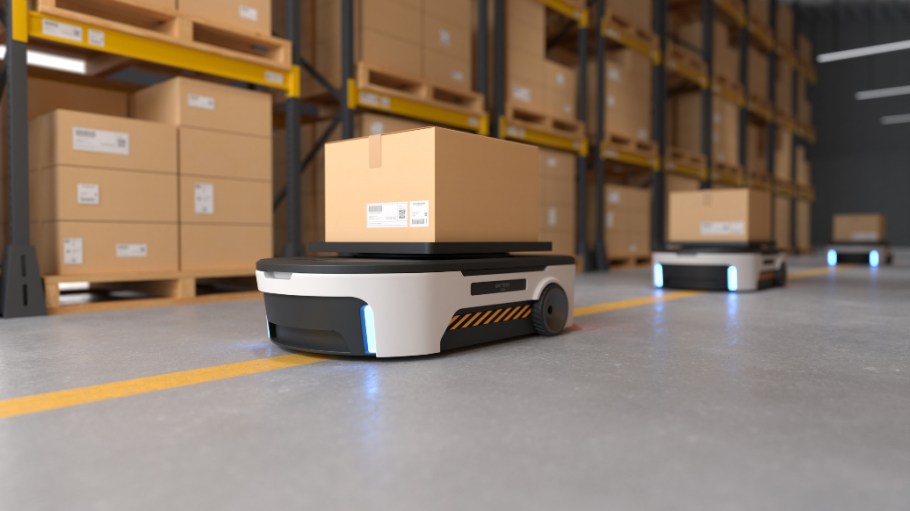
Mobile robots have the ability to move around an area—often a warehouse or fulfillment center—at least partly autonomously, because they are powered by software that enables them to process and handle inputs without much human intervention.
Interact Analysis’ forecast came out as Trump began announcing updated tariff rates on nations like Cambodia, Canada, Mexico and the European Union, each of which have seen double-digit levies on goods inbound to the U.S.
About 70 percent of industrial robots globally are produced in Japan, China, Germany and South Korea, according to the International Federation of Robotics (IFR). Goods inbound from Germany are currently subject to a 30-percent duty; South Korea and Japan are likely to face a 25-percent tariff effective August 1 and tensions with China remain high amidst a pause that temporarily wiped the triple-digit duties Trump leveraged against the Asian nation earlier this year.
Such duty rates could see the cost of robotics skyrocketing for U.S. deployment; according to Standard Bots, many warehouse robots cost between $20,000 and $100,000, depending on how technologically advanced they are.
It seems the come-down from mass deployment of robotics-based automation has already started in some regions. IFR Vice President Jane Hefner said at Automate 2025 that the organization’s preliminary 2024 results show that industry-agnostic U.S. deployment of industrial robots declined by 9 percent year on year in 2024, as compared with 2023. Global adoption saw a slight decrease, as well, per the data.
Interact Analysis upgraded its forecast to reflect about a 10 percent decrease in anticipated market size for 2025 in the country, forecasted a 10 percent decrease in anticipated U.S. Only the EMEA region saw a larger plunge, at nearly 16 percent.
Despite some companies’ continued quests to automate their warehouses by partnering with third-party robotics companies like Locus Robotics, Apptronik, Exotec and others, Interact’s new forecast shows that it expects that global adoption is likely to grow at a slower rate than it initially projected for the coming years.
Previously, it had projected that 2030 revenue attributable to mobile robots would stand at more than $20 billion; it has now downgraded that projection to $15.6 billion by 2030. That also means it has cut its expectations for compound annual growth rate for mobile robotics in the next five years. In October 2024, it projected that the CAGR would be 26 percent; that figure has now dropped to 21 percent.
Sharma said the declining sentiment is due to a number of challenges the mobile robotics industry faces in finding viable customers who remain bullish on the promise of such technology in the face of economic concerns.
“The message from Interact Analysis is clear: the mobile robot industry is still growing, but not as fast or as smoothly as once expected. Tariffs, economic uncertainty, and shifting global dynamics are forcing companies to rethink their strategies and timelines,” he wrote. “For stakeholders across the automation ecosystem—from vendors and integrators to end-users and investors—this is a time for strategic patience and adaptability. The fundamentals of automation remain strong, but the path forward will require some careful navigation.”