Despite President Donald Trump’s erratic tariff strategy, consumers are continuing to spend—for now.
Poonam Goyal, sector head and senior equity analyst for North American e-commerce at Bloomberg Intelligence, said that despite some doomsday predictions about consumers pulling back because of the Trump administration’s macroeconomic moves, they have remained resilient throughout the first half of 2025.
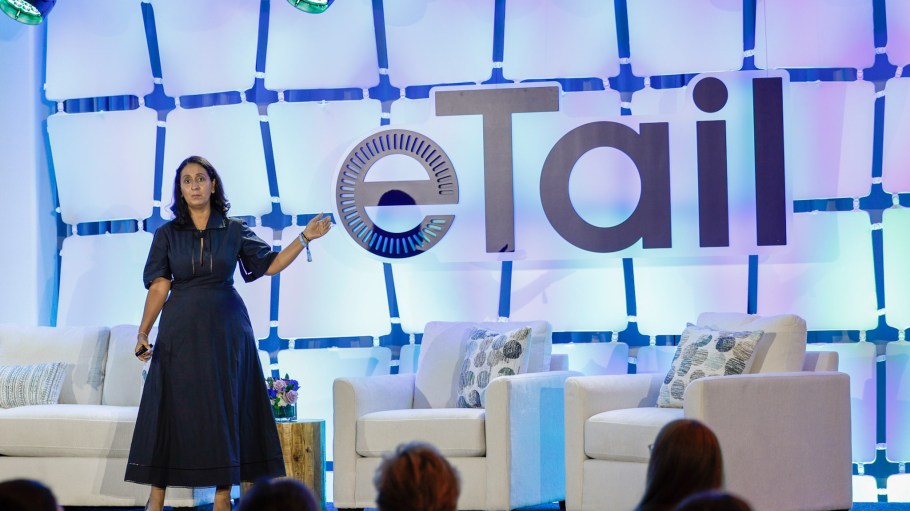
In a presentation at eTail East, she noted that consumer sentiment has started to tick back up. That’s according to the University of Michigan’s Survey of Consumers, widely considered a measurement of sentiment for the U.S. shopper.
Related Stories
In July, the index crept up one full percentage point, as compared with June. That, paired with other indicators like a nearly flat unemployment rate, indicate that the consumer remains hardy despite the continued upheaval coming from Washington. That’s, in part, because consumers’ definition of value continues to change for the circumstances.
“Even though [brands and retailers] all feel the pain of tariffs, inflation, higher costs, the consumer really hasn’t seen it. When they go to stores, they’re still being met with discounts. There’s still a lot of inventory in the pipeline, depending on what retailer you’re shopping at,” she said. “For the normal person, it’s like, ‘If I can’t buy it here, I can buy it here—if I can’t buy it on Amazon, maybe I can get a cheaper price at Temu.’”
What’s more, she noted, the prices of consumer staples continue to remain steady, which leads the consumer to believe their spending power has buoyancy in today’s market. The Trump administration famously ran its campaign on promises of cheaper prices on eggs and gas. Goyal said, for the moment, they’re delivering on those promises, even if other sectors have started reactively hiking prices.
“You are seeing prices rise selectively. But when I think about what you buy on a day to day basis—the price of milk, the price of eggs, the price of gas, even—they’re going down. They’re not really materially rising, or they’re staying steady. So when the consumer looks at their pocketbook, [they’re] saying, ‘Well, I’m getting gas at under $3 a gallon still; it’s not $5 where it was a few years ago.’ So that gives them confidence that things are going to be okay,” she said. “[For] apparel, household goods, when you look at those categories, I think it depends on the retailer that you’re shopping at to see if prices have gone up.”
Goyal said she had seen prices increase at some apparel brands and retailers, like Zara and Primark, both fast-fashion purveyors. For instance, while a Primark T-shirt may have cost $4 or $5 prior to the announcement of tariffs, it now may sit around $7. Still, she noted, if that’s on the comparative low end of what it costs a consumer to purchase that item in today’s market, they are still likely to purchase it.
“Where do I go to get this T-shirt for now, less than $7? Not that many places. So therefore, they’re paying for it,” Goyal said. “It’s all really comparable—are you still offering value relative to your peers in the same price point?”
While tariff rates have gone into effect for many countries—some at higher rates than leaders had worked to negotiate—Goyal said she believes prices should remain stable through the end of 2025.
“From what I’m hearing, the inventory for the back half is already here, so it’s not really getting impacted by the high tariffs that we’re about to see. So therefore, that tells me that we have at least six months,” she said. “Holiday isn’t really at risk right now, but what’s at risk is 2026. What happens in the spring, when you’re getting all this new inventory in at higher prices?”
For now, though, many retailers face a consumer content with the status quo; Goyal said indicators like unemployment rates and consumer credit usage continue to suggest a consumer that will carry some level of optimism.
The unemployment rate, in particular, remains the most important indicator in Goyal’s eyes. The Bureau of Labor Statistics reported a 4.2-percent unemployment rate for July, which remained nearly flat as compared with June. Goyal said that rate gives her no pause; it would need to rise an additional percentage point or two for her to reconsider that stance.
“When you look at where we are today versus where we were five years ago, 10 years ago, even 20 years ago, we’re still sitting at pretty much full employment. And that is really what’s driving the consumer to spend. As long as the consumers are employed, they will spend,” she said. “So unless you see this number rise to over 5, 6 percent—in the mid-to-high single digits—I don’t think we’ll have a place where consumers will pull back spending or materially even trade down from where they are today.”
But that’s not to say that retailers and brands are in the clear, she said. 2026 could prove tricky for companies, particularly if tariff rates on certain countries increase or remain flat at higher-than-expected rates.
The Trump administration has yet to sort out an official tariff rate on China, a long-discussed issue that has, in recent months, seen the rate on the Asian nation hitting triple digits at times. Trump is expected to come to an agreement with China ahead of the end of the year, but in the interim, the duty rate stands at 30 percent. Other key sourcing hubs, like Vietnam and the European Union, face duties of 20 percent and 15 percent, respectively.
“Clearly, tariffs will impact retailers. We’re starting to see mid single digit price increases selectively taking place in retail. Could that go higher? I think so in 2026, if we don’t see any relief to these tariff rates,” Goyal said.
Trump has made it clear that he aims to revitalize American manufacturing, using tariffs as a jumping off point. He has specific aspirations for some industries more than others, and fashion and apparel don’t seem to fit into his picture—instead, he has focused on technology, defense and shipbuilding, among other industries. Goyal said in today’s macroeconomic environment, it’s highly unlikely that brands and retailers will be able to rely on goods made in the U.S. for their American consumers.
“We will not make apparel in the United States—or footwear. That is not what we do. We had let go of that decades ago, and the idea that if we introduce tariffs to all these other countries, that we will start to bring production here—sure, we can bring a little but there’s no way that we’re going to produce 80 percent of what we consume in the United States. We don’t have the infrastructure for that. We don’t have the talent for that,” Goyal said.