
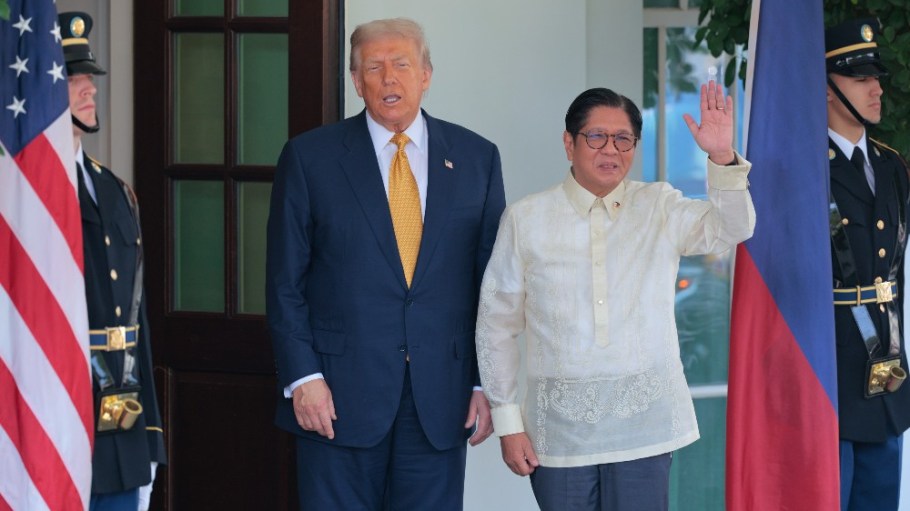
As the Trump administration’s Aug. 1 tariff deadline inches closer, world leaders are descending on Washington with the aim of securing favorable trade deals.
Philippine President Ferdinand Marcos Jr. visited the White House Tuesday after holding negotiations with Secretary of State Marco Rubio and Defense Secretary Pete Hegseth on Monday. Following an Oval Office meeting with President Donald Trump, it was determined that the country will pay a 19-percent duty rate on exports to the United States.
Related Stories
Eager to come to a consensus on U.S.-Philippine trade, Marcos told reporters that the Southeast Asian nation’s relationship with America “has evolved into as important a relationship as is possible to have.”
Notably, the Philippines relies heavily on China for a multitude of imports, and the country represents its largest trading partner, accounting for 25.7 percent of its imported goods in 2024, amounting to $32.8 billion. However, tensions between the countries have percolated due to territorial disputes over the Spratly Islands and Scarborough Shoal, located in the South China Sea.
By contrast, the U.S. represents just 6.4 percent of imports valued at over $8 billion, but it’s the Philippines’ largest export market, having taken in 16.6 percent of the country’s total exports last year—a value of $12.1 billion, according to the Philippine Statistics Authority.
Asked by press how the Philippines will balance its relationships with the U.S. and China, Marcos appeared to push back on the idea that China could influence its dealings with America “because our foreign policy is an independent one.”
“Our strongest partner has always been the United States,” he added.
Calling the meeting “a beautiful visit,” Trump Truthed that the trade deal had been concluded, with Marcos agreeing that the Philippines will open its market to the U.S. and charge zero duties on American-made imports. The countries also agreed to work together militarily, he added.
Meanwhile, Malaysia is reportedly seeking similar trade terms (a duty rate of 20 percent) to replace the 24-percent reciprocal tariffs announced by Trump on “Liberation Day” on April 2.
According to Malaysian news outlet The Star, the country’s Investment, Trade and Industry Minister Tengku Datuk Seri Zafrul Abdul Aziz said Tuesday that Malaysia will hold firm during negotiations with the aim of preserving its economic health and independence.
The country has addressed certain U.S. concerns pertaining to semiconductors, but negotiators thus far have held off on granting the Trump administration’s request for an extension of tax breaks on American electric vehicles as well as reduced shareholding limits in the country’s power and financial sectors and cuts in subsidies for fishermen.
U.S. Trade Representative (USTR) data shows that U.S. trade with Malaysia amounted to about $80.2 billion in 2024, with the U.S. trade deficit totaling $24.8 billion.
“We will not take the easy way out and will not bow to pressure, but negotiate strategically to defend jobs, shore up confidence among investors and, more importantly, defend the nation’s sovereignty,” Zafrul said. Instead of engaging in countermeasures, he hopes for productive negotiations with the U.S. that will result in more beneficial trade terms.
“We are facing this challenge with a strong economic foundation and are confident that we will be able to face the situation in an organized manner,” he said, according to The Star.
With 10 days to go until the tariff deadline, Treasury Secretary Scott Bessent said he believes Aug. 1 is “a pretty hard deadline” for most countries—except, perhaps, for China.
Countering comments made Monday that the administration plans to prioritize quality over timing when it comes to trade agreements, Bessent said on Fox News Tuesday that for most countries, reciprocal tariff rates will “boomerang back” to the values announced by the president on April 2.
“That doesn’t mean we can’t negotiate when the countries are at the higher level. As a matter of fact, I think President Trump may have created a pretty ingenious strategy here, that if you’re working at the high level, you’re actually going to work faster,” he told anchor Maria Bartiromo.
When it comes to China, though, the stakes and timing are different. The countries are currently engaged in a bilateral trade truce—and a pause on most duties—until Aug. 12. “I’m going to be in Stockholm on Monday and Tuesday with my Chinese counterparts, and we’ll be working out and what is likely an extension,” Bessent said. “Then I think trade is in a very good place with China. We’re going to be talking about a lot of the other things that our countries can do together.”
Bessent said the administration hopes to see China “pull back on some of this glut of manufacturing that they’re doing and concentrate on building a consumer economy.” Officials also hope to speak about China’s purchasing of Russian and Iranian oil.
“I think we’ve actually moved to a new level with China, where it’s very constructive and… we’re going to be able to get a lot of things done now that trade has kind of settled in at a good level,” he added.
The president himself also hinted Tuesday that he plans to travel to China to meet with Chinese President Xi Jinping face-to-face. “President Xi has invited me to China and we’ll probably be doing that in the not-too-distant future,” Trump said during his meeting with Marcos in the Oval Office. “A little bit out, but not too distant.”


