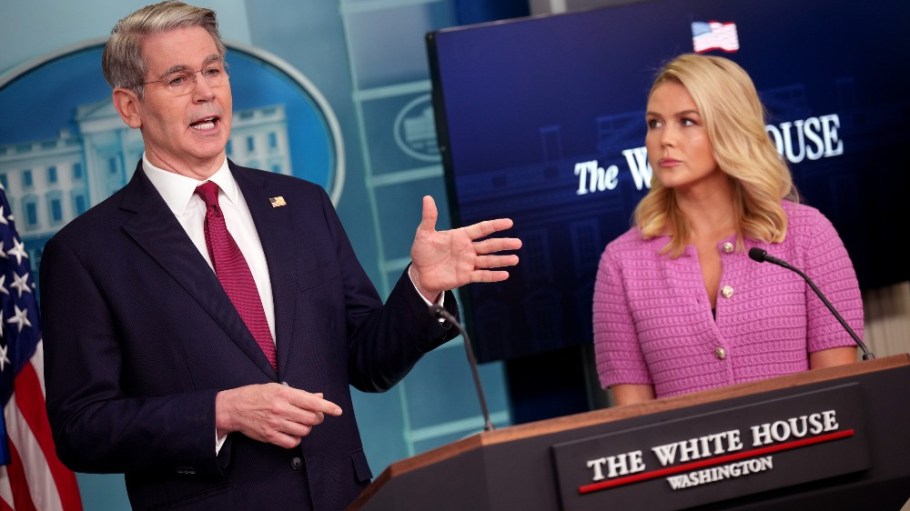
Amid assertions that the seismic upheaval caused by its tariff policy will ultimately bolster a resurgence in American manufacturing, the Trump administration has indicated that it’s willing to leave some industries in the dust.
“President Trump is interested in the jobs of the future, not the jobs of the past,” Treasury Secretary Scott Bessent said during a Tuesday press conference. “We don’t need to necessarily have a booming textile industry like where I grew up again, but we do want to have precision manufacturing and bring that back.”
Related Stories
In his attempt to defend the administration’s recent trade actions—which have sent markets careening wildly while upending global supply chains and driving up prices at retail—Bessent’s comments perhaps inadvertently set off alarm bells within a sector that, while embattled, still employs some 471,000 American workers.
The National Council of Textile Organizations (NCTO) wasted no time in hitting back at the assertion that U.S. textile producers are irrelevant to the administration’s stated reshoring efforts. The group’s president and CEO, Kim Glas, penned an open letter to the Treasury secretary, who hails from South Carolina, a major textile hub, asking for a meeting with the country’s textile stakeholders.
“Our industry saw your remarks and were disheartened to hear this sentiment, especially since this industry has been noted by President Trump himself on a number of occasions as critical and strategic,” Glas wrote.
“The U.S. textile industry was proud to make lifesaving PPE during the first Trump Administration in response to Covid. The U.S. proudly makes over 8,000 different products to the U.S. military alone to ensure we do not have to rely on foreign adversaries to make essential products. This is a strategically important, relevant, and key industry,” she added.
Bessent’s unprompted slight underscored inconsistencies in the administration’s stated strategy with regard to tightening up trade and bringing back U.S. manufacturing. The White House’s press release on reciprocal tariffs earlier this month explicitly pointed to textile manufacturing as an area of focus for reshoring.
“Today we write to underscore the importance of our industry and the jobs it offers to thousands of workers, sustaining communities across the United States,” Glas wrote to Bessent, noting that 2024 saw the industry produce shipments of man-made fiber, yarns, fabrics, apparel and non-apparel sewn products valued at $64 billion. The U.S. exported $28 billion in textile-related products last year, making it the second-largest exporter of textile and apparel products in the world, she added.
Meanwhile, 145-percent duties on China-made goods and the promise of steep reciprocal duties on most U.S. trade partners have thrown textile and apparel brands and retailers into turmoil; earlier this month, supply chain visibility provider Vizion released data showing that apparel import bookings nosedived nearly 60 percent over the course of one week.
Asked about the possibility that U.S. stores could run out of inventory, Bessent said he was not concerned about the possibility of empty retail shelves “at present.”
That sentiment is not shared by members of the fashion sector. On Wednesday, the American Apparel and Footwear Association (AAFA) requested that Congress intervene to put a stop to the sweeping duties, which it has said represent a “potentially crushing burden” for U.S. brands and retailers.
AAFA president and CEO Steve Lamar wrote to Senate Majority Leader John Thune (R-S.D.) and Minority Leader Chuck Schumer (D-N.Y.) urging members to vote in favor of S.J. Res 49, a bipartisan bill that would invalidate President Trump’s use of the International Emergency Economic Powers Act (IEEPA) for the purpose of levying widespread tariffs on U.S. trading partners, giving Congress greater authority over matters of trade.
Introduced by Senators Ron Wyden (D-Ore.) and Rand Paul (R-Ken.), the bill is slated to come to a vote sometime this week.
“This measure, if enacted, would be a much-needed first step to inject Congressional oversight into the President’s controversial use of tariffs under the International Emergency Economic Powers Act (IEEPA), ensuring that Congressional primacy on tariff policy… is upheld,” Lamar wrote. “Swift action on this resolution is vital to end the emergency our industry is now experiencing with crushing tariffs announced on April 2 and since then, and which have already damaged American manufacturers, American workers, American consumers, American businesses, American 401k investors, and the American economy.”
The administration, for its part, has vowed to veto the bill. On Monday, the Office of Management and Budget released a policy statement stating that the proposal “would undermine the administration’s efforts to address the unusual and extraordinary threats to national security and economic stability, posed by the conditions reflected in the large and persistent annual U.S. goods trade deficit.”
The statement added that “there can be no doubt that S.J. Res. 49—if passed—would undermine U.S. national and economic security. If S.J. Res. 49 were presented to the president, he would veto it.”
The resolution is not the first Congressional attempt to wrest back power over tariffs from the White House. Earlier this month, Senator Chuck Grassley (R-Iowa), alongside Maria Cantwell (D-Wash.), introduced the Trade Review Act of 2025, which would limit the president’s authority to impose new tariffs by introducing new oversight requirements. President Trump made similar statements about vetoing that bill in the event of its passage.
However, this week’s effort may have legs, given that Senators Susan Collins (R-Maine) and Lisa Murkowski (R-Alaska) indicating that they would support the bill and its objective of limiting the executive branch’s power to impose unilateral tariffs without checks from other branches of government.
“It is not perfect, I think it’s too broad,” Collins told reporters, according to Politico. “But it sends the message that I want to send—that we really need to be far more discriminatory in imposing these tariffs.”