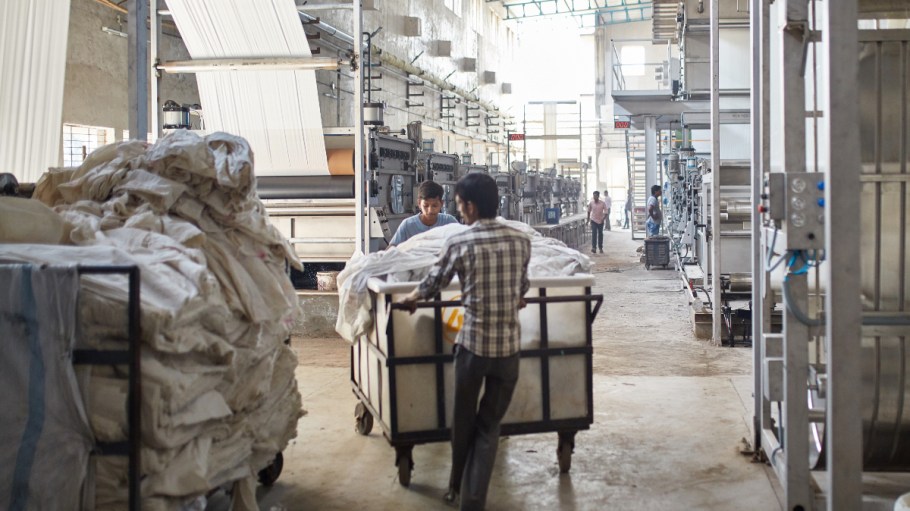
After bringing production to a halt for seven days, spinning mills in Tamil Nadu in the small and medium sector said that they will begin work on Saturday.
Tamil Nadu spinning mills said they’d resume production Saturday after a seven-day shutdown.
The development came after the small and mid-size yarn producers met with the state chief minister on Friday.
Tamil Nadu, India‘s tenth biggest state and sixth most populous, is home to more than 2,000 mills, and about 46 percent of South Asian nation’s micro small and medium mills. The state’s apparel-exporting powerhouse, the knitwear specialist Tirupur, cranks out 75 percent of the knitted garments, 25 percent of weaving and 45 percent of made-up textiles.
Related Stories
The sector directly employs about 6 million people and generate exports earnings over 750 billion rupees, approximately $9.14 billion.
The Tamil Nadu’s Micro Small and Medium Scale Enterprises (MSME) sector spinning mills had halted production to protest crippling daily losses of more than 100,000 rupees or approximately $1,218.
S. Jagadesh Chandran, secretary of South Indian Spinners Association (SISPA), told Sourcing Journal that central government officials will meet with the mills shortly.
He said the mills’ situation would be discussed with Tamil Nadu’s chief minister and aid would be provided to the sector.
The spinning mills want the government to drop an 11 percent import duty on cotton, which has resulted in 15 percent higher prices for domestic cotton. This is fueling export losses, putting India at a disadvantage compared to neighboring countries.
The fiscal year ended March 31 saw exports of cotton yarn fall about 50 percent and cotton textiles down 23 percent.
Warning that some mills might close for good, Chandran said spinning mills nationwide are running well below capacity amid slumping export orders for yarn, fabric, and finished garments. Bigger yarn mills aren’t immune to the trouble, with many running at 50 percent capacity in the past seven months, he added.
While mills had sizable stocks of coarse yarn, apparel manufacturers are having a harder time customizing yarn, he continued. “There has been a decline in orders for exporters already, and so the supply excess is already there for the mills,” Chandran said.
In a joint media conference last week, SISMA, ISMA and Open End Spinning Mills Association (OSMA) said they made the “unanimous” decision to stop production to curb the mounting losses.
According to G Venkatesan, vice-president, SISPA, the shutdown affected 3.5 million kilograms of daily yarn production, and 1 million workers livelihoods.
G Subramaniam, president of India Spinning Mill Owners Association (ISMA), pointed out that mills were having problems repaying bank loans, managing high electricity bills and settling taxes for goods and services taxes. Energy costs are rising in Tamil Nadu, with several rate hikes over the past year. He said mills needed banks to provide better financial support. Interest rate hikes, which surged several percentage points up from 7.5 percent, are another area of concern.
In a joint memorandum by seven state associations to Thiru Thangam Thennarasu, the state minister for finance and electricity, the groups appealed to save the state’s distressed textile sector.
“The textile Industry in Tamil Nadu has been facing unprecedented losses for the past several months. For the first time, in the last 20 years, exports of yarn and textiles have declined by around 28 percent. There is a great fear among the spinning mill entrepreneurs that the industry will face a situation, where it would not be able to operate the mills in future on the reason of continuous financial unviability,” they wrote.
“As the mills are forced to incur huge and heavy losses, they are unable to meet the administrative expenses like bank loan repayment (principal and interest), cotton purchase payments, electricity bills, [g]oods and service tax and other payments,” they continued. “Therefore, the mills are at a very critical situation during these months and they are almost placed at a standstill situation. If this situation continues, even for a month, the spinning mills will soon become non-performing assets (and the mills will be at risk of permanent closure.”
Textile and apparel exports from India fell 15.26 percent to $8.4 billion in the April-June quarter this year, from last year’s comparable $9.9 billion.
Exports are down 13.23 percent for textile and down 17.72 percent for apparel during the period.
Exports of cotton yarn/fabs./made-ups, handloom Products etc. fell 12.83 percent for the same time period, according to figures from the press information bureau.
“Spinning mills stopped because not getting the price realization they want. They’re hoping there will be a price correction in the yarn,” Chandrima Chatterjee, secretary general, Confederation of Indian Textile Industry (CITI) told Sourcing Journal.
“There is a serious need to introspect,” she added. “The volatility in garments is worrisome, but I feel more worrisome is the textile decline because that is intrinsically more stable, it has high entry points and entry exits, so it should not be so volatile.”
“Cotton is a commodity and will have fluctuations, but we have to find ways to de-link this from value-added sectors like textiles or garments. Basically, we need to create a better hedging mechanism to prevent these kind of shocks,” she said.
The lack of demand has affected manufacturers nationwide. In the Tirupur cluster, for example, sluggish demand sent sales down 4.49 percent year-on-year to $4.26 billion in fiscal year 2022-23, manufacturers said.
While Chatterjee acknowledged the “demand issue,” she pointed to the “price and availability” challenges as well, asking, “How to make it more stable?”
Industry analysts believe the situation is solvable, urging more consolidated policy for the entire industry, from the cotton to the spinning mills, textiles producers, and apparel manufacturers, as a whole.