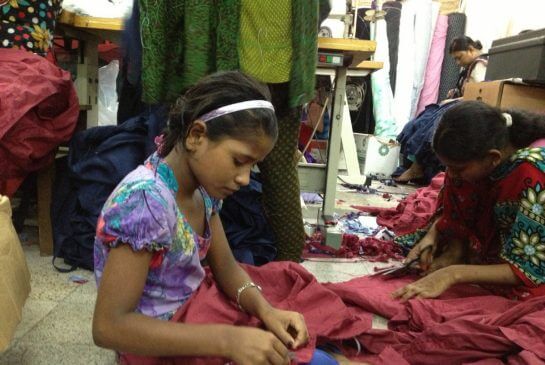
Earlier this year, in my role as the CEO of The Centre for Child Rights and Business, I visited a packaging and printing workshop in Karachi, Pakistan, in a rundown neighborhood. The owner proudly showed off boxes produced for a German retailer. Despite outdated machinery and a lack of basic health and safety standards, the quality of the cardboard and printing was impressive. What was even more striking was that the cardboard was made from recycled materials, gathered by local children who, unable to attend school, contributed to their families’ incomes by collecting and processing paper scraps.
Related Stories
Around the same time, our team in the DRC visited 13 children working in artisanal mines for cobalt and copper. The cobalt they produced would be sold to global refineries and ultimately end up in products like electric cars, e-bikes and mobile phones. Meanwhile, our team in India helped reunite children who had been trafficked to work on tea plantations, far from their families.
These stories share a common thread: a lack of visibility and engagement in the upstream parts of supply chains, which allows such violations to occur.
It’s easy to turn a blind eye to human rights violations when the connection to global supply chains is distant or murky. But this neglect has perpetuated human rights abuses for decades. Although increasing scrutiny has been placed on direct suppliers, the practices of those further down the chain—the “upstream” actors—remain largely overlooked, as has the interdependent and exploitative relationship that holds together the formal and informal actors, driven by unfair purchasing practices higher up and bound together by political and economic decisions made thousands of miles away. Decisions such as the cancellation of supply chain child labor programs previously funded by the US government and the EU’s pushback on stringent supply chain regulations threaten to weaken existing child labor regulations and reduce companies’ responsibility to ensure fair practices in lower tiers of the supply chain.
What’s deeply concerning about these trends isn’t just the loss of child labor programs or the potential dilution of European laws. Rather, it’s the message these changes send to companies: that it’s acceptable to overlook the conditions in lower tiers of supply chains; that their contribution is somehow too far removed to warrant accountability.
In the early 2000s, businesses learned that the conditions under which products are produced matter to consumers, lawmakers and courts. Many companies invested in supply chain compliance, but simply put, because these investments did not tackle the unfair purchasing practices and include lower-tier producers who experience most of the risk, for many of the communities that produce the raw materials and ingredients behind the products, there was little to no meaningful progress.
There is a visible fatigue among many businesses and industry experts on whether it will be worth pushing the same arguments, and if a change in the current political context is at all possible. In these moments, it’s important to remind ourselves that under no circumstances should we tolerate companies and their suppliers ignoring lower tiers and failing to adopt fair purchasing practices and investments that can actually lift communities out of exploitative working and living conditions.
We don’t just need any supply chains; we need resilient supply chains. By failing to practice accountability, we risk overlooking the degree to which nearly every sector, business, and consumer is linked to upstream sourcing and producing communities. And when we ignore these needs, we sow the seeds of discontent, conflict and migration.
We are living in a year marked by instability and uncertainty. Politicians across the globe seem to be failing producer communities and consumers who request fairer products. In this climate it’s even more important that companies shift from rhetoric to meaningful action and support people in the lower tiers of supply chains. With targeted actions, we can give these communities a chance to thrive. Those actions need to start with global buyers who have the power and resources to trigger change, to consider the impact of their purchasing practices, invest in the resilience of their supply chain, and join forces with peers, CSOs and, where possible, governments to take action. There are pockets of positive examples we have seen firsthand. Companies like Disney and Lidl are coming together in the DRC, Bangladesh, Pakistan and Malaysia to support child rights action hubs. Global companies like IKEA are investing in global access to decent work for youth across their supply chains, Twinning’s is engaging in paying yearly bonuses to tea pluckers to make up for imbalanced tea prices and more. Unfortunately, most of these companies do not apply these practices across their supply chain, and even more unfortunately, many of their peers are not joining in.
The resilience of our supply chains and the people who power them depends on these practices.
Dr. Ines Kaempfer is the CEO of The Centre for Child Rights and Business, a social enterprise working with brands and their suppliers to protect children’s rights and enhance human rights due diligence in global supply chains. She has been advocating for stronger protection of human rights and child rights in supply chains for close to two decades, and continues to spearhead innovative approaches that are (slowly) driving long-term change.