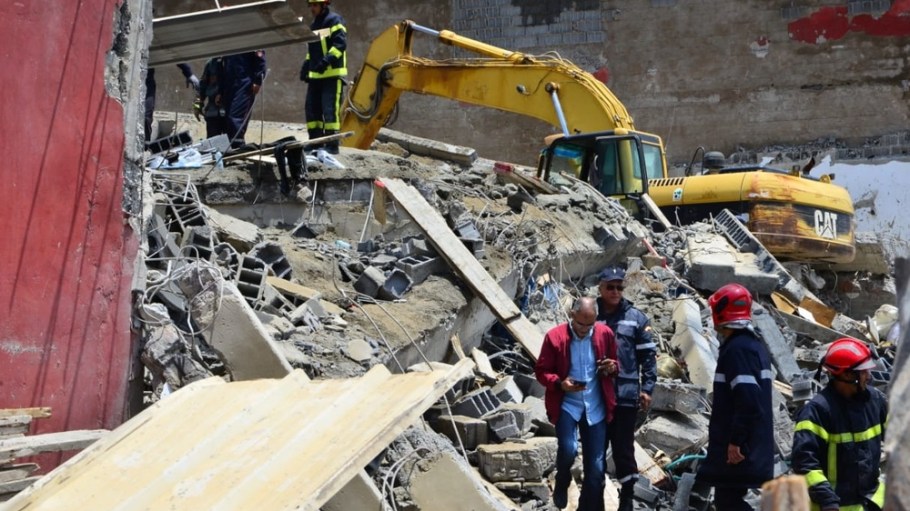
Six workers were killed on Thursday after parts of a building housing a textile factory in Casablanca, Morocco’s largest city, collapsed, a labor union reported.
The accident, which took place in the Tit Mellil industrial zone, occurred as the manufacturer was adding four new floors without taking proper safety precautions, according to Syndicat National des Travailleurs du Textile et du Cuir (SNTTC-UMT), an affiliate of IndustriALL Global Union. Three of the dead worked for the building contractor and three for the unnamed facility.
Related Stories
SNTT-UMT blamed both the construction company for its lack of oversight, as well as the officials who authorized the expansion without ensuring that legal standards were being met. It’s calling for their “prosecution and accountability,” as well as a broader national debate on occupational health and safety, one that brings together all stakeholders.
“Such a tragic accident was not the first of its kind,” said Al-Arabi Hamouk, general secretary of SNTTC-UMT. “It was expected that there would be a reaction from the governments since the incident of the workers who drowned in Tangiers, but things remained the same. Frequent accidents require strict control.”
Building collapses and other disasters happen with some frequency in Casablanca, where dilapidated infrastructure, corruption and neglect have contributed to hazardous accommodations in one of North Africa’s most densely populated cities. The Economic, Social and Environmental Council estimates that some 2,000 work-related deaths take place in Morocco every year, “one of the highest figures” in the Middle East and North Africa.
The International Accord for Health and Safety in the Garment Industry, the successor to the Accord on Fire and Building Safety in Bangladesh, named Morocco as one of four priority countries for an expansion of its programs, with the others being Sri Lanka, India and Pakistan. Pakistan was ultimately picked as the first country outside of Bangladesh to benefit from the Accord’s legally binding mechanism. It now has more than 60 signatories, including H&M Group, Uniqlo owner Fast Retailing and Zara parent Inditex.
Christie Miedema, campaign and outreach coordinator at the Clean Clothes Campaign, the garment industry’s largest consortium of trade unions and labor organizations, said that Morocco has been on its radar since 2021, when the group’s online tracker logged four major accidents, including the flooding at Tangiers, where a 14-year-old girl was among the nearly 30 workers who died.
Working conditions in Morocco can be grueling, too. A study conducted by SETEM Federation found that nearly half (47 percent) of the workers surveyed toiled for more than 55 hours a week for an average of 250 euros ($270) per month. Roughly 70 percent lacked labor contracts and up to 88 percent said they did not have the freedom to unionize.
As the acceleration of fashion cycles has led retailers to move production closer to their European markets, Miedema said it’s clear that the Accord’s safety program should “go where the brands go.” Morocco’s biggest destinations for its garments and textiles, which account for 15 percent of its industrial GDP, include France, Spain, Ireland, Portugal and the United Kingdom.
“Workers in Morocco and other high-risk production locations cannot wait years for a next step,” she said. “They need safe factories now and therefore we urge brands sourcing from any country with prevalent unsafe factory conditions to prioritize bringing the Accord program to their workers.”
Dominique Muller, policy director at U.K. advocacy group Labor Behind the Label, has noticed a “nearshoring” trend toward countries like Morocco, Tunisia and Turkey. This ramped up during the Covid-19 pandemic, when snarled supply chains in Asia created bottlenecks and higher shipping costs. In 2022, Morocco exported 3.8 billion euros ($4.1 billion) of textiles to the European Union, up 37.5 percent from 2.6 billion euros ($2.8 billion) in 2021.
“Morocco is top of the list for fast fashion brands moving out of Leicester in the search for lower wages,” Muller said, referring to the English manufacturing hub favored by domestic fast-fashion brands like Boohoo. “This preventable tragedy shows how the search for profit can kill and injure workers. Morocco is no stranger to tragedies like this and brands need to support suppliers who are trying to do the right thing and not simply focus on their profit.”