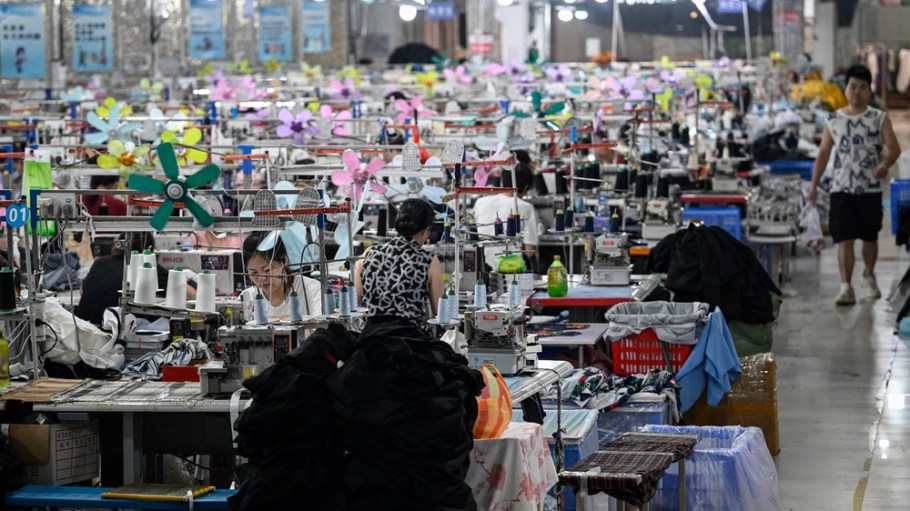
Shein plans to invest more than 10 billion yuan ($1.4 billion) to bolster the development of a so-called “smart supply chain system” in China’s Guangdong Province, where much of its manufacturing prowess is centered, the e-tail Goliath’s founder and CEO, Xu Yangtian, said in a rare public speech that was livestreamed on Tuesday.
Thanking government leaders at the Guangdong High-Quality Development Conference in Guangzhou, Xu credited the province for creating the “world-class business environment” that has been “at the foundation of Shein’s rapid growth” since 2014, culminating in export volumes exceeding 100 billion yuan ($14.4 billion) with sales spanning apparel, footwear, beauty and home goods and operations across more than 160 countries and regions.
Related Stories
“From garment factories in Panyu, to logistics hubs in Baiyun, to the cross-border ecosystem spread across the province—these form the core support for our small-batch, fast-turnaround model,” the typically low-profile executive told an audience that included Guangzhou Party Secretary Huang Kunming and Guangdong Province Governor Meng Fanli. “From design to delivery into a customer’s hands, we have compressed the cycle to two to three weeks. This reflects the extreme efficiency of Guangdong’s apparel supply chain and the high-performance delivery of its international logistics system.”
The Singapore-headquartered firm, founded in the eastern Chinese city of Nanjing, has “devoted itself fully” to improving Guangdong’s manufacturing ecosystem, Xu said, including by extending digital factory tools across the supply chain and establishing the Center of Innovation for Garment Manufacturing as a shared training and testing space.
Doing so has allowed Shein to provide jobs to more than 600,000 people across 10,000 suppliers, he added, marking the first time the company has explicitly disclosed its manufacturing size following a 2023 Temu lawsuit alleging that Shein forced more than 8,300 suppliers in the region to sign agreements blocking its rival.
But Xu said that Shein also wants to deepen its participation in “cross-border e-commerce and industrial belt” pilot programs over the next three years to help more small- and medium-sized companies benefit from the “digital transformation of traditional manufacturing” that has contributed to the company’s global dominance, building a “world-class fashion industry cluster” that will hone Guangdong’s multidisciplinary talent and enable the province to “go global steadily and sustainably.”
Shein’s success comes down to its “deep integration” of manufacturing and services that uses digitalization as a “connective thread” to incorporate consumer insight, supply chain responsiveness and global services into the full manufacturing chain to shore up speed and precision, Xu said.
“On the manufacturing side, demand has become the core engine driving production,” he said. “Under the small-batch, fast-turnaround model, we apply technology and digital tools to monitor global fashion trends, predict industry directions, and translate fragmented market demand into frontline production instructions. On the services side, we have incorporated cross-border logistics, localized operations and the manufacturing process—using real-time market sales trends to guide factories in allocating production on demand, dynamically adjusting logistics delivery and task distribution across the full chain.”
Xu’s emphasis on Guangdong as “Shein’s roots,” along with his promise to “grow together with this land,” marks a sharp turnaround for a business that has sought to distance itself from China amid increasing U.S.-Sino tensions in recent years, including by moving to Singapore in 2022 and seeking a public float in New York, then London, as part of its global rebranding.
When President Donald Trump, upon his return to office last year, started stacking extra tariffs on China, and later tossed out the de minimis exception for small-value parcels, Shein reportedly coaxed its Chinese suppliers to move to Vietnam, even offering to help them build plants there.
With its IPO ambitions now angled toward Hong Kong, which would require approval from Beijing, however, cozying up to China might be a strategic move, said Neil Saunders, managing director of retail at GlobalData, a business intelligence platform. Last August, Bloomberg reported that Shein was mulling moving its headquarters back to China to bump up its odds.
“Shein has found itself in something of an isolated position of late,” Saunders said. “There isn’t much love for it from the EU, with regulations and investigations being stepped up. And the U.S. is rather ambivalent and is not favorably predisposed to cheap imports. So, it is hardly surprising that it is looking to get China on side. The way to do this is to focus on investment and to help create jobs and prosperity in the country, which is part of what this investment is about.”
Disquiet on the Western front
Indeed, backlash against Shein’s cut-price churn and opaque operations—exacerbated by allegations of sweatshop conditions—has reached an inflection point in the West.
In the United States, bipartisan lawmakers questioned whether American customers could be inadvertently purchasing apparel made in part with cotton grown, picked and processed using forced labor in northwest China’s Xinjiang Uyghur Autonomous Region. And just as rumors of Shein’s IPO were reaching their peak in 2024, they demanded that the Securities and Exchange Commission require additional disclosures about its ties to the Chinese Communist Party or scuttle its public listing altogether.
The French government, following the discovery of illicit weapons and childlike sex dolls on Shein’s website, hauled the e-tailer in front of a Paris tribunal in December to ask for a temporary suspension, though the maneuver ultimately failed for being a “disproportionate response.” Its offensive against ultra-fast fashion as a whole—and Shein in particular—is far from over, however, with eco-taxes, a ban on advertising and sanctions against influencer campaigns among the provisions brewing in an upcoming law.
Earlier this month, European regulators opened a formal investigation into Shein for violating the bloc’s digital platform rules through “addictive design,” a lack of transparency around how it recommends products to consumers and the sale of illegal products that could constitute child sexual abuse material. This is in addition to the millions of euros in fines the company has amassed from government watchdogs in France and Spain, which accused it of misleading consumers on discounting and sustainability-related claims.
Xu’s speech can thus be interpreted as a “peace offering” to Beijing, said Kevin Lyons, a professor of professional practice specializing in supply chain operations at Rutgers Business School. To get the green light from China Securities Regulatory Commission for a Hong Kong IPO, Shein needs to prove it is a “loyal” domestic player, he said. Investing billions into local factories and logistics is a “good way to prove loyalty.”
There’s also more than a little bit of “hedging against global headwinds,” Lyons said. In other words, the move may not be only a matter of politics; it could be “as simple as survival,” as he put it.
“Between the U.S. ending the de minimis tax loophole, which allowed Shein to ship small duty-free packages, and mounting EU tariffs, Shein’s ultra-cheap model is under fire,” he said. “So, this could be a pivot. By upgrading to what is called ‘intelligent’ supply chains in Guangdong, they are trying to squeeze even more efficiency out of their ‘small-batch’ production model to offset those rising global costs.”
According to Euromonitor data, although the United States remained Shein’s largest apparel sales market in 2025, sales value fell by 4.5 percent, underscoring the company’s need to diversify.
Even so, this isn’t only a Shein story, but a broader one about China that reveals the superpower’s ambition to expand e-commerce as a beachhead for infiltrating Western markets despite mounting trade barriers, said Sheng Lu, professor of fashion and apparel studies at the University of Delaware. And if the company is to continue its data-driven, on-demand production model, it will require suppliers to be increasingly nimble, flexible and able to produce a wide variety of products in small batches.
“Few places outside of China can meet these requirements due to more limited capacity in raw material supply, logistics and skilled labor,” Lu said. Still, there are caveats aplenty. Many of the pressures Shein faces are “structural and policy-driven, rather than purely operational,” he added. To put it another way, investing in faster production cycles or building a “smarter” supply chain will not automatically alleviate these regulatory concerns.
Ahead of an upcoming sixth round of U.S.-China economic and trade talks, the countries’ relationship remains fraught, though China could tamp down some of its countermeasures to U.S. tariffs after the Supreme Court’s annulment of the previous “reciprocal regime” lowered its levy to 10 percent. Still, there’s a risk that Shein’s cozier relationship with Guangdong could backfire.
“It is clear that Shein will invest in better supply chain processes, which means they will be faster to market and faster to customize items to consumers’ wishes,” said Yossi Sheffi, the Elisha Gray II professor of engineering systems at the Massachusetts Institute of Technology. “Of course, getting closer to Beijing may raise the ire of the administration and they may face higher tariffs.”
Xu, for one, was unequivocal in his praise for Guangdong’s “outstanding business environment.” Every step of Shein’s growth, he said, has been “nurtured by this land of Guangdong.” Xu further stressed that the e-tailer’s commitment as a “supply chain anchor enterprise” will “only grow stronger.”
“When we first arrived in Guangzhou, leaders at the provincial, municipal and district levels proactively came to us to coordinate supply chain resource connections and implement supporting policies,” he said. “This style of service—unobtrusive when unnecessary, responsive when needed—gave us the freedom to act boldly and reinforced our confidence in placing our supply chain headquarters in Guangzhou.”