When Team U.S.A. marches into the Arena di Verona on Sunday to raucous applause, bidding arrivederci to the Milan-Cortina Olympics like modern-day gladiators, a sleepy suburban enclave in New Jersey might be cheering loudest of all.
It was at the aptly—though coincidentally—named Better Team U.S.A. in Clifton, more than 4,000 miles from the northern Italian city, that a 20-person team meticulously crafted all 232 closing-ceremony puffer jackets in a 16,000-square-foot workspace. This detail often surprises those who hear it; many assume that most apparel manufacturing has long decamped overseas. New York City’s once-thrumming Garment District, just across the Hudson River, is now described as a shadow of its former self. How did New Jersey become part of the conversation?
Related Stories
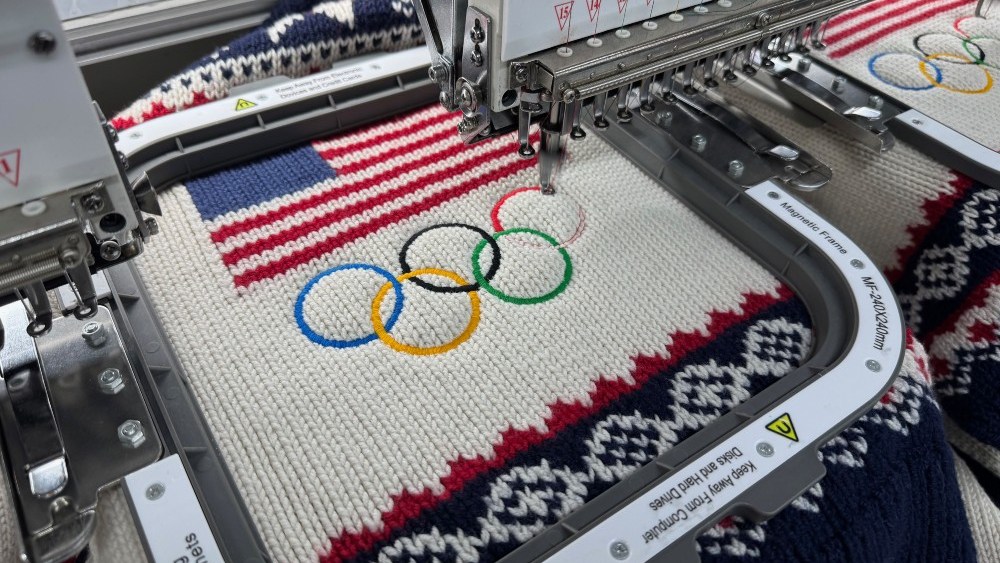
“Every single one was made here,” said Martin DiBattista, president of Better Team U.S.A., a multi-generational business that began with DiBattista’s grandfather, who immigrated from Italy in the 1950s, but whose current iteration is just over a decade old. “We touched every single jacket, counted all those zippers, did all the embroideries, overcame all the challenges to get them out so Team U.S.A. can proudly represent our country and be comfortable in—I mean, they look like comforters.” And the colors? Red, white and blue, of course.
Better Team U.S.A. came into its own just as perennial Olympic outfitter Ralph Lauren was being pilloried in the press for manufacturing the 2012 London Games uniforms in China. The apparent faux pas touched off a political firestorm that prompted then-Senator Robert Menendez of New Jersey to introduce the Team U.S.A Made In America Act of 2012, which would have required the U.S. Olympic Committee to procure only uniforms “sewn or assembled” stateside.
“At a time when too many Americans are looking for work, and our manufacturers are closing factories, we need to do everything we can to keep jobs in America and not give the work of producing our iconic American uniforms for our Olympians to China,” he said. “I call on my colleagues to help pass this bill to ensure we don’t find ourselves in this appalling, embarrassing situation before the opening of the Sochi 2014 Winter Olympics.”
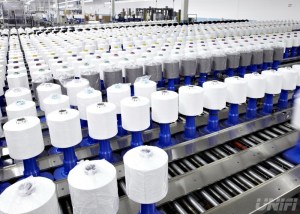
The bill didn’t become law, but Ralph Lauren followed its intent. As far as challenges went, it was a towering one. As late as the 1970s, more than 90 percent of clothing sold in the United States was made in the United States. With the advent of globalization and neo-liberal trade policies, that number has fallen precipitously to a mere 3 percent today. The search for domestic wool ranches, yarn mills and cut-and-sew shops that had the capacity and capability to meet Ralph Lauren’s rigorous standards sent its sourcing team far afield to places like Port Washington, Wisconsin; Gastonia, North Carolina; Stafford, Connecticut; Wasco County, Oregon—and Clifton, New Jersey.
DiBattista got the call to make the Winter Olympics jackets for the 2018 Games in PyeongChang, then for the 2022 Games in Beijing and now, in a full-circle moment for his family, for the 2026 Games in their ancestral homeland. It’s not his “first rodeo,” he said, but neither does it ever get old.
“Every time the Ralph Lauren promotion comes out, we get excited,” DiBattista said. “Those are our jackets. And it’s still, like, how crazy is this? This is stuff that the whole world is kind of looking at.”
A ‘tough transition‘
No matter how many variations it takes, there’s no mistaking Ralph Lauren’s instantly recognizable aesthetic: somewhere between New England prep-school chic and rustic Western Americana. But even “made in the U.S.A.’s” loudest proponents have to admit that the industry is struggling. President Donald Trump, whose aggressive tariff policies were designed to reshore manufacturing, said last May that he wanted to bring back “chips and computers…and tanks and ships” and was “not looking to make sneakers and T-shirts.”
The decline in demand is something that siblings Ilona Wang and Wei Wang, owners of Andari Fashion Inc., a 35-year-old knitwear factory founded by their Taiwanese immigrant parents in the Los Angeles suburb of El Monte, have lived through.
“In the early ‘90s, a lot of big-name brands like Calvin Klein, J.Crew and Liz Claiborne were produced in the U.S.,” Ilona Wang said. “And then the offshoring started in the mid- to late-90s, and it was a tough transition for us for many years.”
Even so, Andari found clients who valued making products closer to home, allowing it to transition from large-scale production to serving higher-price-point buyers seeking smaller quantities with better materials. Among them is Ralph Lauren, which, aside from tapping the Wangs for the hefty wool sweaters and tasseled beanies that have appeared at the Olympics since Sochi, has also relied on them to produce items for its main, consumer-facing range.
“Right now we’re working on the U.S.A. flag sweater, and that’s seasonless—basically year-round,” said Wei Wang. “That really helps a lot; it keeps our battery running continuously.”
Not that the work for the Olympics ever stops for the company’s 100 3D and flatbed machines—or its equal number of employees. With all of the designing, sampling and production that needs to happen, the two-year gap between Winter and Summer events is barely enough. Already, Andari is laying the groundwork for the ceremonial items that will debut at the 2028 Summer Olympics, which will take place in L.A. Knitting panels for a single sweater takes a machine about 50 minutes, after which each panel is inspected for defects. The assembly process can take another 30 minutes or more. Then, the garment is washed, dried, pressed and labeled.
“Typically, the creative process starts about a year and a half before the Olympics. It takes time working with the design team,” Ilona Wang said. “We get some requests on the initial designs, and we’ll test different materials, different knitting structures, different patterns and body constructions. They’ll see a lot of test panels based on their ideas and then once they review all the possibilities, the design team will finalize the design.”
Finding a future in tech
Gabrielle Ferrara Rose, president at Ferrara Manufacturing in New York City, knows that T-shirt manufacturing isn’t coming back to America. Labor and operating costs in the country are simply too high to compete with cheaper sourcing destinations in Central and South America, Asia or Africa. To go toe-to-toe with the global South, U.S. manufacturers will have to find a different value proposition based on wider margins and improved efficiency.
“We like to make beautiful clothing, but we’re also really excited about the technology and innovation that could be applied to clothing,” said Rose, whose parents founded the company in 1987 in the Garment District before investing in 70,000 square feet of manufacturing space in Long Island City in 2020. The story of “Made in the U.S.A.,” which Ferrara Manufacturing has translated into toggle coats, racing jackets and other items for Ralph Lauren for the Olympics since 2014, is important not only for its patriotism and craft, she said, but also because the apparel industry has historically served as a testbed for broader innovation.
“So 3D printing and robotic sewing, for example, can be tested out in the apparel industry, and then applied to other industries after we’ve worked out the kinks,” Rose said. “If you think about any other major industrial country, where did they start their industrial revolution? Apparel and textiles. So if we don’t have that as a base, if we can’t make clothing in our country, then forget about microchips and superconductors.”
To stitch the lapels on Ralph Lauren’s jackets, for instance, Ferrara Manufacturing used a 3D-printed automatic sewing jig that “digitizes the tailoring experience,” reducing human error and speeding up the process. As a result, its outgoing expenses have shifted from traditional manufacturing costs to R&D. Another plus: Doubling down on technology enables the factory to onboard people with less experience.
“The average tenure at our company is 10 years, but we have been able to bring on a lot of new talent that can be introduced to manufacturing and grow at our company because of the technology,” Rose said.
In Clifton, Better Team U.S.A. has big ambitions to modernize garment production in a state that DiBattista said offers a “Goldilocks” situation, thanks to commercial incentives and proximity to New York City without the spiraling rents. DiBattista also stumbled upon an unexpected network of cutting rooms and other manufacturers that he didn’t know existed, but he became aware of during the pandemic when he was looking for help making reusable medical gowns. (“We all work in silos,” DiBattista said.)
The company is now planning to add a second floor to the building, which it will fill with programmable sewing machines and other forms of robotics to complement its 3D modeling and digital pattern-making prowess.
“The future for us is to compete,” DiBattista said. “And for us to be able to compete in manufacturing, we have to use technology, robotics and digitization, so that’s what we’re trying to pioneer.” His vision is to build a “next-generation manufacturing platform” that will include Better Team U.S.A.’s factory partners and, in doing so, collapse those silos and allow everyone to get more work.
Protecting American manufacturing
Ralph Lauren appears to understand that creating a foundation for fashion manufacturing in the United States is key to future-proofing it. For several years, the brand has partnered with the Council of the Fashion Designers of America to help manufacturers in New York City pay for workforce training, capital improvements and relocation costs. In January, it announced two new grant programs—one for manufacturers in New York City and another for their counterparts nationwide—to “modernize equipment, expand services, train workers” and otherwise “build the capacity and resilience of American fashion manufacturing.”
“This is not only an investment in our industry; it’s an investment in a vital part of American culture that we share with the world,” Katie Ioanilli, chief global impact and communications officer at Ralph Lauren, said at the time.
One thing that hasn’t brought about the promised manufacturing revival is tariffs. The Wangs in Los Angeles received an initial surge in interest—“last year, we were basically getting emails and calls on a daily basis, non-stop,” Ilona Wang said—but the still-higher cost of domestic production still spooked many buyers.
“I think it takes a certain type of client to be able to produce here in the U.S.,” she added.
Input costs have also risen for suppliers who rely on imported components that are difficult or impossible to find stateside. The extra duties can result in a death spiral where bigger price tags force more buyers to look overseas.
Still, there are ways policy can bolster manufacturing, said Rose of Ferrara Manufacturing. As a recipient of military contracts, she’s a “big, big supporter” of the Berry Amendment, which restricts the Department of Defense from buying clothing and textiles that aren’t produced in the United States. (The Kissell Amendment imposes similar guardrails on Department of Homeland Security procurements, albeit with more foreign exceptions.) But it could go further, say by requiring other departments or even federal contractors to follow suit.
“The United States government is one of the largest potential customers for U.S. manufacturing,” she said. “So being able to buy more clothes, buy more textiles here in the United States through any policy is really important to keeping our industrial base alive.”
Keeping with tradition
Not everything has to involve gleaming, bleeding-edge equipment, however. The sweaters that are a standby of the Winter Olympic uniforms come from an entirely organic source: sheep. They’re courtesy of an Oregon-based farming group that connected with Ralph Lauren in 2014 despite initial crossed wires.
“It came about with a phone call out of the blue; they had their product development research team member looking for partners in the United States to make clothing items,” said Jeanne Carver, founder of Shaniko Wool Company, part of her family’s Imperial Stock Ranch. “I had yarn in about 500 stores across America branded with our ranch’s name, and they had come across that and called me, and I thought they were from a yarn store. In fact, I asked the gentleman, ‘Which yarn store are you with?’ And he said, ‘Well, I’m not with a store. I’m with product development for Polo Ralph Lauren in New York.’”
A month later, Ralph Lauren sent a team of designers from New York City to the ranch in the high desert of the Beaver State. The creatives toured the grounds, met the animals and luxuriated in the soft skeins that lined the walls of the historic 1900 ranch home that serves as the company’s headquarters. Six months later, Carver got the “largest yarn order of my life until then” without knowing what it was for. Later, she found out it was the 2014 Winter Olympics uniforms.
In the years since, Shaniko Wool Company has become Responsible Wool Standard-certified—a point of pride that Ralph Lauren calls out in its marketing materials. The partnership has also allowed Carver to expand, partnering with other ranches across the Western United States, including Colorado, Wyoming, Utah and California. Those partners have similarly invested in regenerative agriculture practices—which Carver describes with great enthusiasm—such as targeted grazing, increasing ground cover and the use of manure as fertilizer.
Because of the global market, it isn’t easy selling wool in America, she said. Having certification helps secure Shaniko Wool Company’s position as the country’s leading certified wool purveyor. But so has its association with Ralph Lauren and the Olympics.
“This connects all of us to our Olympic team with those products,” Carver said. “We all feel part of it. My post office, my UPS driver, my banker, family, the people at the library—everybody in your life, everybody in the state of Oregon feels connected.”