A longtime retail operator-turned-tech CEO is betting that agentic AI can replace spreadsheet-heavy planning by turning market data into weekly, profit-linked merchandising decisions.
“Built for retailers by retailers,” touts CEO and co-founder Dr. Mark Chrystal, regarding agentic AI-powered retail decision intelligence platform Profitmind which has raised $9 million in a Series A financing round led by Accenture Ventures.
The funding will be used to scale the platform to more retailers globally, expand its product capabilities and hire additional staff.
Related Stories
Prior to the round, 12 retailers across apparel, footwear, auto parts and home goods signed up to use the platform. But the company now has 100 merchants that have expressed interest in leveraging the technology, which assists retail teams in making decisions across price optimization, merchandising, assortment planning and marketing.
Profitmind is designed to replace manual retail planning and analysis cycles that can often include tedious Excel spreadsheets. According to Chrystal, the tech solution is helping drive merchandising decisions for retailers ranging from $20 million to $100 billion in annual revenue.
“We need merchants who understand product, fabric, sourcing and the customer. They shouldn’t have to be an Excel expert,” Chrystal told Sourcing Journal. “My mission with Profitmind is to get teams out of Excel, and get them out of this analysis and data wrangling. Expert merchant with expert AI equals a much better result for the business.”
The solution is built to scour the Internet, including e-commerce websites, to analyze competitive product matches, market data, search patterns, assortment information and more. Upon collecting this data, Profitmind leverages agentic AI powered by large language models to identify, quantify and prioritize market opportunities.
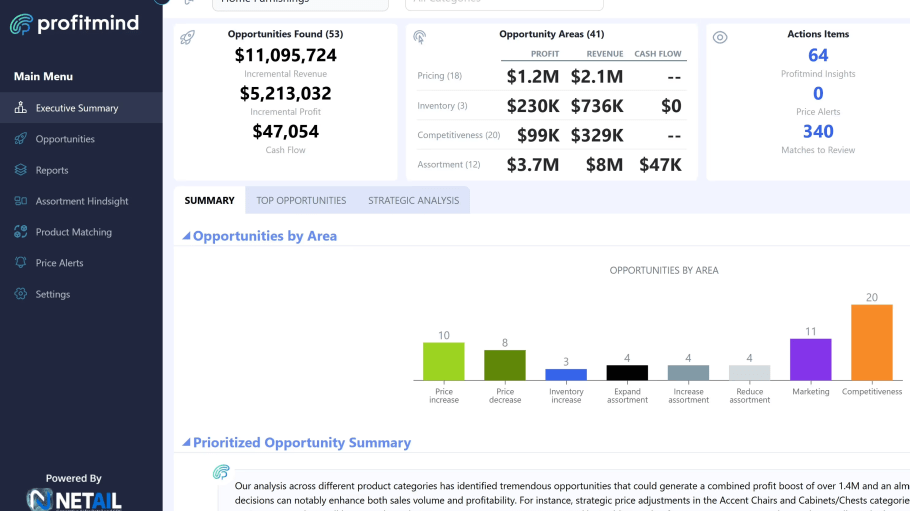
To kick off every week, Profitmind takes this data and provides retail teams a ranked set of recommended actions, such as price changes, promotion adjustments, inventory moves or assortment shifts—all tied to expected impact on sales, profit and working capital.
Once decisions are made on Profitmind’s recommendations, they are exported into execution tools, where results are tracked and measured to help improve future recommendations.
The company launched its first AI agent with a Netherlands-based retailer in summer 2023, before officially debuting publicly in January 2024.
The retail industry is believing the hype that comes with agentic commerce. Seventy-five percent of retailers say AI agents will be essential to compete in the marketplace by 2026, according to the Connected Shoppers Report from Salesforce. That study, which surveyed 1,700 decision makers, found 43 percent are already piloting autonomous AI for at least one use case.
But the technology is aimed at maximizing the human retail experience, and the ability to focus on serving the consumer, Chrystal noted. As AI becomes more pivotal in the growth of retail technologies, the co-founder believes retail expertise will be a necessity for solution providers looking to compete in the space and deliver results.
Chrystal comes from an operator background that spans 25 years in fashion and apparel, having previously served in C-level roles including chief analytics officer of Rue21 and chief supply chain officer of David’s Bridal. His resume also includes executive roles at American Eagle Outfitters (AEO), Disney Store and Victoria’s Secret.
“We’re going to see more situations where operators are able to build tools because of where AI is now,” Chrystal said. “Before, you had to have a PhD in computer science, and your whole background was in building technology, but you’ve never worked the job. You’re just building the stuff that you think they need. As a result, we’ve ended up with all these siloed systems. They’re all great, but they don’t really operate the way we do as retailers.”
Profitmind chairman Andrew Ng, who leads the AI Fund venture studio, is one of the existing backers that is reinvesting in the business.
Additional returning investors include Magarac Venture Partners and Lightscape Partners.
The company is also banking on a partnership with Microsoft to bring more customers on board, offering its services starting this spring on the Microsoft Azure Marketplace, where businesses can visit to access AI-powered apps and cloud solutions.
New investor Thorndale Farm Inc. also participated in the round.
Several individual investors also participated, including board member Mario Ciampi, who formerly served as president of Disney Store and chief operating officer of The Children’s Place.