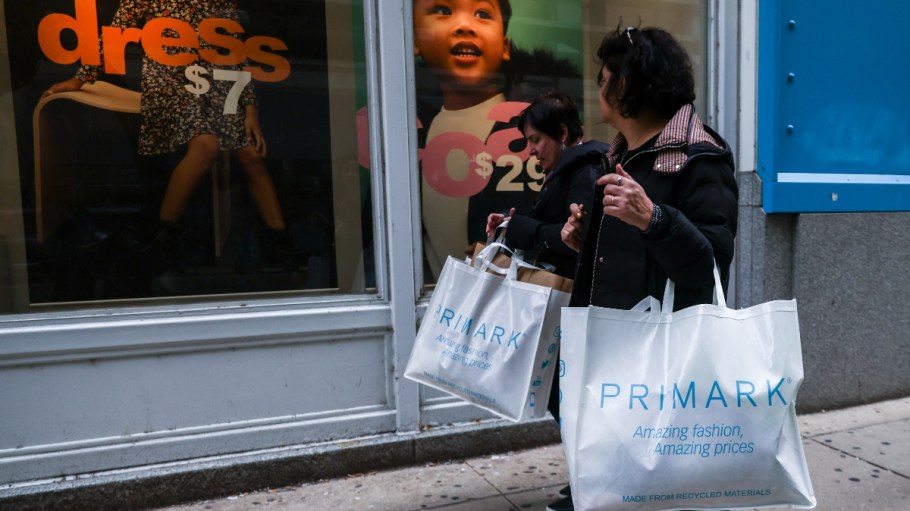
Primark‘s spot on the National Retail Federation’s (NRF) Top 25 Retailers of 2023 list illustrates the consumer focus on low-cost value. But hawking cheap goods isn’t the only ticket to success, according to layoffs at a shopping app that’s seen better days.
For Associated British Foods-owned Primark, 65 percent year-on-year growth last year and $310 million in retail sales earned the Irish fast-fashion retailer the No. 3 spot of the NRF’s retail ranking. It’s a remarkable turnaround for the store-only seller of low-priced fashion, beauty products and home goods, which suffered mightily during Covid lockdowns when e-commerce give much of the industry a boost. It eventually tested a click-and-collect pilot a year ago after traffic to its new and improved website surged 60 percent but still banks on a brick-and-mortar strategy for retail success.
Related Stories
Primark might have made some new fans when it decided to “stand by our customers” and keep prices the same last fall instead of hiking them to deal with rising costs, George Weston, CEO of the retailer’s parent company, told investors in November.
Primark’s success isn’t the only notable development from the NRF ranking.
Released last week in tandem with London-based consultancy Kantar, NRF’s list includes grocery giants in the top two slots with No. 1 Chedraui USA (which bought bargain-priced supermarket chain Smart & Final last year) and No. 2 Raley’s Supermarkets, the upmarket owner of West Coast organic and fresh-food outlets.
Zara owner Inditex saw 19.4 percent year-over-year growth with $2.6 billion in sales, earning it the No. 8 spot. Wholesale membership clubs BJ’s Wholesale and Costco—ranked No. 7 and No. 12, respectively—also saw notable gains during 2022. BJ’s reported $20.4 billion in annual sales, a 22.9 percent improvement over 2021 while Costco grew by 16.9 percent, or $23.7 billion, to reach $164.1 billion in 2022. “People are comfortable putting out the membership fee to buy into the value proposition,” David Marcotte, senior vice president of NRF partner Kantar, said.
Value-based chains and marketplaces also dominated NRF’s Top 100 Retailers list, ranking the industry’s biggest companies on U.S. retail sales. Walmart topped the list, generating $499.65 billion in during 2022, followed by Amazon at $232.46 billion, and Costco. Target took the No. 6 spot on the list with $107.9 billion in sales, while TJX came in at No. 16 at $38.4 billion. Dollar General took No. 17 with $37.87 billion in sales, and competitor Dollar Tree raked in $27.91 billion, earning it the No. 20 spot.
Mass-market and department stores ranked further down the list. Macy’s, at No. 22, generated $24.25 billion in U.S. sales last year, followed by Ross, at No. 27, with $18.67 billion, and Kohl’s, No. 30, at $17.19 billion. Nordstrom (No. 31), saw $14.35 billion in U.S. sales last year, while Gap at No. 36 brought in $13.10 million. Dick’s Sporting Goods (No. 38), Burlington (No. 51), J.C. Penney (No. 59), Dillard’s (No. 65), Foot Locker (No. 72) and Victoria’s Secret (No. 76) rounded out the specialty and department store contingent.
Wish lays off hundreds of workers
Deal-hunting consumers have propelled the likes of Primark along with Shein and Temu to lofty heights. But Wish, the shopping app that came before them, seems to be missing out on their notable success lately.

San Francisco-based Wish has run into financial trouble recently, with stumbles in quality control, shipping delays and missing products opening the door for competitors like Temu. Now, Wish said it will lay off 255 employees—about 34 percent of its global workforce—by the end of the fiscal year.
Under its corporate name, ContextLogic Inc., Wish filed a notice with the Securities and Exchange Commission (SEC) dated July 27 stating that it plans to terminate 160 U.S. employees, or 41 percent of its domestic workforce, as well as 95 non-U.S. employees who make up 26 percent of its international staff. According to the company, this will help “refocus” operations to “support its ongoing business prioritization efforts, better align resources, and improve operational efficiencies.”
Wish estimated that it will incur about $8.7 million in charges related to WARN Act compliance, severance payments, and other personnel reduction costs. The e-commerce marketplace expects to see run-rate savings of between $43 million to $46 million on an annualized basis beginning in the fourth quarter.
The workforce reduction comes amid shrinking revenue and cash holdings for the once-mighty tech startup. Wish’s second-quarter earnings report on Aug. 3 shows revenue falling 42 percent from the same period last year to $78 million. Free cash was negative $91 million, a steep increase from negative $67 million in 2022’s second quarter.
In a statement, Wish CEO Joe Yan said “macroeconomic uncertainties and competitive pressures will likely persist” through the end of 2022.
“In response to this dynamic environment and to position Wish to thrive over the longer term, we are taking aggressive actions to significantly lower our cost structure and improve our operational efficiencies,” he continued. “To that end, and with the intention of putting us back on the path to sustainable growth, the entire Wish team remains focused on further improving customer experiences and deepening merchant relationships.”
Wish’s cash and cash equivalents totaled $318 million as of June 30, down from $506 million six months earlier.
Additional reporting by Jessica Binns.