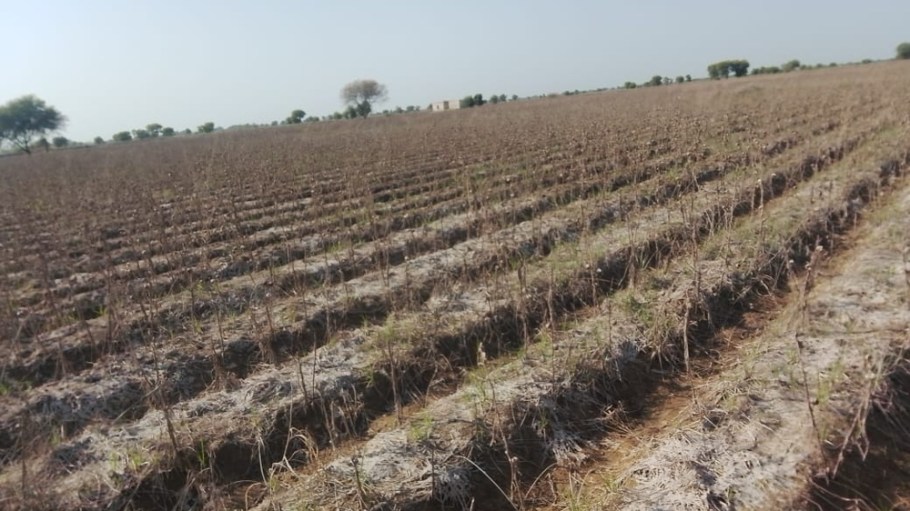
Even through a grainy video being streamed on a cellphone, the extent of the damage to Malik Dilshad’s cotton farm in Basti Shamala, a town near the Punjabi city of Bahawalpur in Pakistan, is unmistakable.
It was slightly over a month ago that the 12-acre field was awash with nodding bolls of erupting white fluff, enough to muster up nearly 16 metric tons of cotton at harvest time. Now, the 36-year-old grower, who inherited the generational plot from his father, can only wave his arm dejectedly at row after row of weak, spindly stems, the result of catastrophic floods that swept the South Asian nation’s agricultural heartland to a degree not experienced in three decades.
Related Stories
Indeed, large swathes of Punjab and Sindh provinces, both key cotton-growing districts, are still draining out. They were inundated not only from torrential monsoon rains that had pummeled the region since late June but also from melting glaciers and a cross-border surge from neighboring India, which opened the floodgates of its upstream dams to ease its own distended river banks.
Dilshad fled with his family in a panic when water started gushing into his house without warning one night in early September. The levels continued to climb, first reaching six feet, then eight, then 10 before falling to around four for the next two weeks. By the time he returned after sheltering in a government-run camp, everything was gone: his house, his livestock, his cotton. Farming is all Dilshad knows and it’s too late in the season to plant much of anything else. He has no idea what he is going to do except be consumed by further debt.
More than 8,400 houses, some 240 bridges and almost 700 kilometers of roads have been battered or destroyed by the deluge, according to the National Disaster Management Authority. The flooding has laid waste to 2.2 million hectares of cropland, devastating 60 percent of central and southern Punjab’s rice crop, 35 percent of its cotton and 30 percent of its sugarcane, a preliminary assessment by the Pakistan Business Forum found. Nearly 1,000 people, 250 of them children, have died. Another 4 million have been impacted, including 2.5 million who are now displaced.
Because it was Pakistan’s “food basket” that bore the brunt of the disaster, the financial cost of the damage is markedly worse than that of the 2022 flood, when one-third of the country, including Balochistan and Sindh provinces, was submerged at the time, said Chaudhry Ahmad Jawad, chief organizer at the Pakistan Business Forum, a trade group based in Lahore. He’s eyeballing a bill of $50 billion versus the $30 billion incurred three years ago, driving the country’s agricultural sector into a “dangerous downward spiral” that threatens both food security and rural livelihoods.
In a letter to Muhammad Aurangzeb, the federal finance minister, last month, the organization called for interest-free government loans, electricity bill waivers, fertilizer subsidies and sales tax exemptions on domestic cotton to aid with recovery. Despite the fiscal pressures of these emergency measures, it said, they will also serve as a “much-needed stimulus for the revival of the agriculture sector, enabling it to once again play its crucial role in national economic growth.”
“Next year, there’s a forecast of 22 percent more rain,” Jawad said. “Our policymakers need to admit that if they had done more to prepare for potential calamity, the damage wouldn’t have been so great. We need new, bigger canal systems—four to five—so we have a way to divert water that then can be used by the agricultural sector in the summer. And this needs to be started as soon as possible.”
Pakistani cotton, which buttresses the country’s nearly $20 billion textile industry, itself responsible for more than 60 percent of exports, stands at a crossroad. Officials had expected a bumper cotton harvest of 10 million bales, amounting to 1.7 million metric tons, this year. Now, Pakistan will have to import as many as 7 million bales to bridge the shortfall, according to the Karachi Cotton Brokers Forum. This could cost the country up to $3 billion, or double what it spent last year to haul in enough cotton from Africa, Australia, Brazil and the United States to keep its spinning machines whirring.
In a note last month, the Economic Policy and Business Development, a think tank in Islamabad, predicted that Pakistan’s gross domestic product growth will slow by 3.2 percent. The trade deficit, too, could expand by an additional $1.9 billion.
“We might be importing more at a higher price,” said Saqib Sohail, formerly head of responsible business projects at Artistic Milliners, a Karachi-based manufacturer that makes jeans for H&M Group and Levi Strauss & Co., and now head of engagement at The Microfibre Consortium, a multi-stakeholder organization. “But for the local community, they are not getting any of the benefit or the revenue of that, so the buying power overall for this sector of people is going to be affected for some time. If they’re not able to produce enough cotton, they might shift to something else or not grow anything. If there’s no way out, the next generation of farmers is not going to go into farming but instead leave for urban centers.”
The cities will not be ready to handle this deluge of migrants vying for the same finite housing and strained public resources, he said, but it’s a trend that’s growing. In the long run, farmers don’t want their children to continue what they see as a losing proposition.
“Then, as a whole country, as an apparel exporter or fabric exporter, we are in a very vulnerable position to not be able to compete,” Sohail said. “And then we also lose the advantage of being a cotton-growing country and we become similar to the likes of Cambodia, Vietnam and others.”
Confronting a new reality
Still, cotton production was already on the decline in Pakistan, at one time the world’s fourth-largest cotton producer, said Adnan Arshad, a climate-smart agricultural researcher at PODA, a nonprofit that supports rural women in Pakistan through training, education and advocacy. Getting a decent price has been a longstanding issue for farmers who are increasingly turning to crops like corn and sugarcane that are more lucrative and less labor-intensive. Any bolls that might have survived are likely to suffer from quality issues from too much moisture, which can lead to fungal growth, depressing their value further and creating further impetus for farmers to plant what they might see as a surer bet. Even the nutritional character of the soil could be altered because of the influx of sediment deposits and underground water contamination, throwing up other obstacles for cultivation later on.
In the absence of sufficient raw material, something that has already caused the ginning sector to implode, textile manufacturers could face less of an incentive to stay in Pakistan, especially when nearby Bangladesh offers reduced production costs and improved market access, Arshad said. Some mills also say they prefer imported cotton because of its superior quality, competitive pricing and, until recently, its tax-exempt status under the export facilitation scheme. At the same time, he said, there is a tremendous need from the agricultural community, both in the short and long term, from drainage pumps and protective clothing to climate insurance and other forms of risk coverage to keep cotton farmers growing cotton.
“Extreme weather events are getting more frequent and intense,” Arshad said. “And these are not crops that are in a greenhouse; they are out in the open field and quite vulnerable. If there is no water, cotton will be impacted very quickly. If there is too much water, cotton will be affected again.”
Indeed, the disaster “once again brings the reality and pace of climate change into sharp focus,” said Hina Fouzia, country director in Pakistan for Better Cotton, which bills itself as the world’s largest sustainable cotton initiative. While only 10 percent of the 230,000 cotton farmers it has licensed across Punjab have been impacted by the flooding, the full extent of the damage can only be assessed as the water continues to recede.
“Just as we did in 2022, Better Cotton will support its invaluable network of partners and licensed farmers as the floods subside and communities can start to recover,” Fouzia wrote in an email. “Our team in Pakistan also created and circulated a real-time reporting tool to enable program partners, farmers and workers to raise issues and concerns pertaining to the floods.”
The flooding could create cascading effects that will shrink cotton productivity in the years to come, especially if Pakistan remains reactive rather than proactive in addressing disasters, said Rubab Zahra, country manager for Pakistan at the Organic Cotton Accelerator, a multi-stakeholder organizer that seeks to grow organic cotton’s profile. Nearly 10,000 farmers are involved in its various programs in Pakistan, including in the Punjab region, where technical partners such as WWF Pakistan are helping on the ground. With nearly two-thirds of the nation’s population residing in rural regions and nearly 40 percent of its workforce connected with agriculture, climate change is “not just going to be a threat for the food security, but also for the livelihoods of millions,” she said.
For farmers, the land is all they have—as income and collateral—which is why it’s crucial to drum up some public-private partnerships, even some corporate funding, Zahra said. The question of who is going to shell out, besides the usual suspects like the World Bank and the International Monetary Fund, which have doled out soft loans in the past, also looms large when the government is still stabilizing its economy amid a challenging global landscape.
“Pakistan is still not there in terms of green financing, though our government has started some discussions with the Asian Development Bank and some other international donors,” she said. “Whenever disasters happen, there’s so much funding being set aside for recovery. But what about resilience building? What about climate adaptation? It’s now becoming very important and fundamental to invest in the form of farmer resilience because, otherwise, the cotton sector definitely is going to get damaged very badly, and of course, the textile sector as well.”
For Sohail, the problem Pakistan has to confront isn’t just a climate one or a water management one, but a human one as well. Fashion brands like Bestseller and H&M Group have previously come through with relief support through their philanthropic foundations, but they can also double down on committing to specific cotton volumes that distribute risk more equitably.
“People are investing money in building warming systems or long-term water storage dams or embankments, but there should also be a focus on the small landowners and farmers who rely pretty much on the income they derive from the soil to survive,” he said. “How do we turn this into a call to action, not only to look at the macro impacts but also the micro level of these people? How can we invest directly in farming communities in Pakistan?”