President Donald Trump’s constantly changing tariff strategy has created a looming cloud of uncertainty hanging over companies and consumers alike. But for off-price retailers, tariffs should help bolster their already burgeoning businesses.
The off-price sector’s ability to provide quality products at below-market prices has long enticed consumers, but that strategy could become more of a boon as shoppers fret over their wallets and traditional retail prepares to raise prices.
Related Stories
Consumer sentiment is down 13.7 percent year on year for August, according to the University of Michigan Surveys of Consumers. It declined 5 percent since July, which Joanne Hsu, the index’s director attributed to “rising worries about inflation” and “growing concerns about purchasing power.” Hsu noted that while consumers are “no longer bracing for the worst-case scenario for the economy feared in April when reciprocal tariffs were announced and then paused,” they continue to expect inflation and unemployment to worsen in the future.
Jessica Ramírez, retail analyst and co-founder of The Consumer Collective, said consumer uncertainty often sees shoppers being cautious with their dollars, which could be a perfect storm for off-price retailers.
“Outside of the discretionary categories, if I think of staples, those are still expensive—inflation is up any way you want to put it, and consumers have been dealing with it for a long time. In general, the job market is not as stable as people have thought; it’s very shaky. There are a lot of concerns that are affecting the consumer,” Ramírez said. “Off-price is the new department store. I think off-price does offer a lot of value to the consumer, and that’s where the consumer has really been going.”
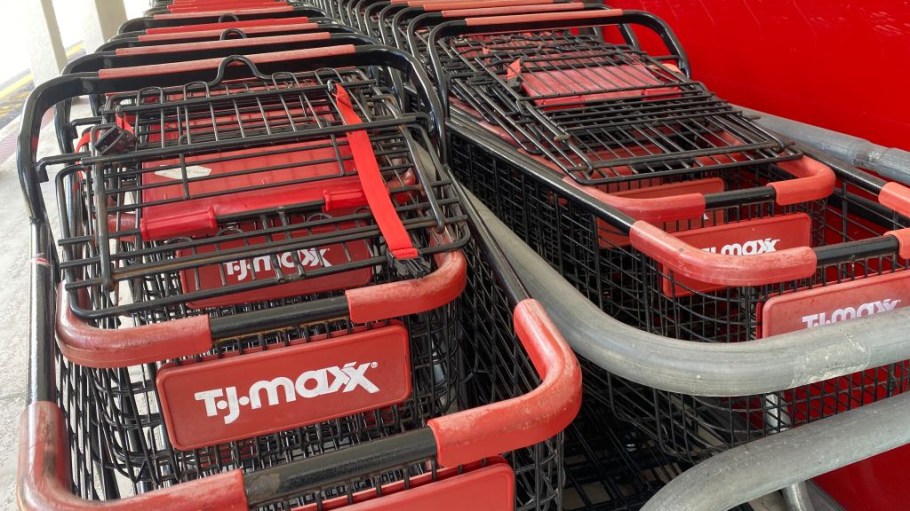
On TJX’s earnings call last week, CEO Ernie Herrman said merchandise margin stayed flat in the face of tariffs. The company raised full-year guidance, and Herrman said that projection is based on the assumption that tariffs will remain at similar rates to what they are at present.
“As for tariffs, our third quarter, fourth quarter, and full-year guidance assumes that we’ll be able to offset the incremental tariff pressure on our business this year,” Herrman told investors.
Ross Stores also delivered stronger-than-expected results, which CEO James Conroy attributed to “lower-than-expected tariff-related costs.”
Experts seem to agree that off-pricers hold the power to stave off negative business impacts coming down from tariffs. Analysts said part of the reason they expect to see off-price retailers do well, even in the face of tariffs, is two-fold: price and agility.
Off-price retailers traditionally sell items for 20 to 70 percent less than the manufacturer’s suggested retail price (MSRP) found in traditional stores. Nancy Mair, retail expert and president and founder of NCM Consulting, called that buffer off-price’s “secret sauce,” especially at a time when some legacy retailers have made it clear they plan to increase prices on goods impacted by tariffs.
Ramírez said that off-price retailers’ lower-cost strategy plays well for consumers seeking well-priced items that will last, particularly when it comes to fashion, apparel and footwear products.
“Value doesn’t necessarily mean it’s cheap. Value means that it’s quality and that it’s going to have longevity in it,” she said, noting that value gives off-pricers an advantage for consumers feeling as though the economy remains on unsteady footing.
Indeed, off-price retailers are capitalizing on the idea of value.
“Our customer surveys tell us that our value perception remains strong, and we are laser-focused on keeping it that way,” Herrman said on last week’s earnings call.
To keep consumers hooked, off-price needs to be able to deliver on trends and offer items that fit into shoppers’ budgets. Mair said off-price’s standard business model gives it a license to operate effectively in that niche.
“They really have the ability to be nimble, quick, flexible and agile,” Mair said. “They understand the ebb and flow of inventory levels and product levels; they just do it better than all other retailers. They have the ability to move back and forth and not get into a poor inventory situation.”
Ramírez said she expects to see off-pricers shift their buys according to the categories that capture consumers’ desires and needs simultaneously. She said accessories and other, small purchases are likely to continue to advance.
“The consumer has kind of been like, ‘You know what? Things are tough. Let me rebel. Let me wear a bright color. Let me live a little.’ We’ve seen a spike in that, and accessories have been really good. There’s so much going on in the news, and the consumer is like, ‘You know what? Let’s see what happens…because I want to feel good today, because everything else is falling apart,’” she explained.
Mair agreed, noting that she’s already started seeing “much bigger assortments of jewelry and things that don’t break the bank but give people a reason to spark a little bit of joy.”
And according to TJX, sourcing that kind of inventory to meet consumers’ preferences shouldn’t be an issue in the off-price market.
Herrman said “availability has continued to be fantastic” in the marketplace; that’s a sentiment he also shared in the company’s February earnings call.
Experts said part of the reason for that availability has been traditional brands and retailers’ penchant for frontloading inventory in an effort to bring items in at the lowest-possible tariff rate. That level of available inventory could benefit off-price retailers through the back half of 2025 and into 2026, said Mair.
“[Companies] definitely have fronted their fall and holiday product. I think that might create a really good pack-and-hold situation for the off-pricers at the end of this year, to have a really strong 2026. I wouldn’t say there’s going to be a flood, but there’s going to be an excess of inventory, like any time there’s a disruption in the market,” Mair told Sourcing Journal.
Ramírez said that, even if discretionary income flattens out, she projects off-price will remain a winner. She expects that they will take market share away from traditional retailers, especially Macy’s and Kohl’s. But brands catering to the consumer could start to see a leg up and become more of a threat—or at least, a peer—to off-price, she said.
“Before, we might have thought Target would have been a competitor to off-price because of those price points, but I think Gap Inc. is coming in hard,” Ramírez said.
While Mair noted that “everybody’s competing with everybody right now” in the retail environment, experts agreed that off-price poses more of a threat to traditional retail than legacy retail poses to off-price.
Mair said when she looks at today’s retail environment, Amazon and Walmart continue to cater to consumers’ desire for immediacy.
“Walmart and Amazon continue to be able to sell every type of product and get it to you quickly. That’s their formula. But off-price is more about the treasure hunt—knowing that they’re always delivering great value, it creates a sense of urgency, because there isn’t a ton of that product out there. Off-price just has that secret sauce,” Mair said.
Although e-commerce marketplaces like Shein, Temu, AliExpress and TikTok Shop offer goods to consumers at rock-bottom prices, they don’t see those companies as a threat to off-price. That’s, in some ways, attributable to Trump’s rescinding of the de minimis provision, set to take effect later this week, which has driven up prices on low-cost goods.
Off-price retailers purchase the majority of their inventory from U.S. companies that have already paid the applicable duties to import the goods, which means that they can bypass that added cost more aptly. Experts have noted that many traditional brands and retailers, which are the companies off-price retailers purchase goods from, have frontloaded goods for the latter half of 2025 in an attempt to avoid the highest tariff rates from the Trump administration.
Kelly Pedersen, partner, global retail leader at advisement firm PwC, said that could see off-price retail prices coming close to those offered by marketplaces and fast-fashion platforms.
“I think we’re going to see some product-price parity in the short term, until the tariffs really make their way through the system,” he said.
But beyond mere price, Ramírez said being able to see the quality of products in person gives the off-price sector a leg up on low-cost e-commerce marketplaces.
“Off-price still has an advantage over them. It’s in person, and it’s very much a bargain hunt. People like that bargain hunt. I think Temu and Shein, it’s an experiment—I’m not saying people aren’t shopping with it, but you’re buying something cheap. If you go into an off-price, I think consumers are looking for that value, and they know they’re going to find it.”
One caveat to all the cheer leading, could come from Resale. Bruce Winder, retail analyst and president of Bruce Winder Retail, said the increasing quality of secondhand items, paired with the storytelling that buying resale can give consumers, could entice them to purchase used rather than new. Resale marketplaces like ThredUp have been banking on that mentality as they shift their projections to reflect a new way forward under tariffs.
“[Secondhand] has become mainstream now, and one can argue that it is a version of off-price. You’re not buying new so it’s not exactly in the same category, but I bet you if you’re an off-price consumer, you’re probably considering thrift, as well,” Winder said.