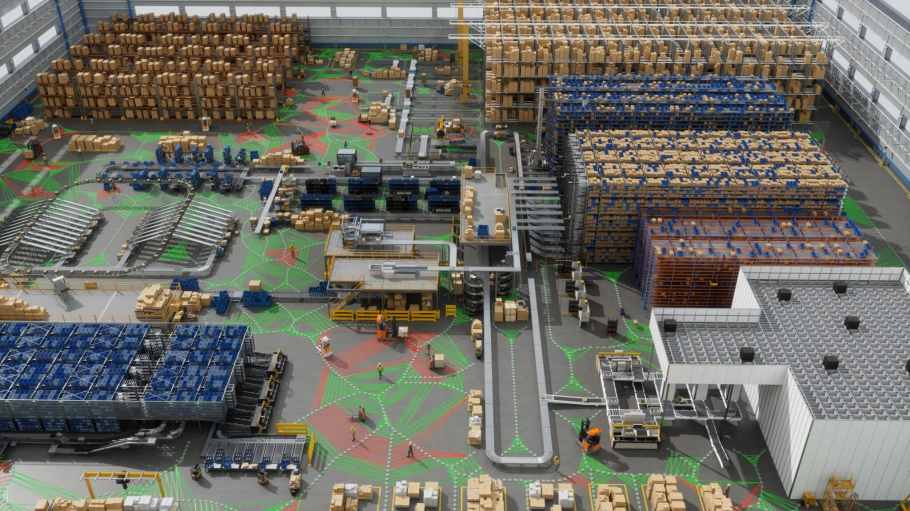
For Nvidia, the future may be in leveraging digital twin technology.
The company announced Monday at the Consumer Electronics Show (CES) 2025 that it had created technology that would allow supply chain companies to create digital twins of their warehouses or industrial factories, in turn enabling them to simulate and test varying robotics capabilities virtually.
The new technology is an Omniverse Blueprint, called Mega. Nvidia’s Omniverse allows users to put together world scenes digitally, simulating a physical environment. The blueprints are reference workflows for AI-powered robotics applications.
Related Stories
The company expects that Mega will help encourage more efficient outcomes in the physical warehouse. It could be particularly impactful in warehouses that employ a fleet of hundreds of robots with varying functions.
While many warehouses are only beginning to adopt robotics and automation, others with high levels of maturity leverage different models of robots to complete various jobs—from picking and packing, to taking stock of inventory, to helping with receiving incoming goods and more. In those more advanced cases, it can be difficult to understand how the robots and systems can best work in tandem for improved efficiencies and cost savings.
But Nvidia wants to change that. With Mega, companies can simulate course availability—otherwise thought of as the path non-stationary robots take to complete their tasks—and can include human workers in the digital landscape, ensuring that—particularly in the case of humanoid robots that work side by side with warehouse employees—the synergy between humans and technology works without snafus.
Madison Huang, director of product and technical marketing for Nvidia Omniverse, said the company has worked to meet the needs of logistics-focused customers powering the supply chain.
“In warehousing and distribution, operators face highly complex decision optimization problems—matrices of variables and interdependencies across human workers, robotic and agentic systems and equipment,” Huang wrote in a blog post.
Clients can simulate multiple scenarios at a time, and Mega tracks the movement and decisioning of each individual robot’s digital twin to share aggregated data about expected key performance indicators like task completion time, warehouse throughput, fleet efficiency, space utilization percentage and more.
Huang wrote that the underlying technology behind the blueprint, which combines sensor data from “any type of intelligent machine” with proprietary software from Nvidia, “allows robots to be tested in an infinite number of scenarios within the digital twin, using synthetic data.”
Importantly, it also tracks where the robots might be falling short, by reporting expected error rates and failure recovery times for specific scenarios simulated with the technology.
German supply chain provider Kion Group is the first adopter of Mega. Rob Smith, CEO of Kion, said the partnership—which also includes consulting firm Accenture—will help futureproof the company’s warehouse work and business.
“At Kion, we leverage AI-driven solutions as an integral part of our strategy to optimize our customers’ supply chains and increase their productivity,” Smith said in a statement. “With Nvidia’s AI leadership and Accenture’s expertise in digital technologies, we are reinventing warehouse automation. Bringing these strong partners together, we are creating a vision for future warehouses that are part of a smart agile system, evolve with the world around them and can handle nearly any supply chain challenge.”