As textile waste keeps growing—for various reasons—recyclers are increasingly expected to undo the environmental damage created by clothing and fabrics that are buried or burned. Considering the fashion industry’s addiction to oil and the consumer’s resulting penchant for plastic, textile recycling is no easy feat.
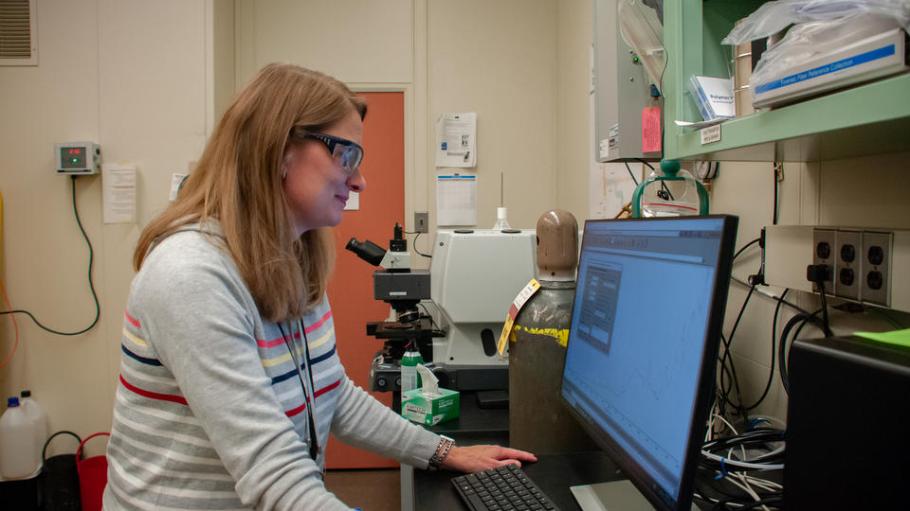
Researchers at the National Institute of Standards and Technology (NIST) developed a near-infrared (NIR) spectroscopy database with the “molecular fingerprints” of a few fibers in pursuit of helping recycling centers sort textile waste more efficiently.
Related Stories
“I had done a lot of mid-infrared spectroscopy throughout my career; I thought NIR would be a slightly different part of the spectrum,” Amanda Forster, a materials research engineer and textile circularity project lead at NIST, told Sourcing Journal. “But NIR spectra is way more complicated and that’s the cool part—that’s where the machine learning can come in, where the AI can come in.”
The resulting NIR-SORT (short for Near-Infrared Spectra of Origin-defined and Real-world Textiles) database is a “spectroscopic and materials characterization dataset for known provenance and post-consumer fabrics” openly accessible to all.
Its sample library consists of 39 known provenance fabrics with pure fiber content and various dyes or finishes (think cotton and polyester), 14 known provenance fabrics with undyed blended fiber content (like spandex blends) and 11 post-consumer fabrics with various fiber contents, dyes and finishes (sourced straight from the thrift store). The cumulative 64 fabrics types’ NIR “fingerprints” are documented as well.
“This reference data will help improve sorting algorithms and unlock the potential for high-throughput sorting, which requires less manual labor,” Forster said. “That should reduce costs and increase efficiency, making textile recycling more economically viable.”
Recycling centers typically use handheld devices for automated sorting via near-infrared light. The handheld devices shining this light measure how much light can pass through or “scatter off” the fabric. This produces a unique pattern, not unlike a fingerprint, that can then identify the given garment’s fiber matrix.
As it stands, this process largely relies on manual labor. Ideally, manufacturers of these NIR scanner systems will use NIR-SORT to train and test their sorting algorithms. As NIST is “the nation’s measurement institute,” the governmental group has the resources required to ensure the database is fed high-quality spectra. Ideally, this means fewer mistakes will be made during fabric identification and therefore more textiles successfully enter the correct recycling steam.
“This project in particular was such a good candidate for machine learning,” Katarina Goodge, the NIST research chemist who led the development of the database, told Sourcing Journal. “The field was already moving in that direction, and so we had to go that direction to be able to support them.”
One of the most pressing challenges with developing artificial intelligence systems is ensuring the fidelity of the data powering the model behind the scenes. As the saying goes: “garbage in, garbage out.” That is to say, if inaccurate or low-fidelity data serves as the backbone for a model, it’s likely to produce false, unhelpful or dubious results.
In an industry where products are increasingly scrutinized for their material matrices, accuracy maintains an important piece of the textile recycling process.
To ensure clean data was going into their dataset, the researchers purchased fabric from a company called Testfabrics, which enabled them to understand the exact fibers and dyes incorporated into each sample, Goodge said.
“Having known provenance samples was a large aspect that we put a lot of time and effort into—finding fabrics where we are confident in the fiber contents and additives that are added to the fabric,” she explained.
And while clean data matters in building technology-based systems and increasing accuracy for machine learning models, those models also need to process data that simulates realistic conditions in order to learn best.
That, Goodge said, is part of why she and Forster chose to include some data from previously used items.
“We literally do have thrift store items in this data set as well, so that there is some amount of comparison, or you can get a better idea of what that looks like in the real world, especially because the condition of the garment will affect what dyes show up—maybe they’ve been worn away; maybe there are stains. We’ve even seen that fiber structure can change with wear condition,” she explained.
For sorters looking to use this publicly available, free-to-download data, having samples with mixed condition could be promising for building future systems.
The faster their systems—whether built on computer vision, classification models or otherwise—can recognize and categorize specific types of fibers, the less manual work has to go into fabric sortation for eventual recycling.
Goodge said that means the time from disposal to recycled fiber could decrease, and that the end recycling facilities may soon be able to share more details about the fibers clients purchase from them.
“The better the models are able to operate, the faster and more accurate [they are],” Goodge said, underlining the speed at which those decisions are made. “It also means your sorting is more accurate, so you’re able to deliver batches to your customers and have more confidence in the content of those batches.”