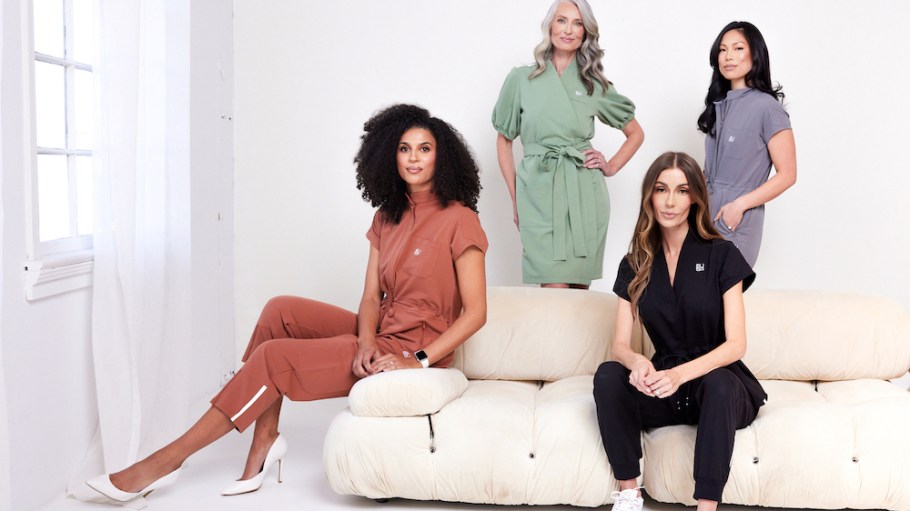
Modern scrubs have scrubbed the boxy, itchy, unisex styles of yesteryear.
Healthcare is one of the largest and fastest-growing job segments, and workers want a uniform to help them perform better as well as flex some individuality. Today’s scrubs outfit doctors and nurses, of course, but also spa and salon employees, home caretakers, pharmacists, estheticians, hairdressers, medical assistants, dental professionals, childcare workers, veterinary teams, lab researchers, and many others.
Related Stories
This health and wellness expansion has created opportunity in a saturated apparel market.
Leading brand FIGS was the OG in the modern scrubs space, “branding” a once unbranded category and growing net revenues each year since its 2013 launch and 2021 public offering, while also being highly profitable, said Trina Spear, co-founder and CEO. FIGS currently serves healthcare professionals in more than 30 countries and has generated over $2.6 billion in net revenues since it stormed onto the scene.
“The opportunity is large and increasing,” said Spear. The U.S. scrubs market is projected to hit $13.36 billion by 2030, with a compounded annual growth rate of 6.5 percent, according to Uniform Market.
Membership activewear company Fabletics had a hunch about scrubs and turned to its customers for validation. “We found that about 400,000 of our members wear scrubs for their job, and 90 percent of them said, ‘If Fabletics had scrubs, I’d buy them from you.’ That was a strong endorsement,” said Adam Goldenberg, CEO, Fabletics. Drawing on its activewear expertise, Fabletics launched scrubs in 2023.
Fabletics’ scrubs also bring people into the brand’s core business, and vice versa. “Each month we’re getting closer to 20,000 to 30,000 new customers into the brand that never bought from us before, and their first purchase is scrubs,” said Goldenberg. “And they’re converting into activewear customers.” Fabletics did $80 million in scrubs sales in 2025—roughly 7 to 8 percent of its overall sales—and Goldenberg sees scrubs as “a potential several hundred-million-dollar opportunity for Fabletics.” In line with its low activewear membership pricing model, Fabletics members can purchase scrub sets for as low as $15.
Dr. Jackie Walters, MD—an OB-GYN, co-founder of WOW Medi Spa and one of Bravo’s longest-running TV personalities—is the newest scrubs entrant. The celebrity healthcare influencer teamed with anesthesiologist Dr. Ebony Jade Hilton MD and business leader Deanna Hamilton and is launching DUES this week. The upscale line of scrubs is rooted in the medical field but takes a hard fashion approach—think scrub wrap dresses and tops that female customers can cinch to show off a feminine waist. Retails range from $38 to $118.
“While our roots are in healthcare, our vision extends beyond to reach anyone whose workwear defines their professional identity,” said Dr. Walters, who added that the items can go from work to after hours. “We’re crafting apparel that elevates confidence, inspires purpose and redefines the standard for scrubs in any field.” DUES features classic and maternity tops, joggers, jackets, lab coats, jumpsuits and “thoughtfully designed essentials” like statement tees and scarves.

Most scrubs in the past have been sold online DTC or through medical stores, but even that is changing.
FIGS recently opened its first two brick-and-mortar stores, called Community Hubs, in Los Angeles and Philadelphia (near large medical institutions), with plans to expand to more cities later in 2025 and in the years ahead. Stores are sleek and modern, “Coffee and Chill zones” build community, and a touch of whimsy speaks to the audience. The store exterior reads “Why Wear Scrubs When You Can Wear FIGS?” while a sign at the customization corner reads: “You call it sutures, we call it embroidery.” A FIGS tote bag states: This Bag Contains: A Stethoscope, Coffee, Big Goals, All Nighters, & A Very Large Needle.
It’s not surprising that modern scrubs for healthcare workers focus on performance for the active demands of the job. Four-way stretch fabrics make moving around easier, wicking properties make long, sweaty shifts more comfortable, water-resistance keeps blood or other spills from staining, and anti-microbial technology protects against odor and keep things clean.
The Welles line of scrubs made sustainability and design its main points of differentiation from the get-go.
Founded by a luxury product developer (Oscar de la Renta, The Row), Welles founder and CEO Rachel Rothenberg-Saenz was horrified by hospital images of overwhelmed nurses during the pandemic, some wearing garbage bags because they didn’t have fresh gowns. She quickly pulled in some former co-workers who got furloughed during Covid and got to work. She was the first of 40,000 applicants to win a New York state grant to build supply chain in New York’s Garment Center for PPE, but she quickly moved into other government uniform contracts, then pivoted to create Welles.
Welles initially aimed for an “athletic feeling” with performance fabric, but after seeing all the PPE waste amid the fashion industry’s already high waste problem, Rothenberg-Saenz wanted to do better. The company spent two years developing its proprietary Terral-X fabric featuring recycled polyester from ocean-bound plastics, Ciclo additive to help the garment degrade at end-of-life in landfill (in three to five years vs 200 to 350 years for traditional synthetics), and sustainable viscose for comfort.
“We also sourced fabrics and applied coatings like peppermint oil and citric acid, which don’t make it 100 percent wrinkle free, but really close, plus it’s a heck of a lot healthier than PFAS and other coatings to wear against your skin, which is your largest organ,” she said.
Dyes are bluesign® certified, PFAS and formaldehyde free and made using environmentally responsible chemistry. Packaging materials are derived from nature and are 100 percent compostable, and even drawstrings and zippers are recycled components. Classic V-neck tops start at $44 and run to joggers for $58 and full-zip jackets for $148.
Rothenberg-Saenz used her design background to infuse Welles with “cool details not found in other scrubs,” such hidden pockets that can fit an ID card or a sunken part that can hold a wedding ring or ear pods. “Every nurse or doctor needs more pockets, but they don’t want to be covered in pockets.”
As the scrubs market grows, so do opportunities for expansions within. FIGS, for example, has already expanded its product assortment to meet every need a healthcare professional has—on shift, off shift, to work, at work, and from work, head to toe, said Spear, noting underscrubs on the base layer, to footwear, loungewear and outerwear.
“We provide healthcare professionals with an entire layering system that meets their every need—the ones they know of and even the ones they don’t.”