MIT and Adobe researchers have been working to cut textile waste out of the equation during the design process.
Rebecca Lin, a researcher at MIT’s Computer Science and Artificial Intelligence Laboratory (CSAIL) and Media Lab and a PhD student at the university, teamed up with Adobe scientists Michal Lukáč and Mackenzie Leake to create software aimed at designing adaptable garments.
The researchers shared their software, which they call Refashion, in a paper detailing its merits and potential future expansion.
Related Stories
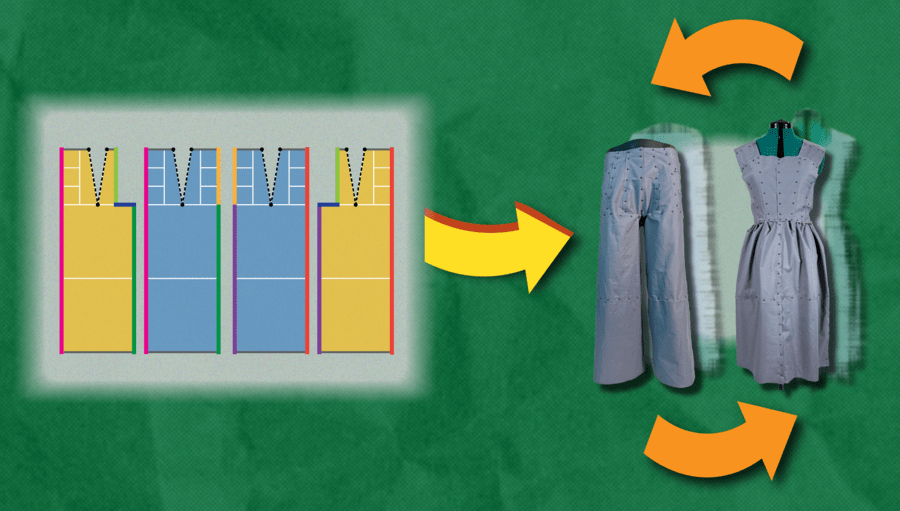
Refashion uses modules—often simple shapes, like rectangles and triangles—to help users lay out garment patterns, allowing designers to create digital pieces that can be reimagined into multiple garments. For instance, a designer might use the software to create a pattern for pants that reconfigure into a dress, or a mini dress that converts to a maxi dress.
Lin and her fellow researchers create adaptability in the garments by using velcro or metal snaps in place of standard stitching techniques; that in mind, a designer can use those snaps to detach or reattach pieces of the garment depending on the need. A designer might use metal snaps to attach a hood to a crew-neck garment; if it rains or winds are added, the hood can be added, and if it’s a clear day, the hood can be detached.
The idea is that Refashion can curtail the need to create two separate garments that risk becoming part of the waste stream. The researchers said their software will help designers preemptively create garments that are reusable and thus, more likely to live longer lives in consumers’ closets, rather than being disposable.
“We wanted to create garments that consider reuse from the start,” Lin said in a statement. “Most clothes you buy today are static, and are discarded when you no longer want them. Refashion instead makes the most of our garments by helping us design items that can be easily resized, repaired or restyled into different outfits.”
Designers can create patterns from scratch or leverage the modular templates to begin creating a garment. They can specify which edges should align for seams, then generate a simulation on a model to determine where there may be gaps or issues with the garment. Refashion features the ability to add pleats, darts and gather effects to designs, so garments can be fitted in desired places. Once a user finalizes their design, the software “automatically creates a simplified diagram of how it can be assembled,” CSAID noted.
Lin said in a video detailing the project that participants who tested the software created a number of innovative designs; one used Refashion to imagine maternity wear that could be reconfigured depending how far along a person is in their pregnancy, while another created a form fitting, straight-cut dress that can be scrunched to add textural interest for other occasions.
While today, Refashion is primarily geared toward creating new items, MIT CSAID said the researchers will consider how the system can be used to help designers use as little fabric as possible to limit waste and whether it can be used to create new items from unwanted consumer garments.
Refashion does not yet include robust ways to add color or patterns to the garments designers make. Lin said in the future, she plans to add that function to the software, alongside a capability that would allow designers to envision patchwork garments that leverage recycled or upcycled materials.
Adrien Bousseau, a senior researcher at Inria Centre at Université Côte d’Azur who evaluated Lin, Lukáč and Leake’s work but was not involved in the paper, said Refashion could set the stage for a greener way forward with technology as the linchpin.
“This is a great example of how computer-aided design can also be key in supporting more sustainable practices in the fashion industry,” Bousseau said in a statement. “By promoting garment alteration from the ground up, they developed a novel design interface and accompanying optimization algorithm that helps designers create garments that can undergo a longer lifetime through reconfiguration. While sustainability often imposes additional constraints on industrial production, I am confident that research like the one by Lin and her colleagues will empower designers in innovating despite these constraints.”