Lectra wants to be on the cutting edge of the garment-making process—and its newest technology can help its clients do so, both by integrating with factories’ existing cutting machines and by giving brands greater visibility into the design and production processes.
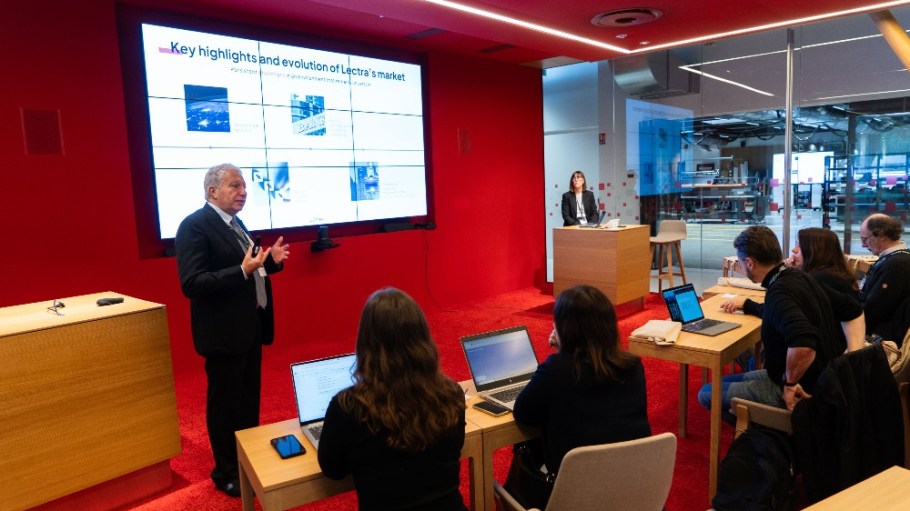
The software company, which serves the fashion, furniture and automotive markets, announced Thursday that it launched a solution aimed at streamlining the manufacturing process for both fashion brands and suppliers. Lectra rolled out the new tool, called Valia Fashion, at a press day in Cestas, France, where it has a large campus fit with an innovation center, a manufacturing facility for its cutting machines and more.
Related Stories
Valia Fashion is the Paris-based technology provider’s latest way of showcasing its commitment to Industry 4.0, which combines technologies like artificial intelligence, cloud, big data and the industrial Internet of Things (IoT). The company said it aims to augment human labor with technology, in turn offering stronger sustainability outcomes and cost savings.
The system is positioned to aid both brands and their manufacturers and suppliers throughout garment production; by interconnecting the various tasks in that process—like fabric estimation, order management and nesting—on one system with a myriad of functions.
Valia uses digital twin technology to show manufacturers how best to process specific fabrics used in garments for clients. Digital twins allow factories to see all of the equipment in their facility from a computer screen; in turn, if the manufacturer needs to produce a garment that has multiple materials—like a suit jacket that uses one fabric for the exterior and a different one for the interior—Valia will suggest which machinery the manufacturer should use, both to get the best efficiency and quality.
Daniel Harari, CEO of Lectra, said many manufacturers cut the materials on the same machine simply out of convenience. But Valia can automate the decisioning behind how materials are treated on the factory floor.
“People have [some] machines that are very recent, but some are very old. If your more recent machine can deal with more delicate fabric with less buffer, your interest is to put the more expensive fabric on the more recent cutter and the less expensive one on the less recent cutter,” Hariri explained. “Maybe some products are easier to cut, so they can go on the less sophisticated machine. Just by doing this, you’re saving time, but you’re also saving money.”
That capability is far from Valia’s only feature; it also has the ability to integrate with cutting machines to instruct them on how to cut the fabric to eliminate the most amount of textile waste possible. Unlike existing solutions, Valia does that work in real time based on how the fabric performs on the cutting machine as well as the number of garments a customer has ordered in each size.
While some of the solution’s features may prove primarily of interest to suppliers and manufacturers, brands also stand to see upsides. Harari said that manufacturers will reap the benefit of Valia after garments have already been designed and purchase orders have been signed. But brands can use it to optimize their assortment before ever ordering garments from a supplier.
Valia can show planners and merchandisers how many units of a designed garment to order, down to size granularity. Harari said Valia can show a brand that, if they order several extra units of size small and, in turn, decrease the number of size medium units they order, they can acquire a greater number of items for the same cost. Alternatively, if a brand wants to order about 1,000 units of a product, Valia can show the company whether purchasing 985 or 1,200 units would be more cost effective. Those figures are not based on demand forecasting estimates, but rather on cost efficiency from a manufacturing standpoint.
Nicolas Favreau, product marketing director at Lectra, said having that information up front can help both brands and suppliers from purchasing fabrics in excess, which could bring them closer to meeting sustainability goals.
“There is a lot of waste when purchasing fabrics, because if you have to produce garments, you purchase the fabrics not knowing how it will be produced precisely, so you base your estimation on the worst case,” Favreau said. “You purchase meters of fabric you can use, and at the end of the process, you still have unused fabric that is a sure loss. With Valia Fashion, you will be able to estimate very precisely your fabric needs, because you will [know more] before producing.”
Today, Valia can improve fabric usage by 2 percent to 4 percent, a figure Lectra plans to bring up as the system continues to learn from each task it completes for a client. For garments with motifs—or prints—that level of improvement may be slightly lower.
On the manufacturing side, Valia Fashion will be compatible with most cutting machines manufactured in or after 2007. While Harari explained that the technology may pair most easily with Lectra’s own cutting machine, Vector, it also partners with Gerber cutting machines—Lectra acquired Gerber in 2021—and competitors’ machines. That, Harari noted, is because the company wants Valia Fashion to be accessible to manufacturers and suppliers without further investment in equipment.
“We want to be able to be compatible with all the machines existing in the market—the difference being that the more intelligent the machine, the more efficient you can be,” Harari said.
For all its automation capabilities, Harari and team remain confident that the technology will not replace existing jobs—even among workers with high-knowledge, low-repetition jobs.
“Those who don’t automate, they lose their position, and it’s a race against progress. The [companies] that still use methods that are 20 years old, they lose business and jobs disappear. But jobs don’t disappear where we put the technology; in reality, they disappear where we don’t put the technology in place,” Harari told Sourcing Journal. “The way we have conceived all our tools is not to replace people, but to leverage their knowledge, so we are viewed…as friends, not as enemies.”
Lectra officials said the cost of Valia varies based on what the client uses it for, and the frequency of use.
The company first started developing Valia Fashion in 2015, nearly 10 years ago. Though a few of Lectra’s clients have started piloting it, the launch marks the first time Valia will be available to the mass market. By the end of this year, Lectra will have spent about 30 million euros ($32.8 million) on developing the solution in the span of that time, making Valia the most expensive solution Lectra has ever developed itself, according to Harari.
The company has launched a variety of solutions itself, but it has also made a point of acquiring other companies—like TextileGenesis, Launchmetrics and Retview—and forming strategic partnerships with emerging startups. On Monday, it announced a partnership with AQC, a quality control platform powered by artificial intelligence and had acquired a minority stake of 30 percent in the company. Last month, Lectra acquired an 18 percent stake in Six Atomic, which uses AI to streamline the pattern grading and 3D rendering processes.
Harari said he could not disclose exactly what Lectra might look to acquire next, but the company does have a concrete idea of the identity of companies it has a keen interest in.
“We believe a lot of the companies that are going to partner with us in the future are mainly companies that are in artificial intelligence—and they are not really startups, but companies that are between three and 10 years old that have developed a very good basis for technology, but cannot sell it worldwide. The scaling gap is the most difficult in that case…and they need to industrialize more. The kind of acquisitions we would do now are mainly targeting that kind of company,” Harari told Sourcing Journal.