For the women traders of Kantamanto Market in Ghana’s capital of Accra, the fire was the last straw.
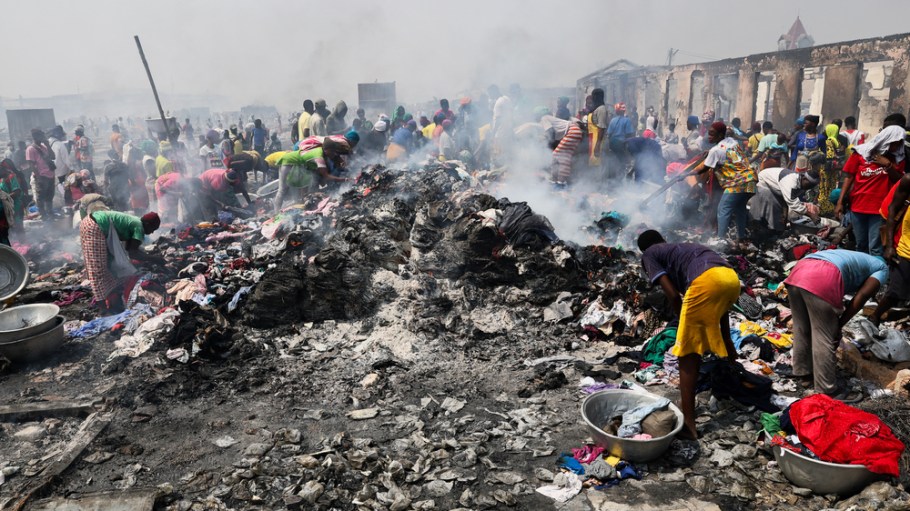
Thousands of them saw their livelihoods go up in smoke when a Jan. 1 inferno ripped through the sprawling warren of clothing-crammed stalls that made up West Africa’s largest garment resale marketplace. In a matter of hours, two people would be dead and more than 60 percent of its retail-facing side reduced to ash and rubble.
In the long, agonizing days that followed, several vendors decided that enough was enough. Women, many of them single mothers, make up the majority of Kantamanto’s retailers, yet there was no one who could speak about the lived experiences that made their jobs an emotional grind: the poor-quality bales that yield an increasingly amount of soiled, stained, torn or otherwise damaged garments that they cannot possibly resell, the financial strain of juggling multiple forms of debt as they continue to run their businesses at a loss, the muted suffering of older women who retire from the trade with little to show for it, and the quieter deaths that happen when no other recourse remains.
Related Stories
Worse, no one seemed to bother to listen in the rare instance when someone might voice her pain—not the Western brands like Marks & Spencer, Nike and Gap, whose clothing waste inundates their streets and merges with their shores, nor the importers that continue to raise the prices of bales despite their ever-diminishing returns. If it wasn’t for The Or Foundation, the environmental justice nonprofit that works with the used-clothing community, they would have been left twisting in the wind after the fire, they said, especially since any initial attention was quickly swept away when a series of destructive blazes roared through Los Angeles a week later.
The organization’s largesse, including $1.5 million in direct relief and another $1 million in rebuilding costs, has helped the market’s leadership resurrect Kantamanto and usher in improvements, including raised and level roofing, fire extinguishers and wiring that meets national standards. By September, Kantamanto will enter the final phase of electrification and the deployment of a unified security force trained in fire safety, first aid and gender-based violence prevention. For the first time, every stall will be able to have its own fan to beat the tropical heat. Vendors will be able to keep devices charged to improve engagement with customers or even participate in online selling. Fire lanes that will allow access to emergency vehicles are also in the works.
“About 80 to 90 percent of the rebuilding of the market is all from The Or Foundation,” said Mary Sarkodie, who has sold the castoffs known colloquially as “dead white men’s clothes” on and off since the 1980s, when she joined her stepmother in the business. “Nobody else came to help us.”
Sarkodie is one of nine women who have banded together to form the Kantamanto Women’s Association, a way, she said, to “make our voices heard” wherever the male-dominated market leadership cannot. And despite claims by the Ghana Used Clothing Dealers Association that so-called “false narratives” about Ghana becoming a “waste-dumping ground” are damaging the sector’s reputation, GUCDA represents mostly importers and “doesn’t actually know what’s happening in the market and they can’t admit that the goods are bad,” she said. GUCDA did not respond to multiple requests for an interview.
But the quality of secondhand garments has taken a significant nosedive, said Zaliatu Asare, another founder of the Kantamanto Women’s Association who has been selling children’s and infant wear for the past decade. Some 40 percent of the clothes encased in the bales that retailers buy sight unseen leave Kantamanto as trash, she said. Sometimes, to fulfill the weight requirements of each 55-kilogram bale, importers “just put anything in there,” leaving a remarkably small proportion of the 15 million garments that enter Kantamanto every week from the United States, the United Kingdom and Europe fit to turn around.
“The women in the market are tired,” she said. “We’re tired of investing money and reaping losses and reaping debts. Imagine opening a bale and seeing [the traces of] someone’s menstrual cycle. There are so many emotions that go along with opening a bale. Some of us want to pass on the business to our children, but why would you want your child to go through something that gives you stress, something that makes you depressed, something that always lands you in debt?”
The issues the sellers face filter down to the rest of the market’s ecosystem. The adolescent girls and young women known as kayayei, who balance up to 55 kilograms of clothing on their heads as they pick their way through the narrow thoroughfares for less than $1 a trip, suffer from chronic injuries such as spinal cord compression, neck fractures and internal damage that can lead to death. Those who sleep outside frequently risk rape and sexual abuse. There are young men who overdye worn jeans, taking stimulants to stay awake because they have to process hundreds of pairs for mere pennies. Many experience mental health challenges on top of the physical toll of making something out of the unending dross Kantamanto is pummeled with.
It wasn’t always like this, said Ruth Odoom, who has for the past 15 years been upcycling clothing into outfits for kids. The used clothing trade used to be a respectable one until fast fashion—and the overconsumption thereof—picked up speed. It’s because of this glut of cheap, poorly made clothes that it’s become a “crime” to go to its beaches, she said. She said there was a time the retailers were ignorant, but now they understand the concept of extended producer responsibility, or EPR. The people of Kantamanto cannot be expected to bear the burden of overproduction.
“I want people in the global North to understand that this is a business that we do; this is our livelihood,” she said. “If it’s trash that’s coming in, how do we grow? How do we become better? How do we get our investments back and take care of ourselves and our families? Kantamanto shouldn’t be a dumping site.”
At some point, the Kantamanto Women’s Association wants to develop a more transparent supply chain so each bale’s contents are less of a gamble. There’s never been an instance during negotiations, the women said, where prices have come down. They said they have to help themselves because no one else will. The losses from the fire have also been difficult to quantify because so many vendors loaded up on extra bales in December in anticipation of the new year. The prices of those bales were higher than usual because of the seasonal demand, too.
Fast fashion is slowly poisoning Ghana, according to a report that Greenpeace Africa published last year. Air samples from public washhouses in Accra’s Old Fadama settlement showed what it described as “dangerously high levels” of toxic substances, including carcinogens such as benzene and polycyclic aromatic hydrocarbons. Infrared testing of discarded garments revealed that nearly 90 percent are derived from fossil-fuel fibers like polyester, fueling microplastic pollution in the environment. And the creation of “plastic beaches” aside, the aggregation of textile waste is polluting waterways and choking natural habitats.
It’s colonialism by another name, said Gloria Asiamah, a 33-year veteran of Kantamanto who is the only female representative in the broader market leadership. She’s visited other secondhand clothing markets: Gikomba in Nairobi, Kenya, and Owino in Kampala, Uganda. Conditions are no better, with many days ending with heads clutched in hands and far too many tears. It’s a state of affairs that’s untenable—and unsustainable.
“We buy, with money, the waste the global North cannot handle,” she said. “Any goods that they throw away are brought to Africa. But if brands cannot handle their unwanted clothes, who can? They need to understand that we’re helping each other. But I don’t know any brand that even supports the work we do.”