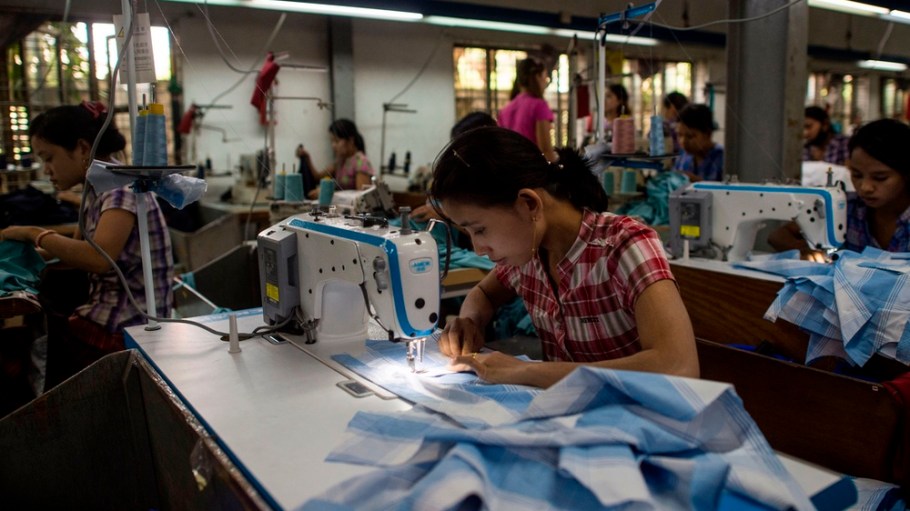
The world’s largest trade union federation has filed complaints with the Organization for Economic Cooperation and Development (OECD) against three fashion retailers that it says are “profiting” from eroding labor rights in Myanmar by continuing to place orders in the junta-ruled Southeast Asian nation, breaching the intergovernmental organization’s guidelines for responsible business conduct aimed at minimizing and remedying supply chain harms.
IndustriALL Global Union, together with its regime-banned affiliates the Confederation of Trade Unions, Myanmar and Industrial Workers Federation of Myanmar, charged Next, New Yorker and LPP at OECD contact points in the United Kingdom, Germany, the Netherlands and Poland earlier this month with reneging on their obligations to operate ethically regarding human rights. Companies that have continued sourcing from Myanmar following the violent 2021 military coup, they say, are “benefiting from an environment of fear, forced labor and exploitation” in a country with no freedom of association and little rule of law.
Related Stories
“We have been urging multinational companies to exit from Myanmar as their existence contributes to the severe violations of human rights and labor rights in the country,” said Khaing Zar Aung, the exiled president of the Industrial Workers Federation of Myanmar. “The brands pretend they comply with the OECD guidelines and human rights due diligence, which is impossible under a military dictatorship. Industrial zones are under martial law and the right to freedom of association is banned.”
But while many high-profile purveyors, including H&M Group, Zara owner Inditex, Uniqlo parent Fast Retailing, Lidl, Marks & Spencer and Primark, have declared that they will be cutting ties with Myanmar—albeit at different and sometimes unspecified time frames—a significant number, including household names such as Adidas and Bestseller, still remain. Those that continue to stick by Myanmar have cited concerns that divesting would exacerbate already deteriorating conditions for workers. They also claim to employ a “heightened version” of human rights due diligence to root out potential violations, a tack that runs counter to the growing, if not universal, consensus that independent oversight cannot occur under such hostile conditions.
Poland’s LPP, which is linked to at least 29 complaints, many involving multiple workers, in an allegation tracker updated by the Business & Human Rights Resource Centre (BHRRC), maintains the same reasons for staying. The brand says that its suppliers are required to adopt its code of conduct, which aligns with International Labour Organization conventions and the United Nations’ Universal Declaration of Human Rights and is “not subject to any negotiations.”
“We are currently undergoing thorough supplier audits in Myanmar; we verify reported cases of abuse very carefully,” a spokesperson said, noting that it places “particular” emphasis on occupational health and safety, employment conditions, wages, work hours and freedom of association. “In accordance with the provisions of the code, if violations are detected, we have the right to gradually reduce the number of orders and resign from cooperation with such a supplier or immediately terminate the contract.”
Britain’s Next, which is linked to two cases in BHRRC’s tracker, and Germany-based New Yorker, which is associated with five, did not respond to requests for comment.
Karina Ufert, CEO of the European Chamber of Commerce in Myanmar, which advocates for European businesses operating in the country, believes that responsible sourcing from Myanmar is still achievable.
“We see brands responding to challenges in the operating environment by strengthening their social and environmental responsibility efforts, maintaining engagement with trade unions and labor organizations, and participating in initiatives such as MADE in Myanmar, which currently covers more than 150 supplier factories,” she said, referring to a European Union-funded project that promotes social and environmental compliance. “While we acknowledge challenges in Myanmar’s garment sector, including instances of excessive overtime and worker migration driven by low wages, positive change can only be achieved through sustained engagement and close collaboration with all stakeholders on the ground, particularly labor representatives, who continue playing a vital role in improving working conditions.”
But IndustriALL’s OECD filings also come just as the International Labour Organization announced that it would be taking action against the Myanmar junta for “non-observance” of conventions relating to forced labor and freedom of association.
The governing body of the ILO, the UN agency said in early November, has decided to place on the agenda of the 113th session of the International Labour Conference in June an “item concerning measures under Article 33 of the constitution to secure compliance by Myanmar” with the recommendations of the 2023 commission of inquiry, which included a cessation by authorities of all forms of violence and other inhumane treatment against trade unionists and the restoration of the protection of basic civil liberties. Member states that fail to comply with Article 33 can face consequences such as economic sanctions and legal proceedings.
“We strongly believe that the ILO must invoke Article 33 and sanction the regime in Myanmar for its failure to uphold basic workers’ rights,” said IndustriALL general secretary Atle Høie. “The ILO Commission of Inquiry of October last year found widespread violations of freedom of association and forced labor conventions. The junta refused to accept the report, and conditions for workers remain terrible, with union leaders killed, in prison or in hiding. The regime is waging a civil war against its own population and must be held to account.”
IndustriALL, whose framework for responsible business disengagement many exiting brands have referred to, will continue to review the situation in Myanmar, it said. That includes looking at other brands sourcing there.
“There is significant evidence of systemic violations of workers’ rights and brands that remain in Myanmar cannot claim ignorance of the abuses,” Høie said. “The largest global brands have already left the country—brands that stay prioritize profits over human and workers’ rights. We are considering filing further complaints regarding other brands that remain.”