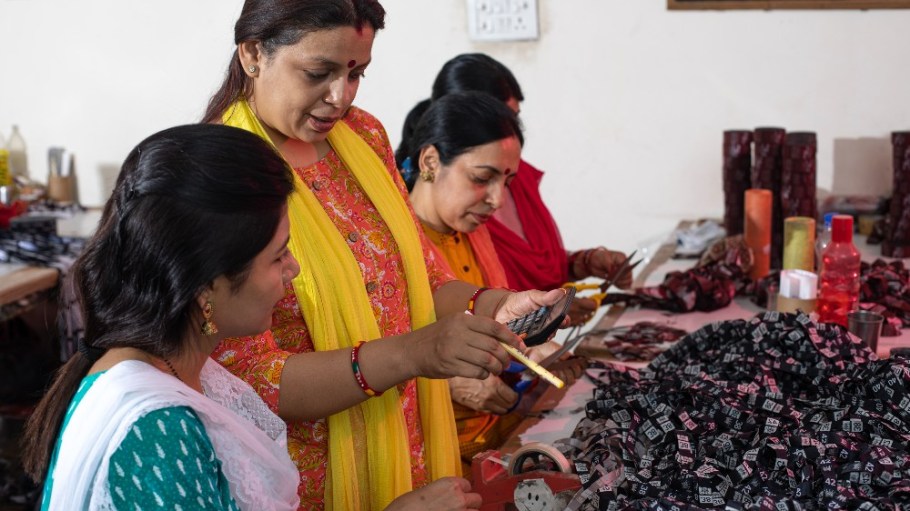
There’s palpable optimism in India as exports of apparel and textile have picked up, defying years of stagnant growth or decline.
Following the general election in India, the government laid out a plan for a 100-day period of focus on the industry. That initiative, which began in September, is expected to boost growth to $350 billion.
Recently appointed textiles minister Giriraj Singh spoke to the country’s 2030 roadmap for the sector. With a goal of about $250 billion in sales for the domestic market and $100 billion in exports, the textiles and apparel industry is expected to generate millions of jobs, he said. As a part of the government’s transformative vision, the Ministry of Textiles had engaged in several initiatives during the first 100 days of the new government, including strengthening infrastructure, focusing on technical textiles, bolstering natural fiber sectors and more.
Related Stories
Between April and September, exports for textile and apparel were up more than 5 percent over the previous year, reaching $17.6 billion. Textile exports grew 2.76 percent to a little over $10 billion while apparel exports grew by 8.5 percent to $7.5 billion, according to figures from the Ministry of Commerce and Trade.
September saw overall growth up by over 12 percent, while apparel exports alone surged by about 17 percent. Textiles and apparel account for around 8 percent of India’s total exports.
During the last financial year, textiles and apparel saw a decline of 3.2 percent to $34.4 billion. Apparel exports declined by 10.25 percent to $14.5 billion from $16.1 billion, while textile exports grew a marginal 2.6 percent to $19.8 billion.
“It’s too early to celebrate,” an apparel manufacturer in New Delhi told Sourcing Journal. “There are too many variables at this time, there is a lot to be addressed to really help and change the way we are looking at the industry. The industry really needs to be given much more focused attention to help it, the way it is done in some neighboring countries. But maybe we can break the time warp we were stuck in, there’s a definite shift now.”
Mithileshwar Thakur, secretary general Apparel Export Promotion Council (AEPC), told Sourcing Journal that Indian apparel exports were now on a “high growth trajectory.”
“We have started harnessing the untapped potential and have been logging double-digit growth in apparel exports in the last few months in spite of geopolitical challenges and consequent supply chain disruptions. India is clearly at the cusp of global attention, and the world has started looking at India as a preferred sourcing destination,” he said.
“Among other issues facing particularly the apparel industry in India is the acute shortage of labor during peak seasons, with migrant labor moving to their home states during festive seasons and thereby adversely impacting capacity,” he added. “The focus of the government and industry now is to move factories to labor surplus states for ready availability of workforce and consequent improvement in efficiency and productivity. Most of the states are coming out with their own textile policies to create conducive business ecosystem for accelerated growth of textile and apparel industries in India.”
Manufacturers in other states, including Tamil Nadu and Telengana, told Sourcing Journal that the immediate concern had shifted to managing plans for capacity building, removing bottlenecks related to raw materials, and requests for more government support for small and medium factories.
The announcement of the 2024 Textile Policy by the state of Gujarat on Oct. 16 is being watched with interest. As Thakur pointed out, one of the big changes that has happened in recent months is the sense of cohesion across the different states of India, spurring on the overall growth. Gujarat’s new textile policy addressed capital subsidies, credit-linked interest subsidies, payroll assistance and fiscal subsidy provisions for labor intensive units. Focus areas include a reduction of carbon emissions and renewable energy; a power tariff subsidy was announced at 1 rupee per kilowatt hour.
Meanwhile, comments from the Bangladesh indicate concerns about “another country waiting to snatch up orders.”
After prime minister Sheikh Hasina’s swift and unexpected departure from the seat of prime minister on Aug. 5, Bangladesh remains in a state of flux. The central body for the apparel industry, the Bangladesh Garment Manufacturers and Exporters Association (BGMEA), was dissolved on Oct. 20, and a new round of elections is expected. The minimum wage for workers is expected to set off a new, and perhaps contentious, round of negotiations.
Manufacturers argue that they have already agreed to a 56-percent hike in wages and any further increase would be financially impossible. But workers are clear that the increase barely gets them to a living wage, as the value of the Bangladesh taka has fallen and their pay isn’t stretching as far as it once did.
How this will affect the pricing structure for global brands is still unclear, though many are still keen to diversify their sourcing portfolios. With Vietnam struggling with labor shortages and with limited capacity in Sri Lanka, the industry in India is looking at ways of scaling up quickly to capture growing demand.
And with Trump’s promise of increased tariffs on China-made goods hanging in the air, a vibrant Indian textile and apparel industry could invite considerable interest in 2025.