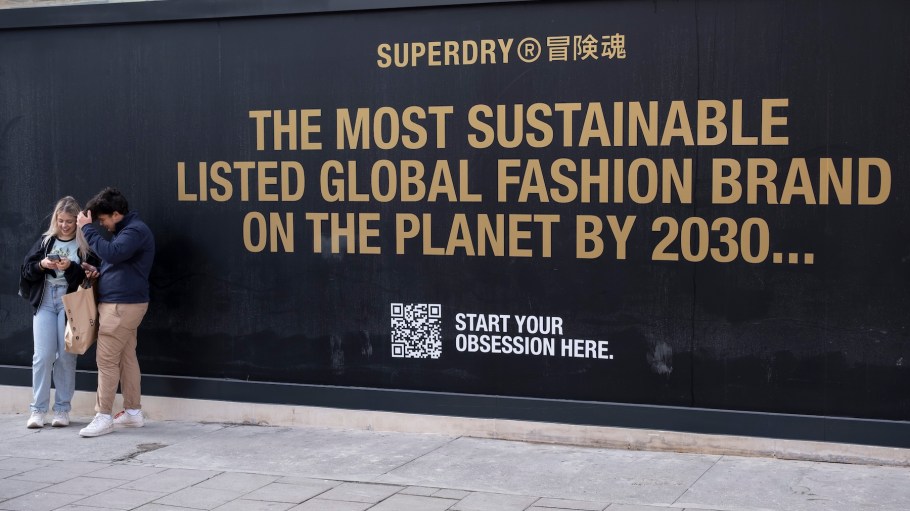
Nike, Lacoste and Superdry served as the hook, line and sinker for the British Advertising Standards Authority’s crackdown on misleading green claims in paid-for Google search ads.
The UK advertising watchdog said on Wednesday that it banned a Google ad from each company in June. These rulings follow a targeted investigation into the retail fashion sector, as conducted with the ASA’s artificial intelligence-powered Active Ad Monitoring system, which uses AI to identify adverts in specific sectors bending the rules or beyond the scope.
Related Stories
All three rulings were focused on misleading environmental claims made by the prominent purveyors. The breaches fall under two main categories: general advertising standards and specific environmental claims standards. In each case, the adverts were banned, and the companies were warned that any future promotions for any sustainability claims must contain a high level of substantiation.
“The ad[s] must not appear again in the form investigated,” the ASA said to all three offenders. “We told [them] to ensure that the basis of future environmental claims—and their meaning—was made clear, and that a high level of substantiation was held to support them.”
Each of those rulings addressed a paid search advertisement for using broad and unqualified terms (like “sustainable clothing” or “sustainable materials”) without providing sufficient clarity or substantiation. Thus, the ASA concluded that these absolute claims were ambiguous, leading consumers to believe the products had no detrimental effect on the environment throughout their entire life cycle—what the ASA called “a standard the companies failed to meet.”
In each ruling, the companies provided evidence of efforts toward sustainability, but the ASA found this evidence insufficient to meet the standard required for an absolute claim based on the product’s full life cycle.
In simpler terms, this means that, although the companies provided evidence of reducing their environmental footprint or using recycled components, the ASA required evidence of high-level substantiation for the absolute claims used in the ads themselves.
Consequently, all three adverts were upheld as breaches of the CAP Code—more specifically, edition 12 of the primary framework for the rulings—and slapped with misleading advertising and lack of substantiation. The code’s key requirements stipulate that the basis of environmental claims must be clear and that the meaning of all terms must be clear to consumers. A high level of substantiation must support absolute ecological claims. In contrast, claims must be based on the full life cycle of the advertised product, unless the ad explicitly states otherwise and qualifies the claim.
“The CAP Code required that the basis of environmental claims must be clear, the meaning of all terms must be clear, and that absolute environmental claims must be supported by a high level of substantiation,” the ASA said. “Claims must be based on the full life cycle of the advertised product, unless the ad stated otherwise.”
![A paid-for Google ad for Lacoste, a clothing retailer, seen on 24 June 2025, stated “Lacoste Kids – Sustainable […] clothing”. The ASA challenged whether the claim “sustainable clothing” was misleading.](https://martav.shop/wp-content/themes/vip/pmc-wwd-2021/assets/public/lazyload-fallback.gif)
Lacoste claimed that the French brand reduced the environmental footprint of its Spring/Summer 2025 Kids collection by comparing it to the crocodile company’s SS22 collection. The contrast indicated reductions across all life cycle stages (for example, a 19 percent reduction in raw materials footprint), with the claims based on life cycle analyses consistent with ISO 14040 and 14044 standards. But for the British regulator, this reduction analysis only proved that the SS25 collection was more sustainable than the SS22 collection—not that the products had no detrimental effect on the environment, considering their entire life cycle.
“Lacoste acknowledged that claims such as green,’ ‘sustainable and ‘eco-friendly’ were very difficult to substantiate,” the ASA reported. “They told us that the ad was removed as soon as the complaint was received and gave an assurance that they would not repeat the claim in the form made in the ad in the future.”
Advertising Standards Authority
Nike stated the claim referred to the availability of products containing recycled materials—for example, polo shirts having at least 75 percent recycled materials. The ASA deemed the claim was ambiguous and absolute, as the sportswear Goliath failed to provide evidence that the polo shirts had no detrimental effect on the environment, considering their entire life cycle.
In response, Nike said the “sustainable materials” reference in its ad was meant to highlight products on its website that include recycled materials—like recycled polyester—and that details were available on product pages. The “Just Do It” giant noted that Google ads’ character limits prevented full explanations but aimed to provide transparency as consumers navigated the site. But the ASA ruled Nike had failed to include qualifying details and failed to explain the basis of its claim about the “sustainability” of its products.
“We have engaged with the UK Advertising Standards Authority on this matter and have taken the necessary required actions,” Nike said in a statement. “We remain committed to providing consumers with clear information to help them make the choices that are right for them.”
Superdry, meanwhile, maintained that the ad was not an absolute claim but referred to products having “sustainability attributes and credentials” (for example, 64 percent of garments contained sustainably sourced material, like organic cotton). In response, Superdry argued that the ad’s purpose was to highlight that it sells products with sustainability attributes, which a consumer could use to build a “wardrobe.” It contended the ad did not claim all Superdry products were sustainable.
The UK branded clothing company explained to the British regulator that its sustainability credentials for products were assessed against standards from Textile Exchange. That said, Superdry’s Sustainability Report 2024 stated that 64 percent of all garments, footwear and accessories purchased contained a “sustainably sourced material.” The report also noted that 40 percent of all raw materials sourced were recycled or “low impact” alternatives. Superdry acknowledged that full life cycle data was not publicly available and that the ad had been “produced in error.”
As such, the complaint was upheld. The ASA found the claims to be absolute and unqualified—meaning that the consumer takeaway would (very likely) be that all Superdry products were sustainable across their entire life cycle. Not to mention, Superdry’s own evidence, reporting that only 64 percent of its products contained sustainably sourced materials, contradicted this absolute impression. Furthermore, no evidence was provided to substantiate the full life cycle impact—even for that 64 percent portion.
“The basis of the claim ‘Sustainable Style. Unlock a wardrobe that combines style and sustainability’ had not been made clear. Its meaning was unlikely to be understood, and we had not seen evidence to support it,” the ASA ruled. “We therefore concluded the ad was likely to mislead. We welcomed Superdry’s decision to remove the ad.”