Google wants consumers to consider its agentic AI tools this holiday season.
The technology giant announced Thursday that it has rolled out several AI-enabled shopping functions just ahead of the holidays.
The features pair with other AI-enabled capabilities Google has already launched, including a way to track items’ prices and virtual try-on options that allow a user to see how clothing looks directly on their body.
Related Stories
Google said it has made conversational commerce, both with its large-language model (LLM), Gemini, and its search tool, which it calls AI Mode, easier for consumers. Users will receive shoppable listings when they ask a question in Gemini or in AI Mode.
Vidhya Srinivasan, vice president/general manager of ads and commerce at Google, wrote in a blog post that the experience helps level up consumers’ shopping abilities.
“For example, if you’re looking for visual inspiration, like ‘cozy sweaters for happy hour in warm autumn colors,’ you’ll see shoppable images. Or, if you’re deciding between a few options—like moisturizers suited to your skin type—you’ll see a comparison table with a side-by-side view of considerations specific to that product, including insights from reviews…to help you quickly understand the differences,” Srinivasan wrote in the blog.
The data Google uses to answer consumers’ conversational inquiries comes from its Shopping Graph, which uses machine learning to garner a “real-time data set of the world’s products and sellers” and gathers information on billions of product listings across the internet.
In addition to its upgrades to Gemini and AI Mode, Google announced Wednesday that it’s going deeper on agentic commerce—which leverages agents to handle tasks for consumers autonomously.
One of the newly launched features allows users to have an AI agent call local stores on their behalf to check inventory on specific items or conduct price checks.
When a user searches for a product “near me,” Google will return an option that reads, “Let Google Call.” If the user selects that option, Google will ask a few follow-up questions about their initial search, based on the specific product they seek. Once the agent has that information, it calls retailers and shops to collect information on the consumer’s behalf. Once it has completed the calls, the agent summarizes its findings and emails or texts them to the consumer, who can then make a choice about where to shop based on the information they receive.

Aashiya Begum, senior product manager for agentic commerce at Google, said the voice agents will help users discover the best fit for their needs, while also highlighting both major retailers and local boutiques and shops that may not be available for e-commerce transactions.
“Not all the merchants have the technical know-how or the resources to have the inventory online, but the consumers are always looking for [the] best stores around them to buy a particular product, and this is our way of bridging that gap,” Begum told Sourcing Journal. “We want everyone to be able to be discovered by consumers, whether they have an online presence or not.”
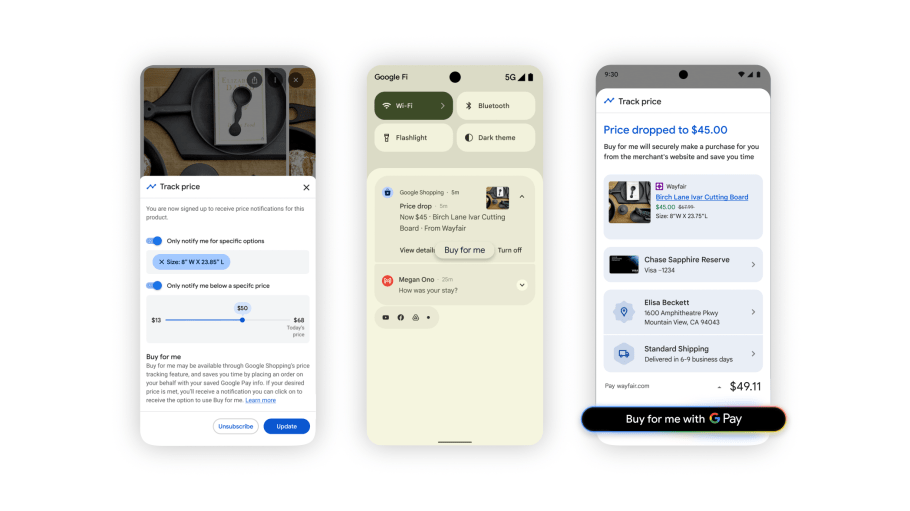
That’s not the only way Google is leveraging AI agents. The company announced Wednesday that agents will now be able to complete transactions with users’ consent from specific brands and retailers. The tool builds on top of an existing function that Google announced this year: its price-tracking tool.
Users have, for several months, been able to use Google to track prices on products of interest and receive alerts when a product became available at their desired price. For instance, if a consumer saw a $75 dress but knew they only wanted to buy it if it went on sale for $50 or less, they could set a price tracker to alert them when the dress hit $50. Now, instead of manually purchasing an item, consumers will be presented with a “Buy for me” option. That functionality will allow users registered with Google Pay to allow an agent to transact on their behalf, with their permission.
That announcement makes good on Google’s promises from earlier this year that users would be able to transact via agents.
While users have long been able to authorize payments with Google Pay, this marks a change in how they complete checkout, said Lisa Yokoyama, director of product, consumer payments at Google.
“The agent is actually going into the merchant’s website, filling in all the information as the customer would [typically] do in order to complete that transaction—so literally filling in the fields that a customer would fill in,” Yokoyama told Sourcing Journal. “That’s the agentic side of it, is this idea that an agent can do that on your behalf, instead of you having to do that directly.”
Google noted that it still has strong safeguards in place to protect consumers’ information and to ensure that all transactions are expressly approved by a shopper before an order is placed. The agent does not automatically purchase an item for the consumer without asking first—so while the checkout process is autonomous, the confirmation process remains manual.
The autonomous buying feature became public on Wednesday, but only with specific retailers. Wayfair, Quince and select Shopify retailers have started allowing Google’s agents to complete transactions on behalf of the consumer, and Yokoyama said she expects a number of others will join that mix in the coming months.
“We want to make sure that customers are getting the right price, that it’s working predictably and well for them,” Yokoyama said. “So that’s how we’re starting—with this select set of retailers—and we’re figuring out how to scale that as time goes on.”