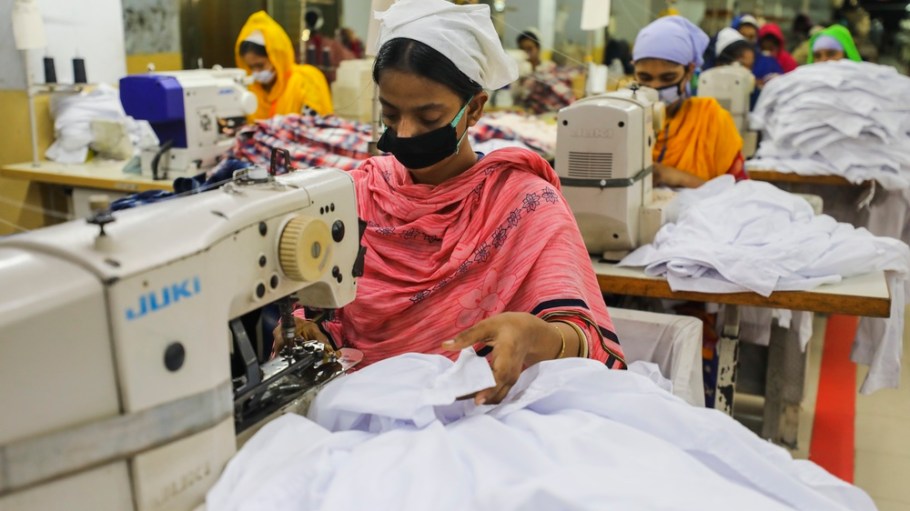
The sudden and indefinite closure of Gazipur-based Giant Textiles on Sunday, coming just days after the shutdown of 16 factories under the Nassa Group, has rattled Bangladesh’s garment industry and left tens of thousands of workers demanding compensation, justice and assurances about their future.
A note outside Giant Textiles on Monday morning read, “Operations suspended indefinitely due to the present situation. Workers are advised to await further instructions.”
The announcement sparked protests, with workers blocking the Dhaka-Mymensingh highway until police were called to disperse the crowd.
Related Stories
Both management and workers accused each other of assaults during the standoff. Workers described incidents of verbal and physical abuse, including reports from women workers who said they had been manhandled and subjected to obscene remarks and threats. Factory management said the shutdown was necessary to protect the safety of the workers.
Three days earlier, 16 Nassa Group factories in Dhaka, Gazipur, Chattogram, and the Cumilla export processing zone announced closures. The factories reportedly employed more than 30,000 people and the company’s website boasted of 1.1 million square feet of production space.
These closures are part of a broader wave that has swept through the industry since former Prime Minister Sheikh Hasina’s Awami League party was ousted from power last August. Numerous factory owners with political ties have either disappeared, gone abroad, or faced legal action. Nassa Group’s founder, Mazumder Nazrul Islam, was arrested last year.
In recent months, Nassa had begun layoffs in several units, citing canceled orders and mounting financial stress. Workers reported that in early August supervisors cut night shifts and later instructed casual and contract workers not to return. Management later confirmed the closures, citing power and gas shortages, as well as insufficient purchase orders.
The government has set deadlines for paying outstanding wages for Nassa workers, with August salaries due by October 15, September salaries by October 30, and all other arrears by November 30.
Negotiations between worker representatives, government officials, factory owners, and the Bangladesh Garment Manufacturers and Exporters Association (BGMEA) have focused on compensating laid-off employees, but workers have continued protests demanding faster payouts and government action to keep factories open.
“We demand either the reopening of the factories or alternative jobs for the affected workers,” Khairul Mamun Mintu of the Bangladesh Garments and Sweater Workers Union told Sourcing Journal, adding that it was unacceptable for thousands of workers to suddenly lose their livelihoods without a safety net.
“When factories this large can suddenly shut down, what surety do we have?” asked a former Nassa worker, now one of thousands without a job.
While one manufacturer described the closures as “temporary shocks” tied to last August’s political upheaval, industry estimates suggest otherwise. More than 150 factories have shut down in the past year, displacing an estimated 120,000 workers.
Union leaders warn that workers are carrying the heaviest burden.
“Workers are facing immediate hardship,” said labor activist Razekuzzaman Ratan. “They need regular pay, benefits, and security. They cannot survive for months when factories keep shutting down overnight.”
Economists point out that while the past year has been chaotic, the sharpest disruptions may already have passed.
“I think the worst is over,” said Professor Mustafizur Rahman, a distinguished fellow at the Centre for Policy Dialogue in Dhaka. “Many of the entrepreneurs who went into hiding have already closed their factories. The government is also working to keep some facilities running under caretaker management.”
While BGMEA highlighted that more than 100 new factories have opened in the same period, union leaders observed that these have still left many jobless.
Analysts also observed that the industry remains extremely cautious in opening new factories.
“We are seeing overall investment stagnation,” Rahman noted. “While large players are expanding capacity—June-July exports grew 8.5 percent—new investment has stalled. Inflation remains high at around 8.5 to 9 percent, imports of capital machinery have fallen, and private sector credit growth is well below target. There is uncertainty about the elections, and investors are waiting and watching.”
Factory owners said that with the elections coming up for April 2026, they were waiting to add capacity. This, despite the fact that Bangladesh scored well in terms of U.S. tariffs, with a levy of 20 percent, compared to 50 percent for neighboring India giving the industry a competitive advantage. Still, many global brands are spreading their sourcing across multiple countries to reduce risk, and are reluctant to invest too heavily in any one market.
This uncertainty is expected to weigh on the industry for at least the next seven months, with workers bearing the consequences. Union leaders are also alarmed by new regulations announced Tuesday that increase the minimum number of workers required to form a union from 20 to 50, and raise the maximum number of unions per factory from three to five. They say the changes will severely limit workers’ ability to organize.
Labor groups are demanding immediate implementation of the 18-point agreement reached in September 2024, which addressed worker welfare, safety, and factory conditions, as well as accountability for deaths and injuries during protests.
For now, finding jobs for those suddenly displaced remains the top priority. But union leaders stress that the struggle extends beyond immediate relief. “Ensuring a living wage, better working conditions, stronger industrial relations, and labor laws that meet global standards must remain our priorities,” one leader said.