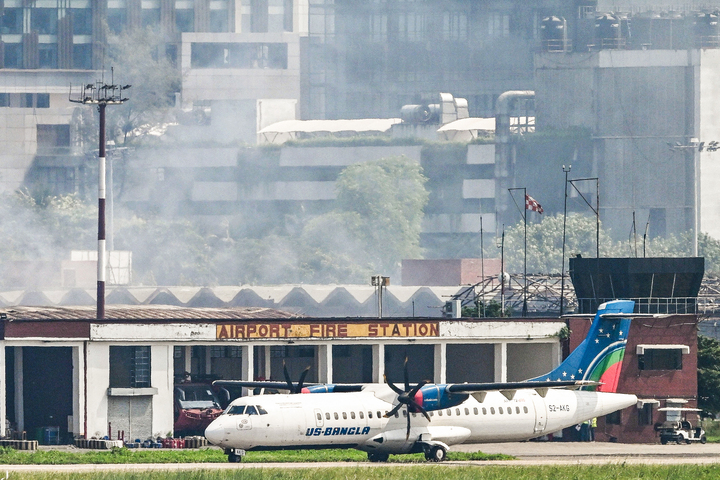
A fire that broke out on Saturday afternoon at the cargo village of Hazrat Shahjalal International Airport in Dhaka caused severe damage to imported goods and the surrounding area. According to airport officials and industry analysts, the damage was estimated at approximately $1 billion, much of it related to goods imported by the apparel industry.
“We have asked our members to immediately take stock and estimate the damages,” Faisal Samad, director, Bangladesh Garment Manufacturers and Exporters Association (BGMEA) told Sourcing Journal. “We’re working on a portal where our members can input the names of factories that have suffered losses. It’s difficult to put a number on this right now—the warehouse didn’t only have garments, but all kinds of imports into Bangladesh over the last 15 days.”
Related Stories
Residents nearby said the smoke remained thick long after the fire began, and that it took firefighters more than seven hours to extinguish the blaze. Airport officials confirmed that flights had since resumed and that alternate arrangements were being made for the storage of imported materials to ensure business operations were not further disrupted.
While estimates from exporters varied, it was unanimous that this was a major blow to the apparel industry as the site handles large volumes of cargo—averaging 800 to 1,000 tonnes per day during the current high-demand season.
“At the airport and cargo village, our commerce adviser was present and made immediate decisions,” Samad said. “Customs will now operate 24 hours a day for the next 15 days. A new shed in Terminal 3 has been allocated so that all inbound cargo can be stored there. Most importantly, he instructed all relevant agencies to fast-track incoming shipments—no bureaucratic red tape will be allowed, and everything should be cleared within 36 hours. These are good steps.”
Several industry voices have expressed concern and pointed fingers, describing these incidents as part of a broader plot to disrupt the apparel supply chain and destabilize the economy. Chief Adviser Prof. Muhammad Yunus addressed such rumors in a public statement, saying, “We wish to assure all citizens that the security services are investigating each incident thoroughly and protecting lives and property with utmost vigilance. Any credible evidence of sabotage or arson will be met with a swift and resolute response. Let us be clear: if these fires prove to be acts of sabotage meant to sow panic and division, they will succeed only if we allow fear to overtake reason and resolve.”
Commerce and Civil Aviation Adviser Sk Bashir Uddin said a probe had been launched to determine the cause of the fire, while assuring businesses that the firefighting response had been immediate—with 37 units deployed to control the blaze. He added that disruptions to business would be kept to a minimum and that a temporary import cargo storage facility would be set up immediately.
Meanwhile, the apparel industry faced additional setbacks this week. In Dhaka’s Mirpur area, a factory fire claimed the lives of at least 16 workers, while another fire broke out in the Export Processing Zone (EPZ) area of Chattogram.
Fire Service Director Tajul Islam Chowdhury said the cause of the Mirpur fire was still under investigation but suggested that the locked door to the tin-roof section may have prevented workers from escaping. He added that the adjacent chemical warehouse likely contributed to the explosion, which released toxic gases and quickly rendered workers unconscious, leaving them trapped inside.
Factory owners expressed their dismay on social media, noting that while workplace safety had improved significantly over the past decade, unregulated factories remained vulnerable. “Mirpur was not a garment factory—it was misrepresented. It was a chemical unit with a small tailoring space, and these types of operations are not registered with the BGMEA. That’s the government’s responsibility,” said BGMEA director Faisal Samad. “Our focus remains that anyone in the garment business must be compliant.”
A separate fire broke out Thursday in the EPZ (Export Processing Zone) area of Chattogram, reportedly at Adams Caps and Textile Limited, located in Zone 5 of the export hub. The blaze began around 2:20 p.m. at the top of the seven-story building. More than 17 firefighting units from Agrabad and Port Fire Service stations, along with support from the Bangladesh Navy, were deployed to control the fire.
Adding to the strain, Chattogram Port—which handles more than 90 percent of Bangladesh’s international trade—recently implemented a 41 percent hike in port service charges effective Oct. 14. The Bangladesh Shipping Agents Association (BSAA) has called the increase unsustainable, suggesting instead a gradual implementation over six to twelve months with a 10–15 percent rise.
Manufacturers expressed frustration but said they had little choice but to comply amid the current climate of uncertainty and rising costs.
Further compounding the crisis, worker unrest led to the closure of Pacific Jeans, one of Bangladesh’s largest denim producers. All eight of its factories—Pacific Jeans 1 and 2, Pacific Attire, Pacific Accessories, Pacific Workwears, Universal Jeans, HT Fashion, and Jeans 2000—were shut down starting Saturday, according to bdnews24.com.
The management alleged that workers had “vandalized the factory, physically assaulted other workers and employees, and halted work on Oct. 14 and 15,” calling the actions illegal under the Bangladesh EPZ Labor Act, 2019.
While factory closures have not been uncommon over the past year, BGMEA officials say the industry is facing mounting pressures. Many factory owners have fled or been imprisoned following the regime change last August, and the sector continues to grapple with unresolved regulatory and financial issues.
Still, several voices within the industry have called for better engagement with workers and more consistent oversight.
“Are we actually doing anything from the government’s side? Are proper inspections really ongoing? What role is the RSC actually playing here? Are all these different audits just for show?” one industry professional wrote on social media.
Amidst fires, worker unrest and increasing operational costs, many manufacturers acknowledge that Bangladesh’s apparel sector is undergoing a turbulent phase, one in which they are often uncertain about how things will change. Yet they also point to the resilience that has carried the industry through some of its toughest challenges, and appear to be confident, that this too, shall pass.