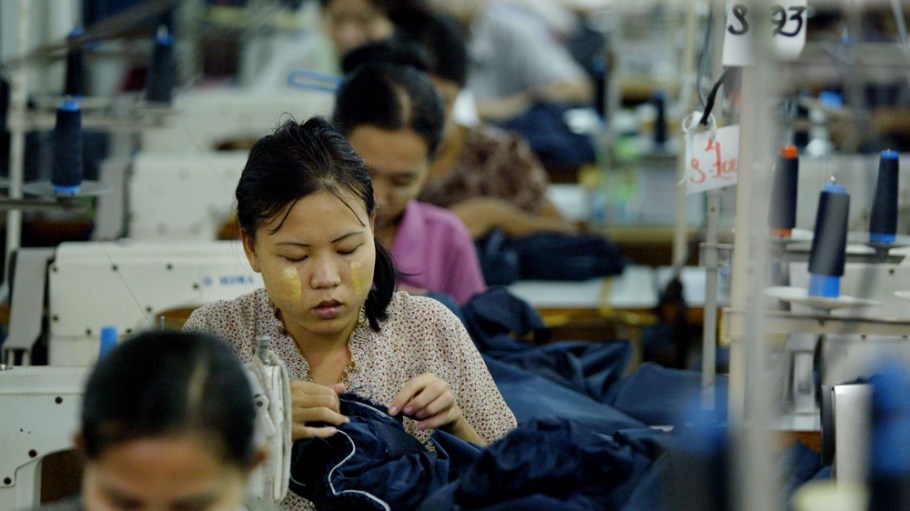
A garment workers’ union in Myanmar has called into question Bestseller’s support for increased minimum wages in the disaster-ravaged Southeast Asian nation, citing complaints of rights abuses, including those alleging wage theft, unfair dismissal and a refusal to pay for medical treatment for workplace injuries, that have emerged from the Danish retailer’s suppliers in recent months.
They add to a list of allegations logged by the Business & Human Rights Resource Centre—many of which involve multiple workers—that have grown to 665 since Feb. 1, 2021, the day the military violently seized power from the semi-civilian government. Bestseller aside, the offending factories are linked with familiar names such as Adidas, H&M Group and Zara owner Inditex despite their commitment to enhanced due diligence in the face of continual attacks on freedom of association and collective bargaining, including the outlawing of most unions and the persecution of their members.
Related Stories
“The workers’ situation in their supplier factories is getting worse and worse,” said Khaing Zar Aung, the exiled president of the Industrial Workers Federation of Myanmar, or IWFM, of Bestseller and others. “It shows that their due diligence implementation process is not effective.”
Bestseller is among the few multinational brands that have committed to staying in Myanmar despite the seemingly insurmountable challenge of protecting the safety and rights of the people who make its clothes. It doesn’t plan to immediately cut ties like Mango, Marks & Spencer and Tesco or phase out sourcing like H&M Group, Inditex and Lidl, because it said it would be able to minimize risk by engaging only with suppliers with which it has strong relationships and sufficient leverage. The Jack & Jones and Vero Moda owner has also argued that a complete withdrawal of trade by all Western companies would result in more people falling below the poverty line, creating nothing less than a humanitarian catastrophe.
Last week, Bestseller echoed calls by the EuroCham Myanmar Garment Advocacy Group, a committee of the business interest organization, to review and update the country’s daily minimum wage of 4,800 kyats ($2.28) for garment workers. Other than the addition of a potential 2,000 kyats (95 cents) in allowances, the base rate has remained unchanged since 2018, in direct conflict with inflation that surged to a high of nearly 29 percent during the 2023-2024 fiscal year.
An “inadequate” minimum wage that forces workers to rely on overtime and attendance bonuses to meet basic needs “drives low wages, fueling workplace disputes, high turnover, labor migration and the loss of specialized skills, which ultimately undermines productivity gains achieved in recent years,” according to the EuroCham Myanmar group.
Bestseller agreed, saying in a statement that it recognizes that while “the majority” of factories in its supply chain have taken “voluntary steps” to increase salaries, the lack of a statutory update continues to “place pressure on workers’ livelihoods across the industry.”
“Low wages are a systemic challenge that cannot be solved by one actor alone,” said Claus Aabling, the brand’s labor rights manager. “Therefore, we believe that speaking up is an important part of our responsibility as a sourcing brand. We support EuroCham Myanmar’s call for a review of the minimum wage and recognize that an increase in the minimum wage is essential to promote fair working conditions and strengthen the overall resilience of the garment sector in Myanmar.”
But while IWFM concurred in a statement of its own that low wages are pushing Myanmar’s workers deeper into exploitation, it also asked how a wage adjustment, while “commendable in principle,” could be realistically achieved “under the current conditions of widespread repression and a collapsed rule of law.” Because the junta “does not represent a credible or trustworthy partner in wage-setting processes,” it added, its actions have “actively undermined the possibility of fair and peaceful labor dialogue.”
The IndustriALL Global Union affiliate also asked why European buyers were waiting to act when they possessed the ability to raise wages voluntarily. Or, at the very least, ensure that all suppliers pay overtime based on the adjusted daily rate of 6,800 kyats.
“It is important to recall that when international garment investors, including those from Europe, first entered Myanmar, they agreed, in good faith, to voluntarily pay interim wages above market levels,” IWFM added. “This historical precedent clearly shows that companies can act independently to improve wages without waiting for a government decree. Today, EuroCham and its members can do the same.”
Khaing Zar Aung said that despite Bestseller’s claim that its suppliers pay higher wages—the retailer, in a recent update, said monitoring over the past six months found that the general average daily salary has risen to 15,000-16,000 kyats ($7.14-$7.61)—such efforts still fall short of addressing the broader and more urgent labor rights violations allegedly taking place at its supplier factories.
She pointed specifically to recent complaints from facilities owned by Dishang Fashion, where a worker was reportedly fired for trying to start a union and another said she was stiffed on a full month’s wages after resigning for personal reasons. At GTIG Guohua Glory, a worker who sustained a head injury after falling from a factory truck in 2023 was still being denied medical coverage as of February, Khaing Zar Aung said. Neither Dishang Fashion nor GTIG Guohua Glory responded to requests for comment.
Bestseller said that it takes IWFM’s concerns seriously and shares the view that improving labor conditions in Myanmar requires “sustained, on-the-ground engagement and robust due diligence.”
While the retailer wasn’t able to immediately investigate and respond to two of the allegations, a spokesperson said that GTIG Guohua Glory provided the injured worker with extended paid leave, along with compensation for ongoing medical treatment. The retailer also said it hoped that its previous transparency with the Business & Human Rights Resource Centre and in its due diligence reporting have shown its “hands-on approach” to identifying and addressing risks relating to freedom of association, wage compliance and occupational health and safety.
“We recognize that the choice to stay in Myanmar comes with a responsibility: to act swiftly when concerns are raised, to investigate thoroughly, and to push for remediation where needed,” Bestseller said. “We are actively involved in monitoring conditions in our supply chain, maintaining direct relationships with factories and workers, and we report transparently on these efforts.”
Khaing Zar Aung said, however, that these weren’t isolated incidents but ones that reflect structural issues that demand structural changes and “genuine brand accountability.” Bestseller’s oft-stated commitment to “protect workers by remaining in Myanmar,” she added, must “go beyond good intentions” by adopting zero tolerance for union-busting, wage theft and occupational health and safety negligence. Public commitments, too, must be underpinned by definitive timelines and enforceable stakes, Khaing Zar Aung added.
“Simply supporting a higher minimum wage, without ensuring that the foundational rights of workers are respected, protected, and enforced, risks being a symbolic gesture rather than a substantive intervention,” IWFM said. “If brands choose to remain in Myanmar under the rationale of protecting workers from job loss, they must also take full responsibility for the working conditions and rights of those very workers. Anything less risks enabling exploitation under the guise of employment protection.”