Byte-Sized AI is a bi-weekly column that covers all things artificial intelligence—from startup funding, to newly inked partnerships, to just-launched, AI-powered capabilities from major retailers, software providers and supply chain players.
Sereact scores Series A
Sereact, a German startup building AI software for logistics robotics, announced Monday that it had raised a €25 million ($26.2 million) Series A round, led by Creandum. The round also saw participation from firms Point Nine and Air Street Capital and angel investors like Mehdi Ghissassi, formerly of Google DeepMind; Rubin Ritter, formerly of Zalando and others.
Related Stories
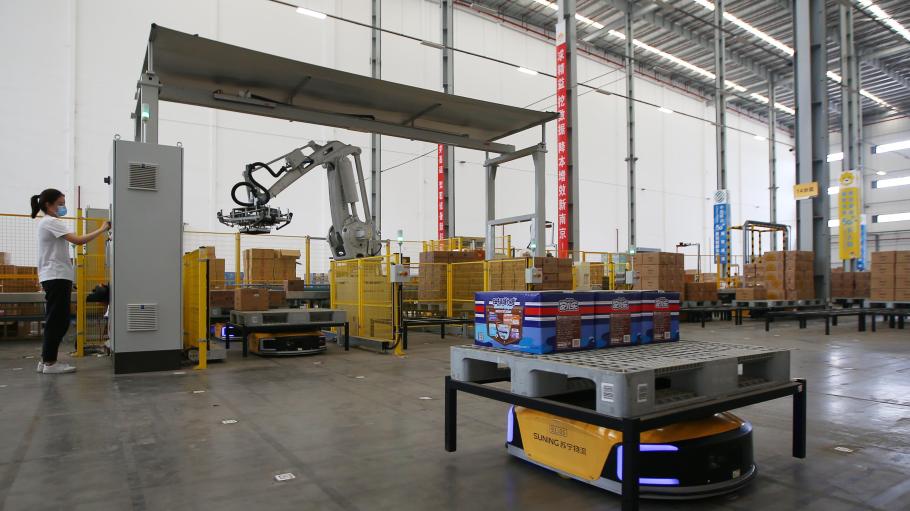
Sereact’s software is hardware agnostic, which means it should have the ability to integrate with clients’ existing robots and systems. The technology is designed to enable robots to understand, process and adapt to their environments in real time, with little human direction or intervention.
Ralf Gulde, CEO and co-founder of Sereact, said that differentiation sets the company’s technology apart from other providers.
“With our technology, robots act situationally rather than following rigidly programmed sequences. They adapt to dynamic tasks in real-time, enabling an unprecedented level of autonomy,” Gulde said in a statement.
Current clients include Daimler Truck and e-commerce company Bol.
The company plans to use the funds to support additional types of robots, like humanoids and mobile robots. It will also work to develop AI-based solutions that extend outside the logistics and manufacturing industries.
While much of its business is currently done in Europe, Sereact also plans to use the money to expand further into the U.S. and grow its headcount, though it did not specify by how much or in which business units.
Supply chain intelligence company releases AI-powered freight fraud system
Overhaul, an Austin, Tex.-based supply chain intelligence company, announced this month that it had released a fraud-fighting tool it calls Overhaul FraudWatch.
The tool uses AI scoring to check for indicators of fraud from carriers. It also sends immediate notifications to clients if an unauthorized party gains control of a shipment, or if it detects “suspicious double brokering.”
It does so by combining internal data about identifiably fraudulent brokers with intelligence from law enforcement networks tracking organized theft and patterns of fraud.
Data from the Transportation Intermediaries Association shows that 98 percent of logistics companies identified truckload freight fraud as “a critical vulnerability” in their shipment processes.
Barry Conlon, CEO of Overhaul, said the tool comes at a critical inflection point for an industry that already has myriad uncertainties.
“Fraud is no longer a risk you can afford to ignore—it’s a crisis affecting businesses of every size,” Conlon said in a statement. “FraudWatch delivers the tools businesses need to outsmart bad actors, equipping them to identify vulnerabilities and stop fraud before it disrupts their operations.”
Overhaul believes its tool has the capability to stop many instances of fraud before they can ever be carried out. And in a time where third-party logistics companies and carriers report over $400,000 of financial impact from cargo theft and fraud annually, AI systems can help simplify the process of identifying issues in complex supply chains.
European retailer creates virtual stylist powered by Google Cloud tech
Omoda, a Dutch fashion retailer, announced last week that it had launched a conversational AI agent called Omoda Stylist and a discovery feature it calls Discover the Look. Both of the new features are powered by Google’s generative AI technology.
Omoda Stylist allows users to use a chatbot-style tool to find information or products that match what they’re looking for. Using advanced AI to understand consumers’ queries and personal preferences, the model allows users to search for queries like, “smart casual workwear for in-office days.” From there, the tool recommends items by aggregating data about the user, product detail pages and more. If consumers pair Omoda Stylist’s recommendations with its Discover the Look tool, they can also figure out which other items might complement the item they’re interested in purchasing.
Customers who use Discover the Look have, to date, converted at a rate 2.5 times higher than their counterparts not using the tool.
Joost Smit, head of Benelux, Google Cloud, said the tools show how AI can positively impact retail experiences.
“By combining Google Cloud’s generative AI with Omoda’s structured data and deep retail expertise, we’re enabling the next era of personalized retail,” Smit said in a statement. “This partnership exemplifies how AI can enhance consumer experiences while driving tangible business outcomes for retailers. We’re thrilled to support them on their journey, driving longer-term customer loyalty while bridging the gap between convenience, sustainability and personalization.”