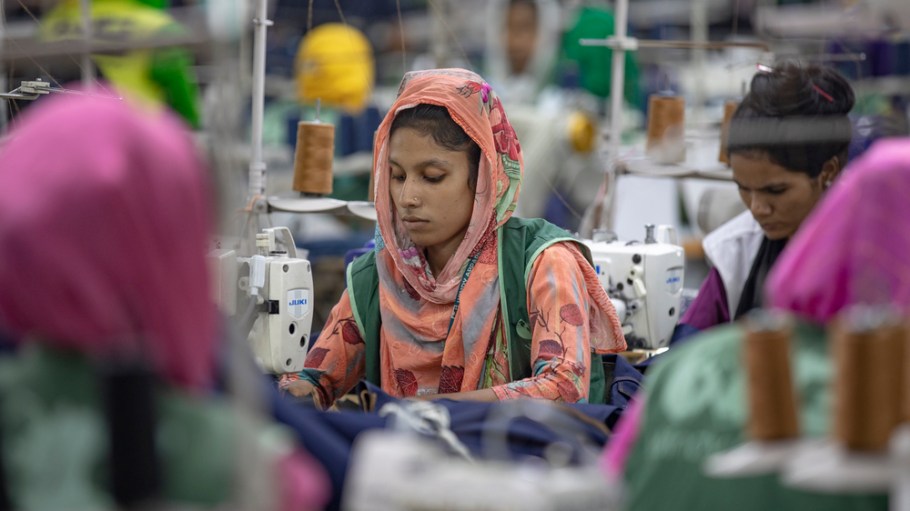
“My body is burning. But still there is no break at all. I have to complete [my] work… I am suffering [in the heat], but I have to do my job.”
That’s Raina, a garment worker in Bangladesh’s capital of Dhaka, speaking of the extreme heat and humidity that have become an unavoidable part of the summer months. She left her coastal village 20 years ago in search of a better life. Instead, she sews pockets into jeans in a poorly ventilated, overheated factory for 10 to 14 hours a day, six days a week, for roughly 17,000 taka, or just over $139, a month, with no compensation for overtime.
Related Stories
When Climate Rights International, a California-based human rights monitoring and advocacy organization, interviewed her last May, Raina was six months pregnant. Despite a heatwave that saw temperatures soar past 43 degrees Celsius, or 109 degrees Fahrenheit, she received no extra breaks nor reduced production targets. She described experiencing excessive sweating, headaches, vision loss, confusion, dizziness, vomiting, urinary tract infections, even loss of consciousness.
“Once I fainted,” Raina said. “It was the shock of the heat. The line chief and another worker took me to the toilet and my fellow worker put water on my head and gave me some time to lie down underneath the table. [But] there is no space to have a break, so I just lie down underneath the table. And after a little break, I started work again.”
When it’s hot and stifling, five to seven people “just fall down” every day in her factory, she said. But they suffer, and then they move on. Choosing to do otherwise would leave them without a job.
Climate Rights International’s report, published last week, paints a distressing portrait of what it describes as a crisis “unfolding at the intersection of climate change and labor exploitation.” If the uncontrollable heat wasn’t excruciating enough, the systemic labor rights abuses that continue to bedevil Bangladesh’s garment industry make it challenging, if not outright impossible, for its 4.1 million workers to advocate for themselves and make things easier to bear, it says. With little protection from the government, employers or fashion brands whose profits are underpinned by their labor—and worsening conditions exacerbated by Bangladesh’s monsoon climate and urban heat island effect—workers like Raina are emblematic of “climate injustice in a nutshell.”
“Bangladesh has become the poster child for climate justice,” said Cara Schulte, a researcher at UC Berkeley School of Public Health’s Global Environmental Health Equity Lab and author of the report. “Bangladesh, which is one of the world’s largest apparel export markets, contributes less than half of a percent of global emissions. Yet it’s garment workers in Dhaka and other low-income regions who are suffering from the most extreme climate impacts. The math doesn’t add up.”
Neither does the persistent squeeze on supplier margins that results in workers laboring harder for less, Schulte said. Climate Rights International spoke to workers who described being yelled at or threatened when they slowed down or took breaks. Many were afraid to regularly quench their thirst because it would mean more trips to the bathroom—that is, if there was access to facilities in the first place.
The heat and humidity can also undermine operational efficiency—the human body doesn’t work as well when it’s struggling to keep itself alive—or result in an increased need for rest and medical care, creating a vicious cycle of abuse that makes working conditions for already vulnerable workers that much worse. Few brands include protocols for heat exhaustion in their supplier codes of conduct. Even fewer factories enforce them.
The mental toll of all this isn’t something that receives much attention, either. Not only can high temperatures aggravate feelings of irritability, anger and distress, leading to increased cases of interpersonal violence, but they can also fuel mental illnesses such as anxiety, depression or schizophrenia, raising the risk of suicide ideation and death.
“Sometimes I feel really like…I’m going to die like this,” said Kaswar, a rickshaw worker who left his home for Dhaka because of recurrent floods. He is almost 50 years old and has never experienced such extreme heat, he said. Neither has he heard the same from his father or grandfather.
“Almost two months ago, one of my friends, [another] rickshaw driver, he died out of this heat stroke,” he said. “But still, I have to go outside, whether it’s too hot, or whatever it is—rainy or anything. Without working, I cannot maintain my family; I cannot eat anything. So that’s why in that condition, we have to work.”
Schulte said that people often dismiss heat exposure as a purely physical issue, but the “reality is so much more than that.” Heat can affect “every aspect of our lives, from cognitive function, to social dynamics, to income,” she said. “For some workers in Bangladesh, temperature can be the deciding factor in whether or not they can afford to feed their families.”
This holds especially true for workers who get paid on a piece rate model. A worker who would iron 60 pieces in an hour might fall to 50 when it gets insufferably hot. They could end up working extra hours—unpaid—to make up their quotas, which could, again, eat into their physical and emotional well-being. There’s also a broader business case: Research by the Cornell University ILR School’s Global Labor Institute and investment firm Schroders estimated that productivity losses could see Bangladesh, the world’s second-largest exporter of clothing after China, cede $65 billion in export earnings—the equivalent of a 22 percent drop—and 1 million new jobs by 2030.
While Schulte believes this is a moral issue, the economic issue is “certainly where we’ll start to see tables turn,” she said.
“There’s some new research coming out of Nicaragua,” she added. “It’s mostly been done in agricultural workers, but it shows that workers who are allowed to have extra water, take additional breaks, use the bathroom more frequently—things that we think are really basic—while it does reduce the number of minutes you work throughout the day, it’s not by a huge amount because workers who are healthy and who have recovered and taken the time to rest are actually more productive than workers who are pushing through these extremes.”
Intertwined problems
The problems are spiraling at a pace that makes it difficult for Bangladesh—itself undergoing a period of transitional leadership—to ignore. Among the remaining International Labour Organization instruments it has yet to ratify are the Occupational Safety and Health Convention (No. 155) and the Promotional Framework for Occupational Safety and Health (No. 187), both of which spell out important protections for workers. Interventions such as green roofs and water-based cooling might be costly, but Schulte was also surprised by how many workers said that just cold water and a couple of additional breaks throughout the day would “make a difference in their lives” on top of greater social protections or more accessible healthcare or childcare.
“We can’t discount these smaller-scale solutions, and we can’t discount the needs of workers,” she said. “A lot of these conversations about policy and solutions happen without workers in the room.”
Schulte pointed to a Business & Human Rights Resource Center report last month that while more than half of the top 65 fashion brands it assessed have made commitments to reduce supply chain emissions by 2030, not one target involves engaging with or mitigating the impact on workers. One Solidarity Center study in Cambodia found that workers who are represented by a union are better able to manage the impacts of heat stress. Climate justice is strongly intertwined, she said, with workers’ rights, yet unionization rates in Bangladesh are pitifully low and many garment workers are afraid to organize because of the history of anti-union retaliation. Unpicking one issue requires addressing the other—something that goes for brands, also.
“The fashion industry has climate issues on the table, but I think a lot of it has been in response to public pressure to reduce emissions and engage in these sorts of larger-scale climate commitments and ‘conscious collections,’” Schulte said. “And we definitely do need to reduce emissions in the fashion industry, but there needs to be adaptation and climate-proofing of supply chains, too.”
Education is another missing element. Workers whom Climate Rights International spoke with were largely unaware of any code of conduct provisions that some brands have included. In VF Corp.’s “global compliance principles,” for instance, the owner of The North Face included instructions for manufacturers to avoid temperatures above 35 degrees Celsius, or 95 degrees Fahrenheit, though there are more relaxed standards for “unusually hot countries,” which “doesn’t really land,” Schulte said. The standards aside, workers who reported working in factories supplying VF Corp. still said the heat was problematic enough that they sometimes collapsed on the production floor.
H&M Group has been working with the ILO to develop workplace standards on heat and humidity, which it said it was going to base on local labor law. The problem, Schulte said, is that there isn’t really a heat threshold in Bangladesh, which would make any guidelines tough to impose. But something the brand could do is require real-time temperature monitoring to avoid the “classic manipulation of third-party audits, where people go in and take a temperature at 5 a.m. when it’s really cold, and then say, ‘Oh, it’s fine.’” Even adding a refrigerator to every factory would not be expensive for many buyers and would markedly improve the quality of life for workers, she added.
“Brands can’t push off their responsibility,” Schulte said. “I think that there is a clear path forward under international law by which corporations do have a responsibility to make sure that there are not human rights abuses in their supply chains. And under the Paris Agreement, high-income countries have a responsibility to provide support to developing nations to help them adapt to climate change. That includes providing financial resources to help workers in countries like Bangladesh cope with rising temperatures and extreme heat.”
At the same time, the country’s garment sector is long overdue for a labor reckoning.
“We’re going to need to see upskilling. And I do think that the minimum wage is one huge issue,” she said. “Workers who live in extreme poverty feel that they have no other option, and so that’s why they’re stuck in these situations where they’re working in terrible conditions and afraid to speak out because they need the money. And right now, you have brands in the global North demanding cheap clothing and fast turnaround timelines, and we heard from workers that when supervisors feel stressed about what brands are asking, that stress transfers onto workers and that they have to work more hours for less pay.” Or told to pray for better conditions.
“We tell the authority [that the fans are] inadequate, but they do not install additional fans. Rather, our authority tells us that you should pray to Allah for better weather,” said Saira, a relatively new garment worker who is only starting to realize what her job physically requires of her.
“[I am] always standing,” she said. “There is no scope for sitting. When my work is over, then I can sit.”