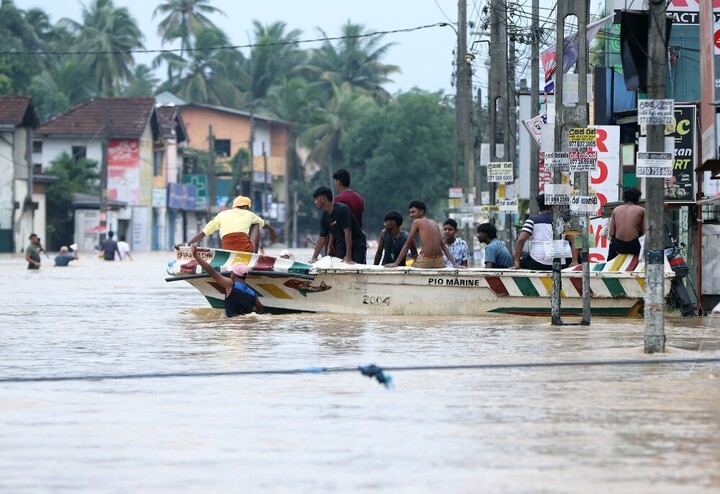
With two typhoons and floods pushing Asia’s economic situation into deeper distress, the death toll across Sri Lanka, Indonesia, Thailand and Malaysia crossed 1,100 on Tuesday, with millions displaced and businesses struggling to cope with the impact.
A state of emergency was declared in Sri Lanka on Saturday as Cyclone Ditwah unleashed heavy rainfall, causing floods, overflowing rivers and landslides that are wreaking havoc across the country.
“We are facing the largest and most challenging natural disaster in our history,” Sri Lankan president Anura Kumara Dissanayake said in an address to the nation on Sunday.
Related Stories
Businesses across the country have been reacting with compassion and alarm.
Production equipment, warehouses, factories and entire industrial zones have been hit by rising waters, compounding the uncertainty facing manufacturers already struggling to account for their workers and assets.
The Disaster Management Centre in Colombo said that all 25 districts of the country have been impacted, including torrential rainfall in Vavuniya, Mullaitivu, Kandy, Mannar, Ratnapura, Anuradhapura, etc. The Kelani River—which runs through the western province and the capital region—burst its banks in several places, leaving suburbs and industrial belts waist-deep in water and prompting urgent rescue and relief missions by the military, police and volunteer groups. There were than 400 deaths, and hundreds reported missing, even as the search continues on Tuesday.
While the focus remains on immediate damage control, locating survivors and restoring basic logistics, economists are watching with growing concern. Sri Lanka has been battling severe inflation and only recently began stabilizing after its 2022 economic collapse and bankruptcy declaration. That fragile recovery has been supported by an IMF bailout and a rebound in exports—particularly apparel, which has been a critical source of foreign exchange.
The growth has been driven by industry efforts to upgrade and build more sustainable factories, with apparel exports rising 6.12 percent year-on-year in the first 10 months of 2025, from January to October, reaching $3.78 billion. Exports to the U.S. grew 1.37 percent, while shipments to the European Union rose 14.05 percent.
Yohan Lawrence, secretary general, Joint Apparel Association Forum (JAAF), told Sourcing Journal that exporters and business groups had not yet had a chance to begin quantifying the damage that has been incurred over the weekend. “The impact in the last few days has been in the low-lying areas of Colomba as well as those close to the rivers. Many of these areas don’t have power, roads have got washed away. As the power lines have been reconnecting, companies are reaching out to their employees,” he said. “We are helping to address the worst-affected areas, and to work with the government to identify immediate requirements
The National Chamber of Exporters of Sri Lanka (NCE) has called on members to report the damage to factories and export operations to help take stock of the situation. “The NCE is actively collecting on-the-ground information from affected exporters, including MSMEs,” Shiham Marikar, secretary general observed. “Early feedback indicates widespread disruptions, including flood-damaged production floors, equipment failures, stalled supply chains, and workforce challenges,” he said, while noting that collaboration with the government would be essential to develop relief measures, including financial assistance, expedited repair support, and facilitation for exporters who are struggling to meet shipment deadlines.
“A swift and coordinated recovery plan is essential for ensuring that Sri Lanka does not lose its hard-earned market access and global competitiveness,” he said.
“The floods have disrupted production, damaged essential facilities, and created significant uncertainty for exporters who are already under immense pressure to meet international commitments,” said Indhra Kaushal Rajapaksa, president, NCE.
“At this critical moment, Sri Lanka’s export sector requires immediate and targeted support,” he added, noting that the export sector is “not just another part of the economy—it is the engine that drives our foreign exchange earnings, sustains national revenue, and supports hundreds of thousands of livelihoods. Any extended interruption will have a serious impact on the country’s overall economic stability.”
Several small manufacturers told Sourcing Journal that their first priority had been to connect with workers and ensure their safety, especially in low-lying areas where communication has been cut off. Beyond that, they face immediate concerns including damage to production facilities, lost stock, ruined warehouses, disrupted export-ready cargo and difficult conversations with global buyers.
“While we are struggling to make sure everyone is safe, and to help the families of those affected, we are also reaching out to the global brands we work with to give us some time as we find our feet again,” said a small manufacturer who asked not to be named. “We’re already facing headwinds with the additional 20 percent reciprocal tariff imposed by the U.S. But we have to keep in mind that buyers easily move between sourcing destinations,” he said.
Other, larger companies like MAS said that most facilities have reopened and resumed operations.
“Sri Lanka is just starting to recover from the severe weather caused by Cyclonic Storm Ditwah, which has disrupted transport routes, flooded several districts and affected daily operations across the country. In the areas that experienced the heaviest rainfall and flooding, our facilities were closed during the first critical days to ensure the safety of our teams,” a spokesperson for MAS told Sourcing Journal.
While government organizations are calling for help from the private sector, and international aid has come in from India and Japan, the business community is assessing how best to respond. Some companies said they have already received assurances of help in phone calls from global customers, though many emphasized that reinforcing logistics will be crucial in the weeks ahead.
In November, manufacturers called on the government to prioritize comprehensive operational reform, bringing to notice the need to upgrade Colombo Port, warning that persistent delays and outdated systems could have disastrous consequences for manufacturers working under strict delivery timelines.
Yet, as JAAF’s Yohan Lawrence noted, the resilience that has carried the industry through multiple crises in recent years remains one of its key strengths. Analysts reviewing the havoc caused by Cyclone Ditwah echoed that sentiment, while stressing that swift, coordinated recovery programs will be essential now, alongside immediate financial assistance, repair support and help with shipment deadlines for affected businesses.