One mailbox-as-a-service provider is headed from Indiana to India.
Indianapolis-headquartered Arrive AI announced it has teamed with India’s Skye Air to bring more robust drone delivery access to the country.
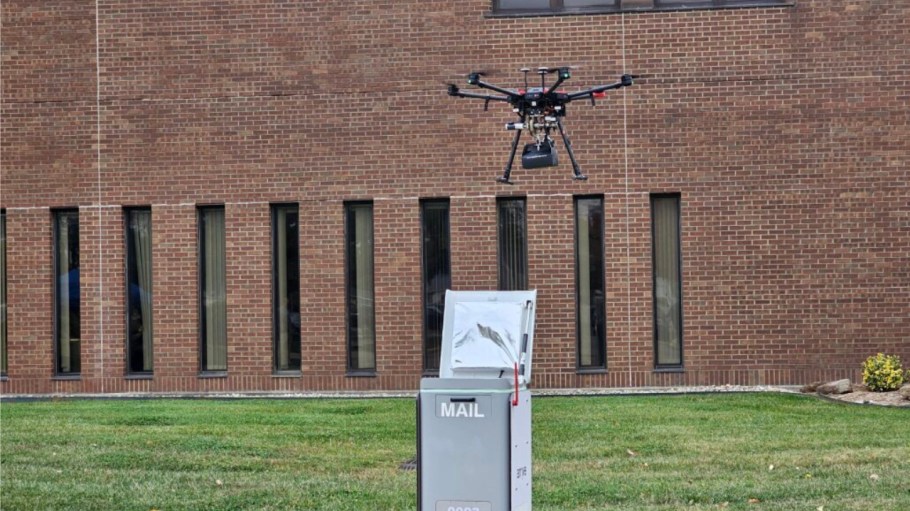
Arrive AI, which recently went public on the Nasdaq, offers mailbox-as-a-service technology. That is to say, the company makes and licenses delivery points, called Arrive Points, that resemble a mailbox—but are designed to receive shipments from drones, autonomous vehicles and robots. Skye Air, headquartered in India, delivers e-commerce orders via drone in as little as seven minutes. According to the company, its drones are equipped to handle parcels that weigh up to 110 pounds, and it makes about 6,000 deliveries a day in Gurugram, India.
Related Stories
The companies will work together to develop Arrive Points suited to meet Skye’s specs for delivery, then expand that technology throughout the country. Dan O’Toole, Arrive’s founder and CEO, said his company plans to deploy between 20 and 40 Arrive Points in India in 2025, though the partnership aims to stand up 500 mailboxes across India in the coming years.
O’Toole and team monitor new Arrive Points for consumer understanding, as well as accessibility for autonomous delivery. From there, they consistently tweak the technology, which is why the company has chosen not to deploy 500 Arrive Points simultaneously.
“Our product is still in its infancy, and we are not getting ahead of ourselves and producing a ton of them because they’re going to be very quickly outdated and obsolete,” O’Toole told Sourcing Journal. “We want to take the learnings of the small batches and re-engineer those into the next units. We’re always evolving.”
Skye will also need to scale its technology; while it currently makes deliveries in one city, it has aspirations to serve the greater New Delhi area, which has a population of about 33 million people. For O’Toole, the prospect of serving a densely populated area with fewer drone-related regulations than other geographies—like the United States—has proven an exciting challenge.
And Ankit Kumar, founder and CEO of Skye Air, said as the company prepares to scale its operations to other areas in India, falling into sync with Arrive makes perfect sense.
“Our partnership with Arrive AI couldn’t have come at a time better than this, when we are scaling up operations and expanding to newer cities such as Bengaluru,” Kumar said in a statement. “Together with Arrive AI’s state-of-the-art product, we are certain to dominate the infrastructure access points. It will make the entire process so much better. We can’t wait to get these units in the field.”
In the U.S., major e-commerce players like Amazon and Walmart have shown a consistent interest in drone delivery. But today, those companies typically ask their consumers to pinpoint a delivery spot, like the center of their backyard or driveway; while that may work well in more suburban areas, it makes scaling in major metropolitan areas a difficult prospect. O’Toole said Arrive’s technology complements the growth of drones and other autonomous delivery methods quite nicely—and ensures parcels are secure. He anticipates that, as drone delivery continues to rise, theft will surge if packages go unprotected at length.
“If you have this whole new industry of autonomous delivery, you’re going to have a whole new industry of autonomous delivery theft,” he said. “[Arrive] is allowing you to go about your normal day with peace of mind that what you have coming is going to be delivered safely and securely.”
Arrive Points have several different configurations; for commercial use, the company deploys units that are 56 inches tall by 24 inches wide; for residential use cases, it uses units that are 41 inches tall by 24 inches wide. Because parcels vary in size and weight, Arrive couldn’t provide an estimate on how many packages fit in an Arrive Point simultaneously.
O’Toole said he first had the idea for Arrive Points 11 years ago, and has held several U.S. patents for the technology since that point. The company went public on the Nasdaq on May 15. The founder said, for him, trading publicly is just the beginning of a new chapter.
“A lot of people would view that as the culmination of the dream, but the reality is, that’s the beginning of the dream—getting to the public markets anda access to that capital is the igniter we need to get to the next level,” he said.
Now, he’s working to secure patents in 58 countries for further global expansion, well beyond India. In the next 60 days, Arrive plans to add 40 roles to its workforce. O’Toole has long believed in the power of autonomous delivery, but the partnership with Skye reinforces its potential prowess, particularly in large e-commerce markets like India. He believes that, because Arrive was an early mover on complementary technology for drones and autonomous delivery, the company has the chops to compete and innovate in a meaningful way for the market.
“Drones are happening. The cool thing for us is, we’re iterating shoulder to shoulder with the biggest market cap companies in the world,” he said. “I always view the drones and the robots and the unmanned vehicles as commodities, and I view [Arrive] as…the center of that delivery universe, where every shipment will start and end.”