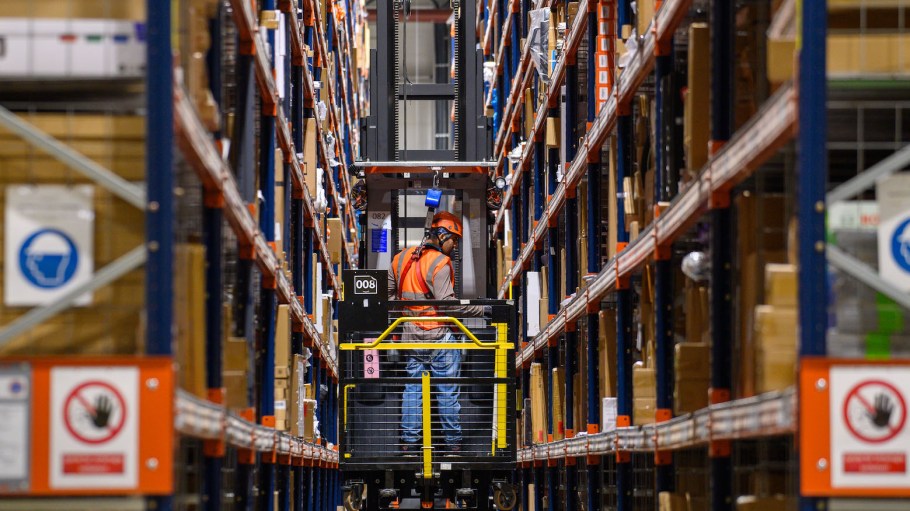
Amazon warehouse workers say workplace monitoring pressures them to perform, contributing to injuries and burnout at the e-commerce giant.
Some 69 percent of Amazon warehouse workers have had to take unpaid time off due to pain or exhaustion from working at the company in the past month, according to a survey by the University of Illinois Chicago’s Center for Urban Economic Development (CUED).
Thirty-four percent say they’ve have had to take off three or more days, while 43 percent claim they have trouble taking breaks when they need them.
Related Stories
Forty-one percent of workers report having been injured on the job while at Amazon, 32 percent within their first year alone. Warehouse work is taking a mental toll on employees as well, with 52 percent saying they feel burned out at Amazon.
The results are based on a national survey of 1,484 frontline Amazon warehouse workers at 451 facilities in 42 states.
An Amazon spokesperson slammed the “ulterior motive” behind the survey.
“This is not a ‘study’—it’s a survey done on social media, by groups with an ulterior motive. If anyone actually wants to know the facts, they can read the data that we publish each year and submit to OSHA, which shows that rates in our buildings have improved significantly and we’re slightly above the average in some areas and slightly below the average in others,” said Maureen Lynch Vogel, Amazon spokesperson.
“While we’re proud of the significant progress we’ve made, we don’t want to be just average—there’s nothing more important than our employees’ health and safety and we’ll continue to invest in safety across our network as we work to keep getting better every day,” she added.
Since 2019, Amazon has improved its recordable incident rates by 23 percent in the U.S., and cut its lost time incident rate by 69 percent.
Participants were recruited into the survey based on a targeted advertising campaign to people on Facebook who listed Amazon as their employer. Recognizing that not all Amazon workers
would list the company as their employer on the social media platform, and that there may be
demographic biases in those who chose to do so, the university ran specific advertisements in geographic areas where Amazon facilities were located or where large numbers of Amazon workers likely resided.
The report points to other factors at play that could exacerbate injuries and burnout. Forty-one percent say they’re pressured to work faster either always or most of the time, while another 30 percent sometimes do.
Among those feeling pressure most of the time, 53 percent have had an injury while even more have experienced burnout (78 percent).
The increasing pressure comes as 60 percent of employees say they experience more workplace monitoring at Amazon than at previous jobs, while 53 percent of these workers feel they’re being watched always or most of the time.
“Our data indicate strongly that the pace and intensity of work within Amazon warehouses is reinforced by the company’s system of technology-enabled workplace monitoring,” wrote CUED researchers Beth Gutelius and Sanjay Pinto. “In this respect, Amazon is an outlier in the industry.”
Seventy-seven percent of Amazon warehouse workers say the technology can tell if they are not actively engaged in their work almost or most of the time.
When asked how the company uses electronic monitoring, 45 percent of the workers said that it is mainly used for control or discipline—more than the 36 percent who say it’s mainly used to help develop workers’ skills and abilities.
The report concluded that regulatory scrutiny was necessary for Amazon’s warehouse working conditions to improve. The company is currently appealing five Washington state citations accusing the company of knowingly putting warehouse workers at risk of injury.
“It is telling that most workers who report that their physical or mental health has deteriorated due to their employment at Amazon do not believe that the company is prioritizing their safety,” Gutelius and Pinto wrote. “In the absence of stronger regulatory guardrails and measures that afford workers greater voice and input in shaping company processes, it is difficult to see how a system that is fundamentally injurious to so many workers will change.”
The survey launched less than a week after the e-commerce giant revealed it is testing two new robotics systems in select warehouses in Houston and Seattle. One called Sequoia aims to improve warehouse workplace safety by delivering totes to individual workstations within each employee’s “power zone,” or the area between the mid-thigh and mid-chest.
The system is designed so employees don’t have to regularly reach above their heads or squat down to pick customer orders, which would prevent repetitive motions like reaching, squatting, pushing or pulling that could result in musculoskeletal injuries.
Awkward lifting, reaching or twisting motions are the top physical factors causing an injury at an Amazon warehouse, with 49 percent of surveyed workers experiencing them, the CUED report said. Forty-eight percent attribute the injuries to heavy packages, while 46 percent cite the pace of work/workload.