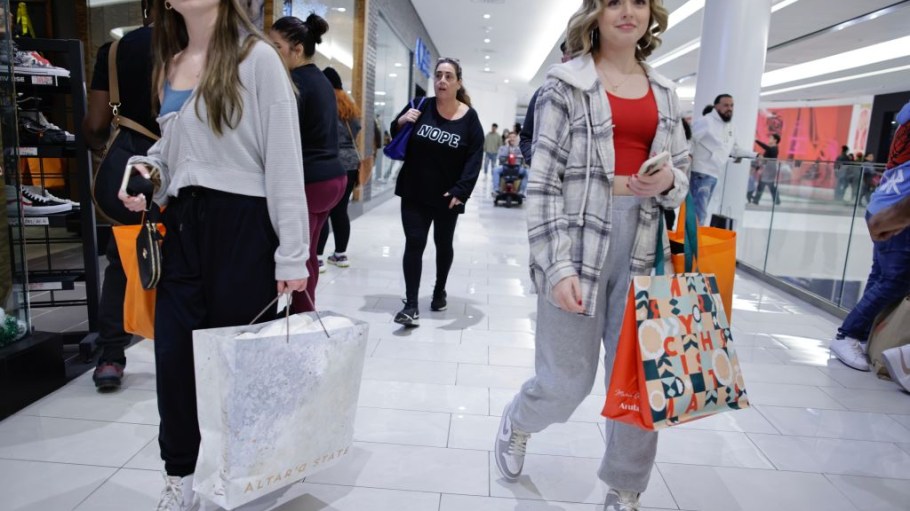
American shoppers are shouldering most of the economic burden created by President Donald Trump’s tariff regime, according to a note released Sunday by Goldman Sachs.
According to the investment bank, U.S. consumers are slated to pay more than half of the duties imposed by the administration by the end of 2025, while American companies will end up paying about 22 percent and foreign exporters will see 18 percent of the burden as they lower prices on their products.
Economists Elsie Peng and David Mericle wrote that U.S. businesses are, at the moment, “likely bearing a larger share of the costs” as they continue to shield shoppers from the worst of the price increases, “because some tariffs have just gone into effect and it takes time to raise prices on consumers and negotiate lower import prices with foreign suppliers.”
Related Stories
“If recently implemented and future tariffs have the same eventual impact on prices as the tariffs implemented earlier this year, then U.S. consumers would eventually absorb 55 percent of tariff costs,” they wrote.
What’s more, despite the president’s insistence to the contrary, tariffs are driving up inflation, the note said, with the rate expected to hit 3 percent by December, a full point above the Federal Reserve’s 2 percent goal. Core personal consumption expenditure prices have already jumped 0.44 percent this year due to the president’s tariff agenda.
The investment bank’s projections did come with a caveat, as the administration’s negotiations with foreign trade partners are perpetually in flux.
Just Friday, for example, Trump threatened China with 100 percent tariffs on a wide range of products because Beijing announcing new export control measures on rare earth minerals. By Monday, the president had all but changed his tune, Truthing that the relationship with China “will all be fine!” Cabinet members went on to hint that the president plans to continue to negotiate with China over the course of the coming weeks. The new tariffs are scheduled to take effect on Nov. 1.
Goldman Sachs’ Sunday projections offer a slightly sunnier picture than the one its analysts painted in August, when they wrote that consumers’ share of the tariff burden could jump to 67 percent by year’s end. But the inflation data rings true, as August saw consumer inflation rise to 2.9 percent.
Without offering concrete figures, White House deputy press secretary Kush Desai said Monday that the markets are responding favorably to the pressures posed by the duties, with firms relocating their manufacturing bases to the U.S. “Companies are already shifting and diversifying their supply chains in response to tariffs, including by onshoring production to the United States.”
“Americans can rest assured that the Administration will continue to deliver economic relief from Joe Biden’s inflation crisis while laying the groundwork for a long-term restoration of American Greatness,” he added.
But shoppers largely aren’t taking the bait when it comes to rousing rhetoric.
According to a poll released Monday by media outlet The Center Square and Noble Predictive Insights, a nonpartisan polling firm, which surveyed 2,565 registered voters from Oct. 2-6, 51 percent disapprove or strongly disapprove of the president’s stewardship of the American economy.
Naturally, voters within the president’s own party were more likely to view his handling of fiscal policy favorably (80 percent), though 83 percent of Democrats and 57 percent of independents disapprove.
Reactions aren’t just split down party lines—they’re also dependent on income levels. According to the poll, six-figure earners were most likely to take a sympathetic view of Trump’s economic performance (59 percent), but the numbers decline sharply alongside salary levels.
Just 39 percent of voters with less than $50,000 in household income approve of Trump’s handling of the economy, while 46 percent of households with between $50,000 and $100,000 said the same.
According to the Yale Budget Lab’s Sept. 26 analysis, tariffs have collectively raised consumer prices by an average of 1.7 percent in the short-run, amounting to average per-household income losses of up to $2,400 this year. The duties have disproportionately impacted leather products and apparel, with shoppers facing 36 percent higher prices on the former and 34 percent higher prices on the latter in the near term.
Noble Predictive Insights’ CEO and founder, Mike Noble, noted the president’s overall approval appears more directly tied to his handling of the economy than it was during his first term. However, this month’s answers from voters were in line with those captured in the spring, indicating that tariffs have become the central recognizable tenet of his economic plan.
“Not only is he tethered to it, it’s actually dragging him down a little bit more,” Noble said. “I think that is a worrisome thing, especially going into the midterms.”