It’s been 10 years since Ethan Song and Hicham Ratnani created Frank & Oak, the men’s e-commerce shirt brand based in Montreal.
Success came quickly, but a rapid rollout of brick-and-mortar stores, product extensions and an ill-fated subscription box program pushed the company into bankruptcy in 2020.
Enter Unified Commerce Group, a newly formed retail acquisition and advisory group created by Dustin Jones and Greg Freihofner, which purchased the brand out of bankruptcy in October 2020. The duo, veterans of Macy’s, Fung Retailing Group, Alibaba and advisers to other Chinese companies, believed that Frank and Oak — the ampersand disappeared, along with the founders who now serve as advisers and equity holders — had enormous potential if the ship could be righted.
Related Articles
They spent the first nine months building a strategy to ensure the brand’s future success, Jones said, closing 10 of its 22 stores, moving away from the subscription model, elevating the management team and instituting operations driven by technology and data.
You May Also Like
Jones said the “primary crack” in the business model was the subscription model. Although at the time of the purchase, Frank and Oak had the largest number of subscriptions in Canada, the return rate was high — as was the money spent on customer acquisition. So UCG “sun-setted the subscription program,” and ramped up its e-commerce business, which now accounts for 60 percent of sales, expected to be in the $45 million-to-$55 million range this year. “Our goal is to double sales every two years,” he said.
And the company is gaining momentum. Sales in the past six months have been “terrific,” Jones said, despite the lingering lockdowns in Canada, as well as supply chain disruptions. Specifically, sales were up in the double digits last fall and in the triple digits in the past three months, Jones said.
Jones said the company attracts 700,000 active monthly users and more than 22,000 active daily users, a figure that is also growing by the double digits.
“We’ve become a vertically integrated omnichannel retailer,” Jones said. “We invested in product, deepened the skus that mattered and are producing all our content in-house.”
Canada still accounts for 79 percent of total sales, with the U.S. representing around 20 percent and China roughly 2 percent. The goal is to increase the market reach in the U.S. and China until they together account for half of all sales, with Canada the other half, within three years, Jones said.

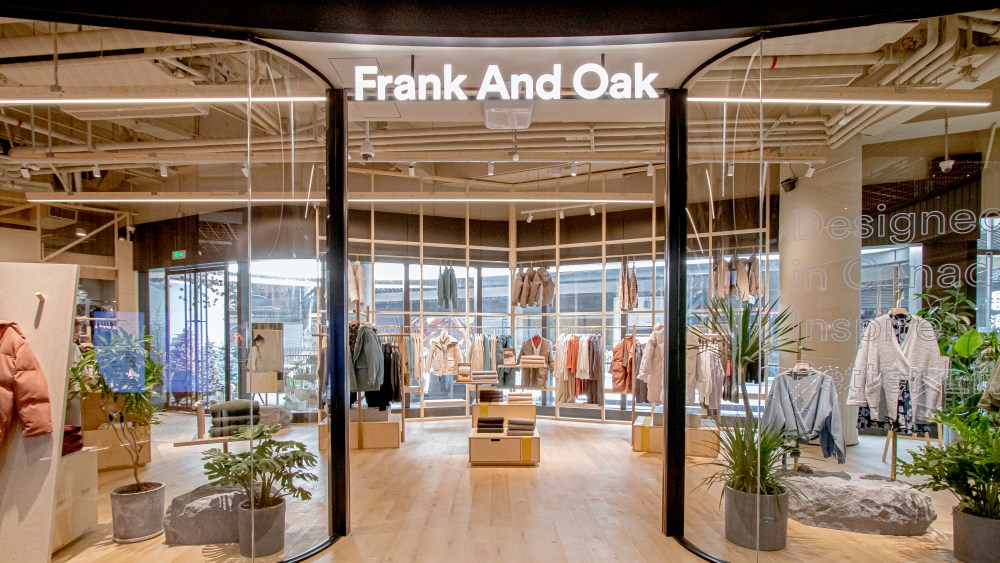
Part of the fuel to the company’s growth was the opening of new flagships in SoHo in New York as well as Vancouver and Shanghai. In addition, the brand is also carried in Nordstrom and the new owners are exploring expanding Frank and Oak’s wholesale distribution further in the future.
Men’s and women’s now account for an even split of sales, with categories ranging from sweaters, jeans, blouses, dresses, intimate apparel and swimwear for women and shorts, swim, socks, shoes and underwear in men. “You can wear head-to-toe Frank and Oak now,” he said.
Outerwear is the brand’s largest category, accounting for 30 percent of business. Sweaters, made from SeaWool, SeaCell and yak, wovens, and womenswear made from kapok, are also popular. But Jones said the company is “seeing strong sell-throughs in every category. That’s why we bought the business. We knew if we could get the infrastructure right, scale it in the U.S. and build it in Asia, [we’d have a strong business model].”
But while a lot has changed with the company since its beginnings in 2012, what hasn’t changed is Frank and Oak’s mission to be a sustainable company. And in honor of the anniversary, the company is doubling down on its commitment to offer purposeful, functional products that are built to last and also kind to the environment.
“We work hard on elevating timeless essentials to meet today’s needs while anticipating tomorrow’s challenges,” Jones said. “The significant milestones we have achieved embody the hard work we’ve accomplished toward making a positive impact on the fashion industry and we are proud to be leaders in the space, encouraging other brands to follow in our path.”
Those milestones include the fact that 78 percent of the assortment now contains certified low-impact, cruelty-free, organic, biodegradable or recycled components. In addition, 55 percent of its denim is made from recycled fabrics, less than 13 percent of the polyester used is virgin — a 22 percent decrease since 2019 — and 100 percent of the wool is recycled or cruelty free. In its Shanghai store, 62 percent of the materials used are fully recyclable or biodegradable.
Jones pointed to some of the brand’s hallmark materials including SeaCell, which is created from algae; SeaWool, made from pulverized oyster shells; kapok; hemp, and biodegradable polyester that doesn’t require the same amounts of fossil fuel to produce, hundreds of years to break down or contribute to land and ocean microplastic pollution.
All mailers, boxes and packaging used are recycled, recyclable or use biodegradable materials, and last year, Frank and Oak worked with Thousand Fell to introduce its first fully circular and recyclable shoe. “And we’re about to launch responsible denim for spring,” Jones said.
“Frank and Oak is like the Tesla of the fashion industry,” he said. “People buy it because it’s trend right, but the fact that it’s also sustainable is the bonus.”
But it’s not just sustainability that is the focus for the anniversary — growth is also on the horizon. Frank and Oak operates 19 stores and it will open a flagship in Brooklyn this spring, along with another in Toronto in April. The new stores, which average 3,300 to 3,600 square feet, are larger than the older units which tend to be only around 2,000 square feet, he said.
Looking beyond Frank and Oak, Jones said UCG is also planning to add another company to its stable and expects to announce another acquisition in the very near future. “We’ve been hunting for a second acquisition and came close three times, but we’re about to close on a second deal,” he said.
He said UCG seeks brands at an early stage in their life cycle and works to continue their growth trajectory as long as they have a strong business model and international potential.
He declined to name names, but said UCG’s investors include “high-net-worth investors” with a history in apparel and retail in the U.S. and Asia.