LONDON — Retail in London has become a competitive sport with each street carving out a niche.
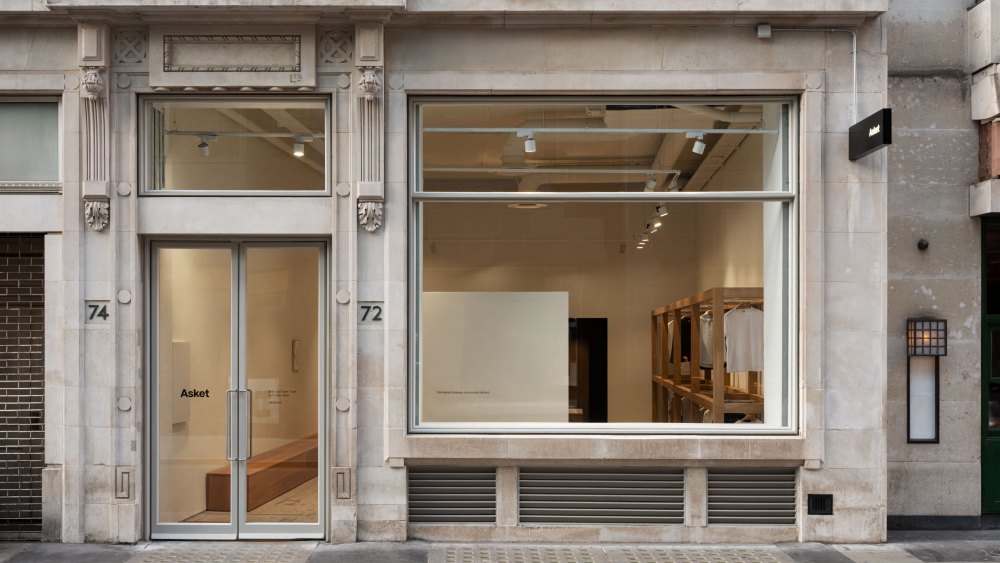
The Stockholm-based anti-fast-fashion brand Asket has set up shop on Brewer Street, taking over from Carhartt for its first international outpost outside Sweden.
The brand’s neighbors are fitting for a menswear brand — opposite the store there’s British cycling lifestyle brand Rapha, barbers Murdock London and a stone’s throw away there’s the luxury gym Third Space, home to the tech and finance bros who probably care about the quality of their T-shirts than the average British man.
Related Articles
“London has been a dream for a long time. Stockholm is obviously our home base, but London is actually the city where we have the biggest customer base, it’s a city that I personally love. It’s a no-brainer to come here,” said Asket cofounder Jakob Dworsky in an interview.
You May Also Like
To settle on the store location has been a two-year process with extensive research.

Dworsky and his cofounder, August Bard Bringéus asked their London customers for ideas too.
“It was pretty conclusive, both from our own walking around and from the customers’ opinions, that Soho would be the ideal Asket spot,” Dworsky said.
The cofounders wanted a store with an open structure that was spacious and with high ceilings just like the architecture of a museum that would allow their clothes breathing space.
From the outside the store is curious and discreet — there’s a white T-shirt and Oxford shirt hanging on a wooden fixture and next to it is a plain white block, mimicking the style of an archive unit that’s often found in museums or in the archive rooms of Parisian couture houses.
One of the units is made up of more than 40 shelves that stocks the brand’s permanent collection of 50 pieces.
“We’re slowing down the whole [retail] experience by creating a lot of discovery, conversation and education over a transaction,” said Dworsky, pointing to a solid oakwood credenza that’s placed between the giant units, which is where the transactions will take place.
The store right now will only stock Asket’s menswear collections as it makes up a larger percentage of the business. The brand was founded in 2015 and only introduced womenswear in 2021.
“The men’s growth has been pretty good. In the beginning it’s much more explosive when you’re small and starting out, but in the last couple of years, it has slowed down a little bit given external factors such as inflation and the COVID-19 pandemic, which was a pretty good period for us as we were mainly online-based,” Dworsky said.
“The last couple of years, if you look at the numbers, has been slower growth, but there’s still growth and profitability. Now we are ready to regain a little bit faster growth with the expansion of our retail presence,” he added.
Asket’s top four markets are the U.S., U.K., Germany and Sweden, which make up more than 80 percent of the brand’s sales.
The white T-shirt remains the brand’s bestseller and is priced at 40 pounds. It’s made out of organic cotton and it has been milled, cut and sewn in Portugal. What sets it apart from other brands is that it comes in three different lengths: short, regular and long.
“A lot of our growth in the U.S. in the beginning was through Reddit threads that talk about our T-shirt,” Dworsky said.
The brand’s Oxford shirts, chinos and raw denim are also topsellers.
To celebrate Asket’s 10-year anniversary, Dworsky said the brand will pause introducing new categories for menswear and will focus on refining each garment for the foreseeable future.
“There’s always more we can do on the products and that’s a continuous journey of trying to perfect them for us,” he added.
The brand wants to inspire the same shopping habits of its menswear customers onto the women, who are increasingly buying into the brand.
“There’s definitely a type of men’s customer who really likes to know that what they bought last year is going to be here in two or three years when they need another one,” Dworsky explained, adding that they encourage customers to try on all the pieces that they’ve seen online.
Setting up a store has been a learning experience for Dworsky and Bringéus.
“The first thing we learned, funnily enough, was that you have to have a cash desk,” Dworsky said.
The cofounders have come a long way since the inception of the brand. They’re now more open to new ideas — in the beginning they were set on being a strictly direct-to-consumer brand.
The thought of venturing into wholesale isn’t completely off the table, but it’s something that they’re still thinking about as they feel that through their own channels they can offer the next experience and tell the story of Asket their way.