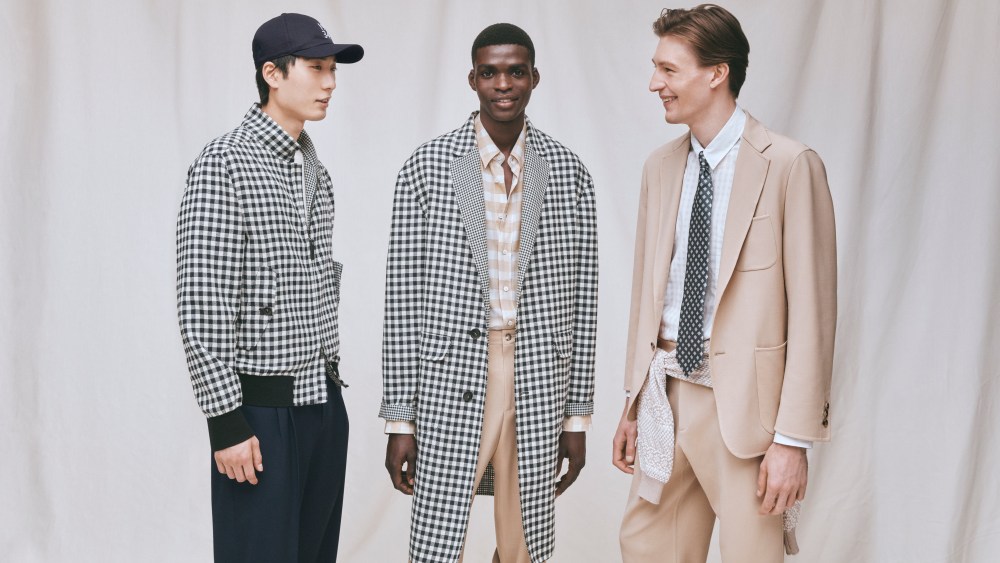
MILAN — As men increasingly make style statements — perhaps not as daring as Brad Pitt or Timothée Chalamet rocking skirts or pink suits, respectively — there is no doubt there’s a renewed focus on menswear.
This is reflected by Milan Men’s Fashion Week, which kicks off Friday with Valentino returning with a dedicated men’s show after three years of coed collections, and Ralph Lauren Purple Label back in town, along with new brands including MCM, Setchu and Seoul-based fashion label Andersson Bell.
Related Articles
According to figures provided by Confindustria Moda, exports of men’s fashion jumped 24.7 percent in 2022 versus the year prior to 8.9 billion euros, with the U.S. skyrocketing 68.6 percent, and China increasing 8.6 percent, among the top-performing countries helping to take export volumes and values above pre-pandemic levels.
You May Also Like
The Valentino Narratives show will be held at the Università degli Studi di Milano Statale and the brand will support students with a donation to the atheneum and promote the reuse of the materials from the set investing in a green area of the city. Menswear last year represented 14 percent of the brand’s sales, and there are 75 Valentino stores that carry men’s and women’s collections, and 25 menswear-dedicated boutiques. The distribution of menswear will be further extended next year in cities such as Paris; Shanghai; Nagoya, Japan; Wuhan, China, and New York, to name a few.
“We are capitalizing on the structural growth of menswear,” said Gildo Zegna, chairman and chief executive officer of the Ermenegildo Zegna Group. “The successful Zegna rebranding has further embedded the brand as a frontrunner in the luxury market, and a leader in ‘quiet luxury.’”
Preserving and enhancing the craftsmanship of Made in Italy production, the know-how and tradition of Italian excellence has increasingly been a priority for established brands and international conglomerates — leading to surprising pairings and a more cooperative attitude among fashion entrepreneurs.
Earlier this month, Zegna teamed again with Prada Group’s chairman and executive director Patrizio Bertelli to buy a 15 percent stake each in knitwear specialist Luigi Fedeli e Figlio Srl.
In 2021, in what was surely considered a major new partnership and a sign of an increased effort to protect the country’s unique supply chain, the two companies joined forces to acquire a majority stake in Filati Biagioli Modesto SpA, which specializes in the production of cashmere and other precious yarns.
“The acquisition of historic Italian companies, each specialized in its own product sector, has allowed us to set up a one-of-a-kind platform synonymous with excellence: our ‘Made in Italy’ Luxury Textile Laboratory,” continued Zegna. “The platform aims to produce the highest-quality fabrics, while safeguarding the unique craftsmanship, creativity and innovation of the Italian supply chain.” Over the years, Zegna’s platform has grown to include Tessitura Ubertino, Dondi, Cappellificio Cervo and Bonotto, among others.
In May, in the first such deal for Chanel and Brunello Cucinelli, the two companies partnered on an acquisition of a 24.5 percent stake each in Italian cashmere manufacturer Cariaggi Lanificio SpA. This is a new development in a deal that was signed last year by Cariaggi and Cucinelli, the latter’s first such M&A deal. At that time, Cucinelli revealed he was buying a 43 percent stake in Cariaggi, his longtime cashmere supplier. While Chanel over the years has been buying stakes in 40 suppliers, of which 15 are based in Italy, this is the first time it is partnering with another established fashion brand.
On Thursday, the deal to sell a 75 percent stake in MinervaHub to investment holding San Quirico SpA, revealed in April, was closed. MinervaHub was established last year to protect a number of Italian manufacturers in the country’s supply chain that help create garments and accessories, and reports sales of more than 170 million euros with a portfolio of more than 1,000 clients.
The remaining 25 percent stake remains in the hands of one of the sellers, Xenon Private Equity, with other coinvestors that include president Matteo Marzotto, who maintains his role.
Another example is Gruppo Florence, which was established in October 2020 with the goal of developing a platform to supply high-quality Made in Italy products to major luxury fashion brands, while safeguarding the technical and cultural know-how of small and medium-sized family-owned Italian companies.
Since then it has grown to own around 24 companies, and reached sales of 600 million euros, and the founding families have agreed to reinvest minority stakes in the holding.
While Italian entrepreneurs have for years lamented the shortage of artisans, also in light of the generational turnover in the industry, Andrea Lardini, president and CEO of the family-owned Lardini company, believes that the pandemic has exacerbated this issue.
“It’s increasingly difficult to find people interested in manual work,” he pointed out, while noting that Lardini has its own school that works with universities and contributes to train young artisans.
The issue is not connected to the salaries, he contended, but rather to an increased desire for freedom, after the lockdowns. “Around 80 of our employees retired during COVID-19 and it’s difficult to replace them,” he said, voicing his concern. “These skills are no longer passed on from one generation to the next. We have invested in our pipeline for the past decade to guarantee consistency in our production,” he said, not surprised that many established fashion brands and luxury conglomerates are acquiring stakes in their suppliers.

Brunello Cucinelli has long voiced the need to give dignity to manual work, and in April he launched a project to beautify the working spaces of the artisans in the pipeline that create the products for his namesake company.
Cucinelli signed an agreement with BNL BNP Paribas that will provide small- and medium-sized companies with projects to improve working conditions, help them complete them and offer financial support.
Francesco Ruffo, CEO of Boglioli, expressed his pride in the company’s own production site in Gambara, near Brescia, which counts around 100 employees. Outsourcing is not an option, he said. “I would rather hire 10 more people than turn to outside production,” he said, relying on the brand’s expertise. In fact, Boglioli this year celebrates 50 years in business and on Monday during its presentation it will unveil a celebratory K-jacket, the brand’s signature deconstructed garment, to be produced in a numbered, limited edition of 50.
Boglioli is increasingly expanding its product offer, said Ruffo, aiming for a total look. The U.S. represents Boglioli’s main market, followed by Italy and Germany and while America registered some signs of a slowdown in the first quarter, Ruffo said it was still showing solid gains and already improved into the second quarter.
Canali is looking at its own anniversary in 2024, marking 90 years, and president and CEO Stefano Canali said “there are reasons to maintain an optimistic outlook in the medium-term” on the back of a strong 2022. Canali reported a 38.4 percent gain in revenues last year, which totaled 193.3 million euros, surpassing 2019 levels and, in the first quarter, sales rose 32.3 percent at constant exchange.
He admitted the second quarter, while still growing, reflected the uncertainties derived from the Silicon Valley Bank failure in March, which sent “shock waves and slowed down the enthusiasm in the U.S., which influences the rest of the world.” Nevertheless, “people have learned to be reactive and there is a strong desire to return to normality,” and his peers are now “used to managing surprises and unexpected events, which are a constant, almost no longer the news, and take calculated risks. We are expecting continued growth.”
The Americas represented 52 percent of Canali’s sales last year, up 48 percent on 2021 and up 48 percent in the first quarter compared with the same period last year.
The Europe, Middle East and Africa area and Italy accounted for 31 percent of revenues in 2022, rising 46 percent and showing a 34 percent gain in the first quarter. The Asia-Pacific and India last year represented 17 percent of sales, down 21 percent from 2021, but growing 18 percent in the first quarter.
Canali has been evolving, focusing on a single collection with the fall 2023 season, moving away from the previous three lines, for a “stronger brand message,” and it is investing in its retail network.
After the opening of a store on Madison Avenue in Manhattan, two units in Paris and one in China at SKP in Beijing, in 2023 Canali will overhaul its Milan store in Via Verri, modeled after the New York concept, and it should be completed by the end of the year. “We just opened a store in Beijing at Season Place with our first Canali café responding to a strong customer request,” said the executive. The company is also reopening a unit at Plaza 66 in Shanghai in a new and bigger location, and will unveil its seventh store in India in Mumbai at the JIO World Plaza shopping arcade.
Kiton CEO Antonio De Matteis also touted “an exceptional” first quarter for his family-owned company, reporting 36 percent growth compared to the same period last year. This on top of a “record year” in 2022. Accordingly, De Matteis was confident about a very positive 2023.
“The evolution of our collections is bringing fruits, we have challenged ourselves and understood the needs of our customers,” he contended. These include a desire to be “very elegant, and they want certainties, to be assured that the product will last and that quality will be a strongpoint.”
Under new creative directors, Etro and Missoni are expanding their menswear collections. In January, Etro unveiled its first men’s collection by Marco De Vincenzo, who joined the Italian brand last year.
“As per Etro’s new strategic vision, menswear collections have been identified as among the growth drivers and the results are already evident,” said CEO Fabrizio Cardinali. “In the first quarter, in fact, men’s collections have registered a double-digit progression in all our reference markets, representing more than 30 percent of total sales.”
Cardinali believes the segment offers much potential for Etro, given the successful debut of the designer. “We are very satisfied with the appreciation of [De Vincenzo’s] solo debut,” said Cardinali, adding that expectations are high for his second collection, which will be shown on Sunday.
Livio Proli, CEO of Missoni, said this fashion week will see the brand “presenting a collection that is expanded and with an extended offer of product categories that will be able to cover multiple occasions.”
Proli appointed Filippo Grazioli creative director of the brand in March 2022 and the designer, while building his experience on womenswear with Martin Margiela and Riccardo Tisci, has said that Stone Island chief Carlo Rivetti was the first to teach him the ins and outs of menswear. Grazioli has been revisiting Missoni’s codes with a youthful flair and Proli said the spring 2024 collection follows this path, “offering an idea of ease that is both appropriate and informal. The Missoni man is athletic and spontaneous; explores the comfort of wearing knitwear as a mental attitude, even when he wears denim.”
Dsquared2, which welcomed Ennio Fontana as its new general manager in March, joining from Roberto Cavalli, just opened a men’s, women’s and children’s boutique in St. Tropez. The brand, designed by Dean and Dan Caten, is holding a show on Friday and is gearing up to launch a capsule on June 21 with Pac-Man, the storied arcade game character from the ‘80s, for fall 2023.
Pac-Man characters including the ghost family are mixed with computer style graphics of fruits, and both brands’ logos in orange and yellow.
The collaboration pieces are headlined by denim, but there are also jersey shorts, T-shirts and hoodies, for example, or men’s boxers and swimwear, as well as sneakers, bags and backpacks.